

Dr. Mamunur Rashid
For the past 16 years, it has been continuously claimed in social and some mainstream media that the banking sector was destroyed due to Awami League government policies. False propaganda was spread to such an extent that it was claimed ten banks were going bankrupt every morning. Strangely, no one heard of anyone being denied access to their personal funds in banks during this period without any complaint.
Did Sheikh Hasina’s government really destroy the banking sector? Was Bangladesh’s banking sector politically corrupt during Sheikh Hasina’s time? Did Awami League destroy the Islamic banking sector through S Alam? What was the state of deposits and loans in the banking sector during Sheikh Hasina’s 16-year tenure? Let’s examine the data.
To find answers to these questions, I will look at two types of data: 1) Growth of loans and bank deposits from 2009 to 2024-25 and 2) Proportional growth of Islamic investments and deposits during the same period. All data has been taken from Bangladesh Bank’s website.
1) 2009-2024 Was the Golden Age of Bangladesh’s Banking Sector Under Sheikh Hasina
As seen in Figure 1, total bank deposits increased 6.79 times from 2.59 trillion taka in 2009 to 17.623 trillion taka in March 2024. During the same period, total loans increased 7.73 times from 2.022 trillion taka in 2009 to 15.612 trillion taka in 2024. The loan-to-deposit ratio remained above 87% on average during this period.
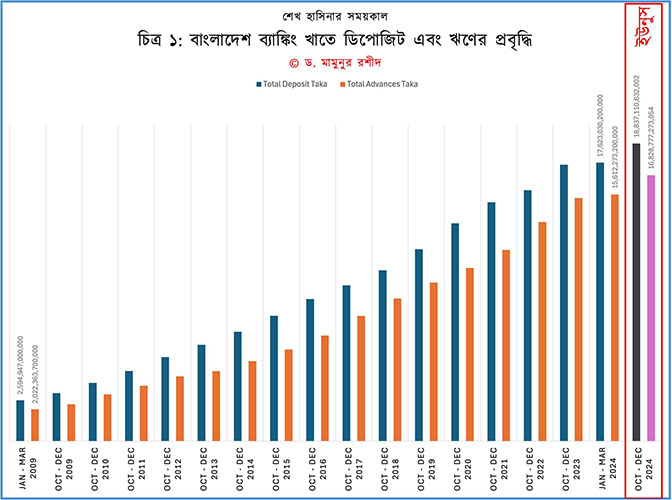
This means for every 100 taka deposited, banks lent about 87 taka. The rest remained as liquidity with banks. In Vietnam, this ratio was 76.7% in 2023. In August 2024, the ratio was 77.2% in India’s banking system. Compared to these, Bangladesh’s banking sector was in much better shape. This massive growth in deposits and loans proves that those who claimed the banking sector was destroyed over 16 years were simply lying to people.
Figure 2 shows annual growth rates of loans and deposits. During 2009-2024, average growth was 14% for bank deposits and 15% for loans. After Yunus came to power, these growth rates halved to 7% and 8% respectively.
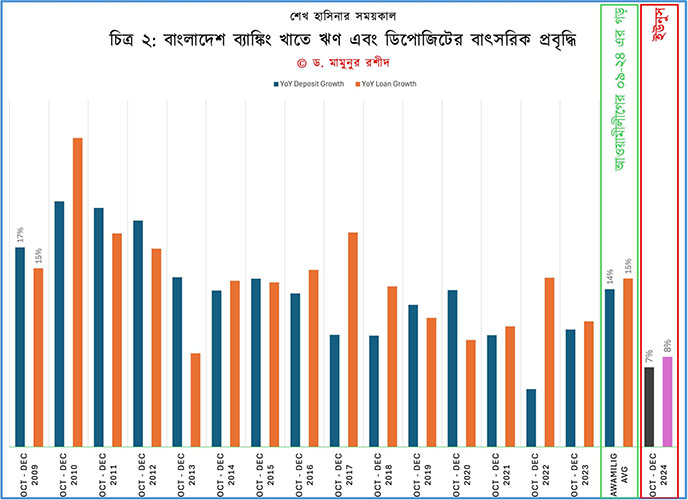
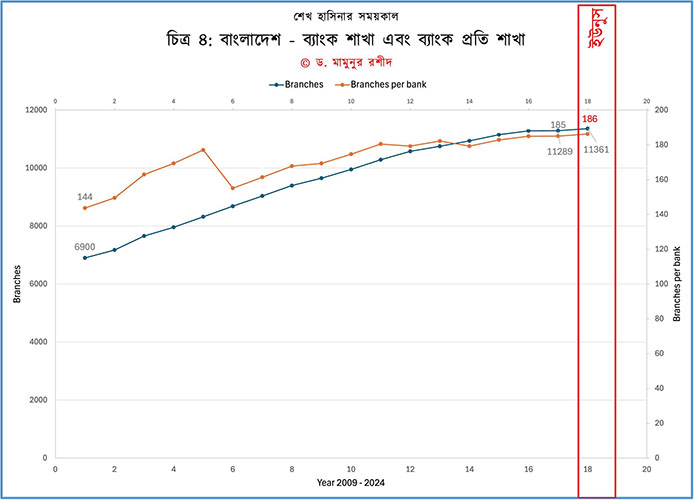
Figure 4 shows bank branches and accounts per branch. In 2009, there were 144 branches per bank which increased to 185 branches in 2024.
As of March 2024, there were 11,289 active bank branches in Bangladesh. These branches provided digital banking services to customers while creating employment opportunities for many students. The rural economy flourished. Then on what basis is it being claimed that Awami League government destroyed the banking sector?
2) About One Third of Bangladesh’s Banking Sector Now Controlled by Islamists
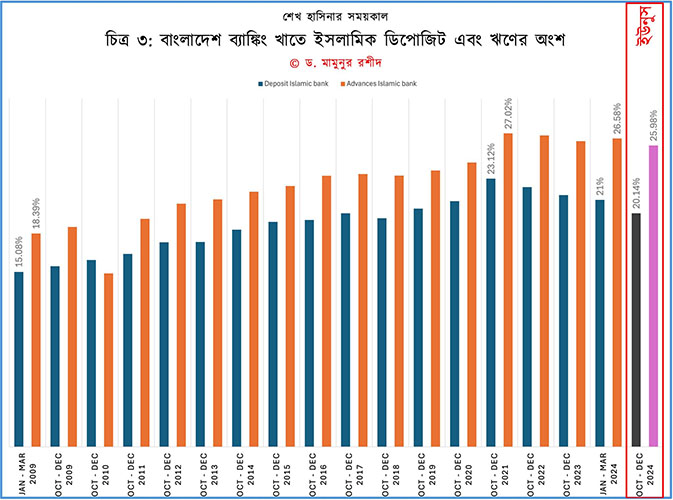
Figure 3 shows that Islamic banking deposits and loans grew from 15.08% and 18.39% in 2009 to peak at 23.12% and 27.02% in 2021 respectively. Due to COVID and Russia-Ukraine war, these shares slightly declined to 21% and 26.58% by March 2024. This is just banking statistics. If we consider the entire financial system, this share would be over 50% in my opinion. Despite such growth, claiming that Awami League destroyed Islamic banking is false propaganda.
As people’s understanding of Islamic financial system increases, growth of Islamic deposits and loans in a Muslim-majority country is natural. But history of Islamic banking in Bangladesh is somewhat different.
After being rehabilitated under Zia’s government, Islamic banking started in Bangladesh in 1983 under leaders of Jamaat-e-Islami who were later convicted of crimes against humanity. At the same time, this party took control of exclusive business of sending migrant workers to Middle East and Hajj pilgrimages. No other Islamic financial system in the world has such naked use of Islam by an organization involved in killing three million people.
Income from this system was used only to rehabilitate members of an Islamic party. This was supplemented by billions in zakat and sadaqa funds annually. Using religion, they collected deposits from people across Bangladesh but used most loans to establish their own political ecosystem. In banking and policy academic research, this is direct corruption. While allegations of nepotism have been raised against Awami League and BNP, Bangladesh’s central bank remained silent about this corruption by Jamaat-e-Islami and continues to do so.
Islamic schools, colleges, universities, dawah centers, restaurants, hotels, housing, coaching centers, hospitals, insurance, leasing, transport, printing and publishing, online shopping, bribing for jobs, bribing to create political positions – these are just few examples of this Islamic ecosystem. Who will stop those who control the financial system? This is why when S Alam took ownership of Islami Bank, they were suddenly labeled as Awami League and false propaganda about money laundering involving Awami League started.
The real reason behind such false allegations is to cover up their own misdeeds and instill fear among people about Awami League to continue their underground activities. Till today, advisors have repeatedly threatened that several banks would collapse the next day. Under the pretext of saving banks, new currency notes were printed removing Sheikh Mujib’s image. Newly printed money was given to some predetermined Islamic banks.
Few days later you might hear that “without touching reserves” Yunus government has saved the banking sector. Let me clarify – after Sheikh Hasina left, in October 2024, the banking sector had additional liquidity of 140 thousand crore taka. Then why was money printing needed to save some banks? How many employees were forcibly laid off from banks? Who has filled those positions?
After destroying the stock market, Yunus government took loans worth thousands of crores from banking sector, which is 70 times more than during Sheikh Hasina’s government (July-December 2023-24 and 2024-25). As a result, private sector credit growth fell to its lowest in 21 years. Now talks of merging several banks are being heard. Due to huge loan burden on banking sector from Yunus government, for the first time in Bangladesh’s history, a sinister plan is being made to merge many banks.

The question remains – is a major ground shift happening in Bangladesh’s banking sector? Is any secret organization trying to control the financial sector by manipulating government, private sector and consumers?
About the Author: Economist and Researcher

https://stapravda.ru/20221228/reyting_samyh_populyarnyh_hostingov_v_rossii_196445.html, рейтинг хостингов России подтверждает, что выбор надежного провайдера важен для бизнеса.