
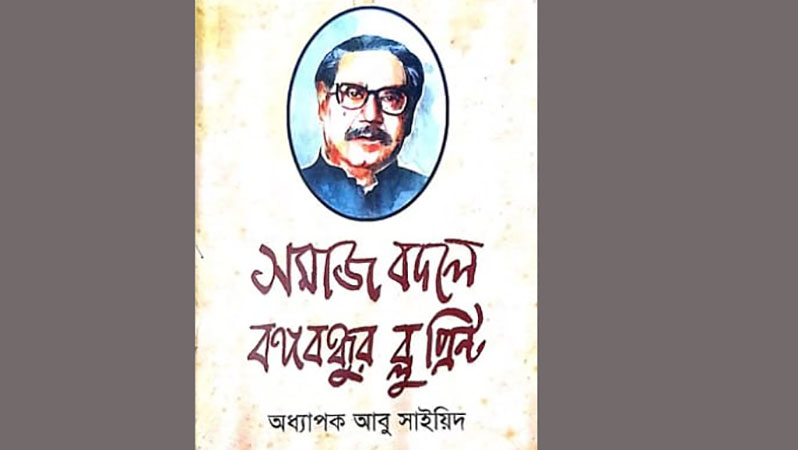
War of Independence: Democratic Journey, Pages: 17-18 – Chapter One
On March 25, 1971, the Pakistan-military junta launched an attack and massacre for ‘Operation Search Light’ with the aim of ‘uprooting’ all efforts and authority of Bangabandhu Sheikh Mujibur Rahman to establish democratic rule. Bangabandhu declared independence. The elected delegation of Bangladesh in the neighboring country of India formed a democratic constitutional government on April 17. The Government of the People’s Republic of Bangladesh was officially sworn in on April 17 in Meherpur.
The young and militant leadership of the Awami League, Sheikh Fazlul Haque Moni, Sirajul Alam Khan, Abdur Razzak and Tofail Ahmed, declared the authority given to them by Bangabandhu Sheikh Mujib to conduct the liberation war. Despite their strong demands for the formation of a revolutionary council, a democratic government was formed by the elected members of the National Provincial Council and the liberation war was conducted under the control of that government in exile. The formation of the Bangladesh government in exile under the authority of the presidential system of government made it possible to find the basis for the principle and legitimacy of conducting the liberation war. The gradual efforts of this democratic government in exile were able to gain widespread moral, subjective, and material support, help and cooperation from countries and people sympathetic to India and the liberation war.
The Declaration of Independence of Bangladesh, adopted on April 10, 1971 and formally proclaimed on April 17, vested all the powers and rights necessary for the establishment of a lawful and constitutional government for the people of Bangladesh in the President. The declaration of the presidential system of government gave the President the power to be the Commander-in-Chief of the Armed Forces, the authority to make all kinds of administration, the authority to make laws, and the power to rule as the President of the Republic until a constitution was formulated.
The government that conducted the armed liberation war of Bangladesh was a democratic, legal and presidential system. Needless to say, in the context of the wartime situation, all executive, administrative, legal and constitutional powers were vested in the President. In the exercise of such powers, executive and decisive conflicts with the Prime Minister were inevitable. But in the context of the wartime situation, the interim President Syed Nazrul Islam, as the constitutional and executive head, seemed to have shown great wisdom and outwardly accepted the executive supremacy of Prime Minister Tajuddin. Under this presidential system of government, it was difficult to run a democratic government by forming an advisory council consisting of various bureaucratic departments, the Department of National Defense, the Ministry of Foreign Affairs and Finance, which were important for conducting the war, and above all, the parties participating in the war. But with the enthusiasm of the people, the united spirit of the council members, and Indian help, the fierce resistance of the Bengali nation, including the Mukti Bahini, Gano Bahini, Guerilla Bahini, Mujib Bahini, quickly defeated and defeated the Pakistani army, and Bangladesh emerged on December 16, 1971.
Return to parliamentary democracy :
Page: 18-19
On January 10, Bangabandhu returned to his homeland. On January 11, President Sheikh Mujibur Rahman issued the Provisional Constitution Order. In this order, a Constituent Assembly was formed with M. N. A. and M. P. to write a constitution with the aim of establishing a parliamentary system of democracy. On January 12, Sheikh Mujib took the oath of office as Prime Minister. On April 10, a meeting of the Constituent Assembly was held. On April 11, a draft constitution committee was formed. In this way, the constitution of Bangladesh began to move towards a parliamentary system at a very rapid pace.
There is no practical basis for arguing that Sheikh Mujib, within 24 hours of his return from Pakistan prison, had taken the issue of replacing the presidential system of government with a parliamentary system of government with special consideration and analysis in the context of the changed national values, consciousness and aspirations in the context of bloody armed independence with special seriousness. After his return on January 10, in the midst of the self-sacrifice of lakhs of martyrs in a crowd of thousands and the painful situation of the famous Bangladesh, Bangabandhu Mujib was naturally overwhelmed with emotions. He did not have the time and environment to analyze calmly. Therefore, it can be assumed that he was naturally driven by his old experience and values about the constitution and the system of government. Sheikh Mujib did not face any obstacles in taking a very quick decision at the first opportunity to fulfill his promise to the countrymen to establish a parliamentary democracy according to his own personal experience and the Awami League party’s manifesto. During the war of independence, Prime Minister Tajuddin Sheikh Mujib could not find a reasonable reason to oppose the proposal of returning to parliamentary democracy under the presidential system of government. In the context of the economy and reconstruction of a war-torn country and in the interest of consolidating independence and sovereignty, and in the strategy of obtaining the help and support of the free, liberal, democratic and capitalist world for obtaining membership in the United Nations, the system of establishing parliamentary democracy must have seemed pragmatic to Bangabandhu at that time. In the context of the formation of a parliamentary system of government in the constitution, Sheikh Mujib very calmly assumed the post of Prime Minister and took on the responsibility of running the government with a troubled mind.
Democracy : The Great Challenge :
In the real situation, there were still some serious fundamental and existing complex situations in the governance of Bangladesh that were waiting for Sheikh Mujib. While establishing constitutional authority in the establishment of democracy, Bangabandhu Sheikh Mujib saw:
1. The presence of Indian troops on Bangladeshi soil, which is a tool for anti-independence propaganda and an obstacle to proving the sovereignty of an independent nation.
2. War-torn economies, repatriation of refugees and displaced people, and trial of war criminals.
3. The rapidly evolving law and order situation and the increasing activity of anti-social elements and the problem of open borders.
4. Food crisis, scarcity of essential commodities, price hike, economic crisis, absence of institutional and administrative infrastructure.
5. Associated with this was the crisis of the old state system created by the previous Pakistan, the prevailing and dilapidated structural constraints.
Serious reactions to problems :
Pages: 19-21
After independence in 1971, Bangladesh inherited an economy that was more dependent on food, less available foreign exchange, and the relative importance of the unemployed and uprooted population than at any other time. In addition to rural poverty, Bangladesh’s export earnings were stagnant, empty-handed, and its export products were virtually cornered in the world market, and its capacity to accumulate fixed assets was shrinking. So its limited capacity for self-sustaining growth was also a disaster. The immediate aftermath of the freedom struggle, the cries of millions, the precarious situation of countless people, the shattered infrastructure, and last but not least, the wartime
The vacuum created by the departure of industrialists, combined with all this, made the very existence of the nascent state questionable.
These identified problems were so complex that the complexity of any one of them was enough to render any democratic government immobile and to thwart the democratic system of governance. But the unparalleled popularity of Prime Minister Sheikh Mujib as the head of parliamentary democracy, the unconditional trust of the people in him, and the limitations of the parliamentary structure enabled him to take firm steps to address the emerging problems. For example, it was possible to send the allied Indian military forces ahead of time, international aid and cooperation organizations and subjective and material elements and means were used very effectively, and through the joint action of people’s representatives and local administration, it was possible to successfully address the huge challenge like the problem of spontaneous rehabilitation of the people.
But the food and economic crisis and the rising prices of essential commodities pose a serious threat to the functioning of a stable democratic government. Along with this, the rapid increase in commodity prices has disrupted public life.
The majority of the unconscious public is affected by the impatience of immediate gains and problems, without waiting for the good results and results of the ideological policies and their far-reaching significance. The economic life of the people is mainly affected by the daily fluctuations in the price of commodities. After independence, the price of daily necessities increased because the production system and structure were destroyed during the Liberation War. On the other hand, the sudden increase in the price of fuel oil was fatal and terrifying for the newly independent country. This terrible blow to the devastated national economy led to the growing discontent and unrest in public life. There was no question of the government neglecting or ignoring the allocation to the public and private sectors for massive rehabilitation and reconstruction. The horror of rapid inflation was about to engulf the nation. Measures to curb inflation by demonetizing high-value notes, imposing restrictions on bank withdrawals, and reducing bank credit did not immediately have a positive impact on the financial turmoil in public life. Because within three years of independence, it was seen that commodity prices had tripled, while production and national income did not increase much.
In fact, from 1971 to 1973, domestic food prices continued to rise due to poor harvests for three consecutive years. The expectation of a good Aman harvest in December 1973 within three years could not convince Bangabandhu that food dependency was going to decrease. As a result of this practical foresight, a plan to import 2.2 million tons of food was adopted in 1973-74. Increasing hoarding, speculation and uncertainty in the import sector and the unprecedented floods in June-September 1974 further accelerated the food crisis.
Compiled by: D. M. Ahmed

https://stapravda.ru/20221228/reyting_samyh_populyarnyh_hostingov_v_rossii_196445.html, рейтинг хостингов России подтверждает, что выбор надежного провайдера важен для бизнеса.