
Nomad Dragonfly
Unable to bear the sting of defeat in the Liberation War, some pro-Pakistan army officers of the Bangladesh Army carried out a brutal massacre at Dhanmondi 32 through a military coup on August 15, 1975, killing the then President and the country’s founding father, Bangabandhu Sheikh Mujibur Rahman, and his family members present at the house. Secret documents of the US State Department reveal that the US Embassy in Dhaka was aware of the plan for this revenge killing long ago. Immediately after the murder, Pakistani President Zulfikar Ali Bhutto, Jamaat-e-Islami founderSyed Abul A’laMaududi, and the Nixon-Kissinger administration happily gave unconditional support to the killers’ military rule.
The killers’ leaders, Colonel Khandaker Abdur Rashid, and his brother-in-law, Colonel Syed Farooq Rahman, maintained contact with the US embassy. According to the then ambassador Davis Boster, he had known Farooq since 1972.
In July 1973, Farooq and Rashid went to the embassy separately to discuss the prices of various weapons. On May 13 of the following year, Farooq went alone to the home of a senior embassy official to inform him of his plans for a military coup and inquire about the possibility of obtaining US support.
According to US government documents and Bangladeshi historians, the purpose of killing Bangabandhu was to seize power and establish an Islamic state like Pakistan and to eliminate the Awami League in order to get out of India-Russia’s circle. To that end, Major (dismissed) Shariful Haque Dalim confirmed the seizure of power in his radio speech on the morning of August 15, including a confession of the murder. In addition, murderer Dalim declared Bangladesh an Islamic republic and also spoke of imposing a state of emergency and a curfew.
From that day on, the slogan “Bangladesh Zindabad” began to be used instead of “Joy Bangla” and the name of Bangladesh Betar was changed to Radio Bangladesh in line with Pakistan.
In his first speech at 6:10am, Dalim said, “Sheikh Mujibur Rahman has been assassinated. Khandaker Mushtaq Ahmed has become the new president.” After that, his statements, which he made several times, were as follows: I am Major Dalim. From this morning, the military has seized power under the strong leadership of Khandaker Mushtaq Ahmed. From now on, martial law has been imposed throughout the country. All of you should cooperate with us. You should be at ease; you will not face any difficulties. Long live Bangladesh.
Although Dalim mentioned the issue of imposing martial law in his speech, the government order to this effect was issued on August 20.
In the early hours of August 15, after Dalim, Mushtaq said in his radio address that he became the President due to a historical necessity, for the sake of the greater interests of the country and its people, and relying on the most merciful Allah and the countrymen. The patriotic military has come forward to his aid like heroes.
Then the army, navy, air force, police and BDR chiefs gave speeches on the radio expressing their loyalty to the government. No evidence was found of the involvement of the armed forces chiefs in the assassination of Bangabandhu and seizing power. However, if army chief Major General KM Shafiullah had been able to resolve the ongoing unrest and chaos in the military and if Deputy Army Chief Ziaur Rahman had not joined hands with the killers, perhaps the plan to kill the Father of the Nation and his family could have been prevented.
Recently, fugitive Dalim claimed in an interview on YouTube that during the Liberation War, a 25-year military and political program (Sena Porishod or Military Council in English) was planned to work against Indian aggression. Its main goal was to assassinate Bangabandhu and seize power and implement the plan. At that time, when Dalim told Ziaur Rahman about the plan, he touched the Quran and swore that they would not tell anyone about this organization until they came to power. However, Dalim wrote in his book that they had killed Bangabandhu because of his arbitrary attitude, suppression of the opposition, corruption and the formation of Baksal, etc. He also admitted his involvement with Siraj Sikder’s PurboBanglarSorbohara Party (East Bengal Proletariat Party).
Khandaker Mushtaq is known as Mir Jafar in the history of Bangladesh for his cunning, jealousy, deceit, greed and flattery. During the Liberation War, he bypassed the leadership of the Mujibnagar government based in Kolkata and tried to form a confederation instead of an independent Bangladesh by negotiating with America and Pakistan. After independence, he took up a ministerial position and conspired with the pro-Pakistani army members. And after August 15, he praised the killers. In the next few months, he wanted to bury Bangabandhu, the Awami League, the Bengali nationalist spirit and culture, socialism, democracy and the principles of secularism.
By August 20, at least 17 countries, including Pakistan, Saudi Arabia and Maulana Abdul Hamid Khan Bhashani, the president of a faction of the pro-Peking National Awami Party, recognized the Mushtaq government.
On behalf of Bhutto, the Pakistani ship Safina-e-Ismail departed for Bangladesh with 50,000 tons of rice, clothsand other gifts. In a letter to Mushtaq, Bhutto referred to Bangladesh as an Islamic republic.
Abu Ala Maududi, the founder of Pakistan-based Jamaat-e-Islami, expressed his joy and said that this murder was the infinite grace of Allah and the victory of Islam.
During the genocide in 1971, Maududi wrote an open letter to Bangabandhu to protect the integrity of Pakistan. The leaders and activists of his party Jamaat and the student organization Islami Chhatra Sangha (later Chhatra Shibir) participated in the genocide by forming the Peace Committee, paramilitary Razakarand Al-Badr forces as collaborators with the Pakistan Army.
After capturing power, Mushtaq announced a new cabinet with ten ministers and five state ministers from Bangabandhu’s time; they tried to convince the people that the leaders of the Awami League had killed their main leader out of greed for power. However, even though Mushtaq was the President, he was actually a paper tiger. Murderous majors and colonels were always scheming on him in Bangabhaban. They created an atmosphere of terror in the entire country, including the cantonment and administration, through murder, mass arrests and intimidation.
However, Bangabandhu’s companions and the top four leaders of the Awami League: Tajuddin Ahmed, Syed Nazrul Islam, M Mansur Ali and Kamruzzaman, were arrested on August 23 for not agreeing to join the cabinet. Fearing a counter-revolution or as part of a pre-planned plan, the army brutally killed these four national leaders in the Dhaka Central Jail on November 3.
On August 24, a major reshuffle was made in the armed forces: General MAG Osmani, who had resigned from Bangabandhu’s cabinet, was made Mushtaq’s military advisor. Zia came into the limelight for the first time after taking an oath as the army chief. Brigadier HM Ershad, who had returned from Pakistan and was training in India at the time, was made Zia’s deputy.
A post called Chief of Defence Staff was created and the then Bangladesh Rifles chief, Major General Khalilur Rahman, was appointed to the post. At the same time, Army Chief Shafiullah was removed and assigned to the Foreign Ministry, but there was no change in the designation of Brigadier Khaled Musharraf.
Others who planned and supported the assassination of Bangabandhu were Colonel Abu Taher, the vice-president of the Central Organizing Committee of the JSD and the founder of the armed organization Gono Bahini, and Marxist revolutionary Siraj Sikder, who formed his party on June 3, 1971. Siraj Sikder died in an alleged crossfire in the custody of the security forces on January 2, 1975. After that, the incidents of murders, robberies and deaths in internal conflicts by this force decreased to a great extent. However, due to their reactionary philosophy, it appears that they had the highest support and cooperation in the assassination of Bangabandhu.
Although Khaled Musharraf staged a military coup on November 4, he was happy with only the post of army chief without removing President Mushtaq. But he could not bring full control over the army. On November 7, when Colonel Taher and Zia-supported army members killed Khaled Musharraf, Zia came to the center of power. But the next year, Taher, who lost a leg in the Liberation War, was hanged in a mock trial in a military court. Pakistan and America also fully supported Zia’s government due to its anti-India attitude.
Ambassador Boster knew everything
After the news of Bangabandhu’s assassination reached Washington, then President Richard Nixon’s Security Adviser Henry Kissinger met with his team. Officials said that in March 1975, the CIA had warned Bangabandhu about a coup plot, but he dismissed the possibility, saying that no one would do such a thing to him. Calling Bangabandhu “one of the world’s prize fools,”Kissinger also wanted to know about the assassins. At that time, an official said that the murderers were pro-American, anti-Soviet and Islamic.
The US ambassador met Bangabandhu on August 5, 1975. On that day, various topics, including the Baksal program and the Israel-Palestine conflict, were discussed, but Boster did not give any message about the military coup.
Earlier, Boster had information about possible military coups in January, March and April.
The murderer Farook went to the US embassy on May 13, 1974, without an appointment, to meet a senior official. He wanted to know what the US government’s attitude would be if the army seized power through a coup.
He also wanted to know whether America would help prevent the intervention of foreign powers. He said that he had been sent by a top official from a section of the army to find out these things. In response, the official said that the US would not interfere in Bangladesh’s affairs in any way.
In a cable sent to the State Department about this meeting, Boster said that there was no possibility of a coup in the army.
Earlier, on July 12, 1973, Farook went to the embassy in plain clothes without an appointment and asked for the prices of various armored vehicles, light tanks and weapons.
In a cable, the booster said that on July 11, another assassin, Khandaker Abdur Rashid, went to the embassy without an appointment in army uniform and asked about the price and availability of light anti-aircraft guns, radars, locating devices, mortars and small spy planes. Both said that they were working as members of a committee headed by Zia.
On the other hand, the then Indian Prime Minister Indira Gandhi had warned Bangabandhu about the military coup attempt in 1974 and 1975 based on intelligence information.
Culture of impunity
After taking power through a counter-coup on November 7, 1975, General Ziarewarded the killer officers with jobs in various embassies. Later, the Ershad and Khaleda Zia governments continued that trend. For example, on September 26, 1975, the Mushtaq government issued an ordinance granting immunity to the killers for the August 15 murders. In 1979, General Zia’s BNP government gave constitutional approval to this ordinance. Neither Ershad nor Khaleda Zia took the initiative to prosecute them. Instead, they were given jobs in various embassies.
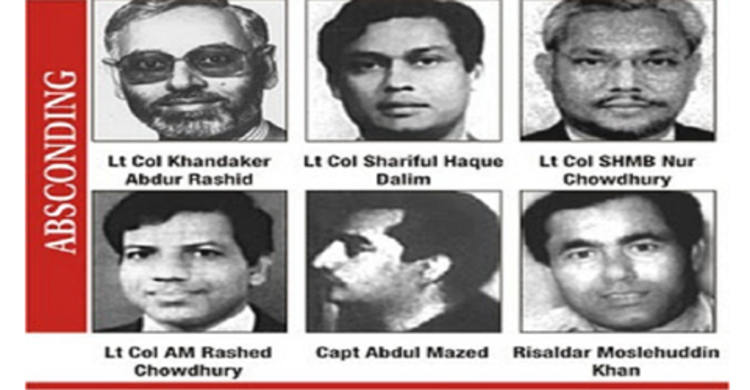
Twenty-one years later, in 1996, the Awami League came to power and repealed the Indemnity Act, paving the way for the trial of the killers. Bangabandhu’s party came to power in the next term and executed five people, including Farooq Rahman, by 2010. The remaining four are Sultan Shahriar Rashid Khan, Muhiuddin Ahmed, Bazlul Huda and AKM Mohiuddin Ahmed. Then in 2020, Abdul Majed was arrested and executed.
In addition, accused Aziz Pasha died in Zimbabwe in 2002 while on the run. Among the fugitives, it was learned a few years ago that Rashid was in Germany or Pakistan, Dalim was in Spain and Pakistan,SHMB Noor Chowdhury in Canada, and AM Rashed Chowdhury in the United States. No trace of the death-row convict Moslem Uddin was found. Also, the Awami League government could not succeed despite many efforts to get back Noor Chowdhury and Rashed Chowdhury, because the governments of Canada and the US did not agree to hand over the fugitive convicts.

https://stapravda.ru/20221228/reyting_samyh_populyarnyh_hostingov_v_rossii_196445.html, рейтинг хостингов России подтверждает, что выбор надежного провайдера важен для бизнеса.