
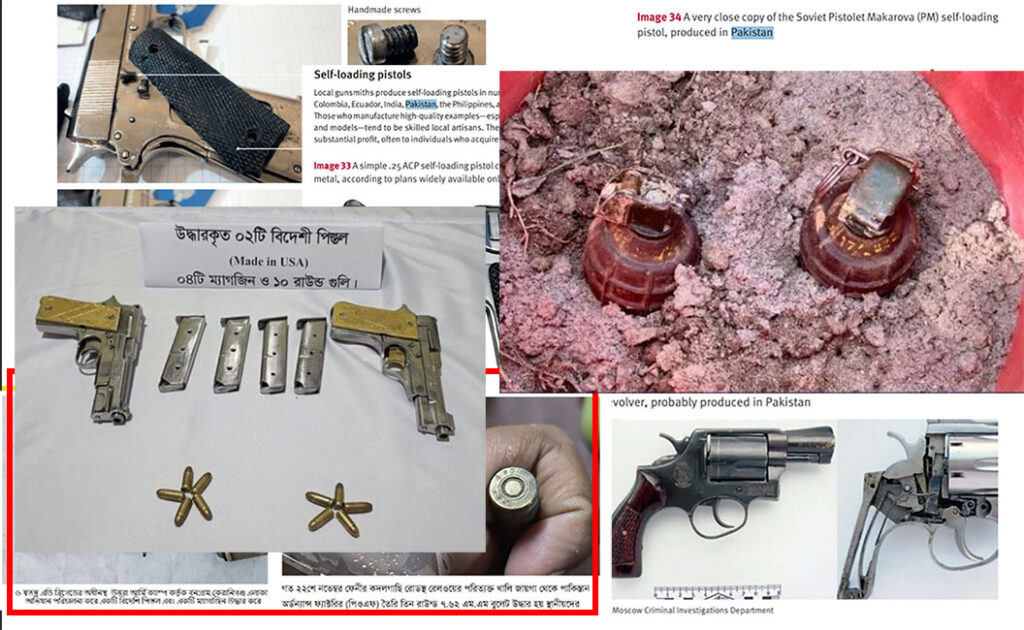
Bangladesh was once known for smuggling Chinese and Pakistani weapons and as a haven for separatist groups; the grenade attack on August 21 used a Pakistani-made RGS grenade.

Special Correspondent. Dhaka, November 22, 2026.
The recovery of two grenades near the main gate of Rajshahi Airport, followed by the recovery of US-made pistols and bullets in the same area within days, has raised fresh concerns about the proliferation of illegal weapons in Bangladesh. While the incidents are isolated, the series of explosives and firearms recovered in the same area raises questions about the potential expansion of cross-border arms smuggling networks.
On November 10, law enforcement agencies recovered two grenades from a flower garden near the main gate of Rajshahi Shah Makhdum Airport. Later, the bomb disposal team defused them by exploding them. Initial technical assessment suggests that the two grenades may be Type-1 fragmentation grenades made in China in the 1970s-80s, according to security sources. However, the police and the relevant security agencies have not yet confirmed the actual origin of the grenades, their route of entry into Bangladesh, or who left them there.
The two grenades are being investigated for links to Myanmar’s long-standing arms supply network. China supplied large quantities of arms and ammunition to the Communist Party of Myanmar in the 1970s and 1980s. After the party collapsed in 1989, a portion of its arsenal fell under the control of various armed groups. These groups later developed arms supply and communication networks with various armed groups in Myanmar, including the Arakan Army.
One possible idea, according to investigators, is that such weapons could enter Bangladesh through the black market for weapons active in the conflict situations in Myanmar’s Rakhine and Chin states and through border smuggling networks.
The long history of arms smuggling: Is Bangladesh’s role changing?
This concern about illegal weapons is not new to Bangladesh. In the past, there have been allegations and precedents of the country’s territory being used by regional separatist armed groups to transport, store and supply weapons.
The most talked about example is the 2004 seizure of 10 trucks of weapons in Chittagong. Subsequent investigations and various reports revealed that the huge consignment of weapons seized at a jetty on the banks of the Karnaphuli River in Chittagong was destined for the separatist organizations United Liberation Front of Assam (ULFA) and National Socialist Council of Nagaland (NSCN-IM) in northeastern India.
The shipment contained about 2,000 firearms, 25,000 grenades and 1.8 million rounds of small arms ammunition. These included Chinese Type-56 assault rifles, rocket-propelled grenade launchers and a large amount of ammunition. This means that Bangladesh was not only used as a transit route for weapons, but also as a dumping and storage site for regional armed groups. There is historical evidence that Bangladesh was used as a transit route for weapons.
The current situation raises the question: is Bangladesh entering a new phase of the old arms smuggling network? Are the same weapons that were once intended to reach armed groups in other countries through Bangladeshi territory now illegally entering the country and being used in political conflicts?
American pistol and bullets recovered in the same area
Amidst this concern, on November 21, the detective police conducted a raid in the Godagari area of Rajshahi and recovered two American-made 7.65 mm pistols, four magazines, and 10 rounds of ammunition. Two people were arrested in the incident.
During initial interrogation, the arrested persons said that they were collecting weapons from the border area of Chapainawabganj and taking them to Khulna for sale. Police are investigating to identify the source, suppliers and potential buyers of the weapons.
However, no link has yet been established between the pistol seizure and the grenade seizure at the airport. Similarly, no evidence has emerged that these weapons were brought for the purpose of any conflict, political violence, or organized sabotage.
Huge amount of foreign weapons recovered during the interim government’s tenure, how many are hidden?
Since the interim government took office, there have been a series of incidents of foreign weapons, grenades, rockets, magazines and large quantities of ammunition being recovered in operations by the army, police, RAB and joint forces in various parts of the country. The recovered weapons include weapons made in the US, China, Pakistan, Germany, Turkey, Japan, the UK, Afghanistan and Myanmar. The recovery of US-made pistols and Chinese rifle bullets in Khilgaon in May 2025, G-3 rifles and 975 rounds of bullets from Myanmar in Teknaf, Japanese and British-made pistols in Khulna and 10 grenades and three foreign pistols looted in Jessore are some examples.
The question is, how did such a huge variety of foreign weapons and ammunition end up in the hands of criminals, terrorists, or unknown arms hoarders in the country in just two years? How many of these were looted from old arsenals in the country, how many were smuggled across the border, and how many entered under the guise of imported goods by sea—there is a need for a full investigation and transparent disclosure of information.
One important issue is the long-standing arms manufacturing and counterfeiting industry in the Darra Adam Khel region of Pakistan’s Khyber Pakhtunkhwa province. A 2019 investigative report by the international media outlet Al Jazeera revealed details of factories there that produced weapons that imitated Chinese pistols, American M16 rifles, and Austrian Glock pistols. The Small Arms Survey has also documented the proliferation of counterfeit and illegally manufactured firearms from various countries in this region of Pakistan. That is, just because a weapon has a US, Chinese, or Russian design or brand mark does not guarantee that it was made in the respective country; forensic testing is required to identify the original origin.
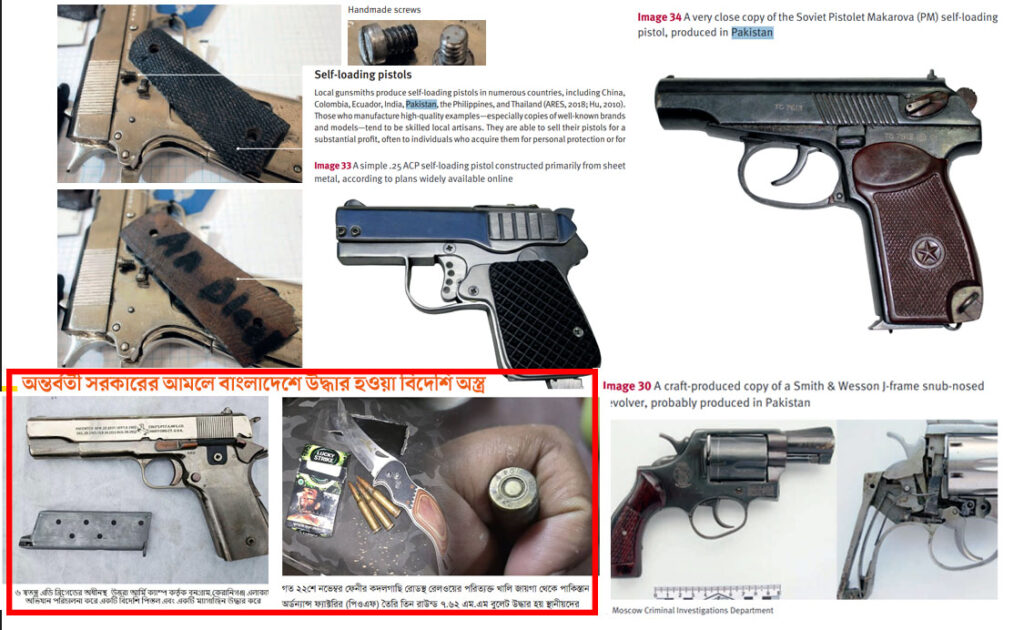
Small Arms Survey (2018): Beyond State Control: Improvised and Craft-produced Small Arms and Light Weapons – Information on the manufacture of weapons imitating various modern firearms in the Dara Adam Khel region of Pakistan. (Inset) – Foreign pistols recovered during an army operation during the interim government and three rounds of 7.62 mm bullets manufactured by the Pakistan Ordnance Factory (POF) recovered
A coordinated investigation is now necessary to identify the sources, import and transportation routes, and potential supplier networks of foreign weapons recovered in various locations in the past two years. Are Bangladesh’s ports and borders merely transit routes for arms smuggling, or are new markets and stockpiles of illegal foreign weapons developing within the country? This question needs to be answered now in the interest of national security.
New questions for Bangladesh’s security
The security situation around Bangladesh has also made this concern more important. The military control and conflict of the Arakan Army in Myanmar’s Rakhine State, the black market for weapons across the border, and the long-standing separatist activities in India’s northeast all combine to place Bangladesh in a complex regional security environment.
In this situation, it is important to determine how active the network is for weapons entering the border, transporting them within the country, storing them, and delivering them to potential buyers.
Especially when Bangladesh’s history has a history of using its territory as a transit and safe storage site for arms smuggling, a new question arises—is the country now at risk of becoming the ultimate destination for illegal weapons and also a place for internal use?
The grenade and pistol recoveries in Rajshahi are not conclusive evidence of this change yet. But the failure to identify the sources, suppliers, transportation routes, and potential users of cross-border weapons and their links to the country cannot rule out the possibility that the illegal arms network will expand further in the future.

https://stapravda.ru/20221228/reyting_samyh_populyarnyh_hostingov_v_rossii_196445.html, рейтинг хостингов России подтверждает, что выбор надежного провайдера важен для бизнеса.