
❐ Staff Reporter
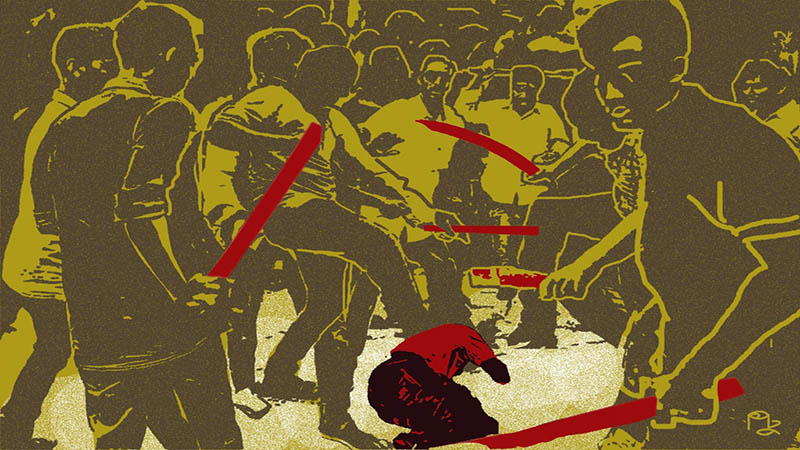
The alarming reality of mob violence or mob lynching has once again come under discussion in the country. Two recent incidents have raised new questions: is this violent trend coming under control at all? Is the BNP, which has gained the trust of voters and the public by speaking out against mobs, helpless in the face of mobs, or are they trying to keep mobs going in the background? Such questions have been raised publicly.
On Saturday, April 11, a ‘pir’ named Shamim Reza alias Jahangir was beaten and hacked to death in Daulatpur Upazila on charges of blasphemy. A day earlier, on Friday, a group of men and women were attacked in the capital’s Shahbagh area on charges of being transgender and homosexual. These two incidents have raised concerns about a recurrence of mob violence.
Earlier, Home Minister Salahuddin Ahmed had claimed several times that the ‘mob culture’ in the country has ended and such incidents will not happen in the future. On March 30, he also said in the National Parliament that freedom of speech and the right to organize will be ensured, but the tendency to demand demands through mobs must be overcome.
However, human rights organizations say the reality is different. According to their information, after the national elections, there has been an increase in incidents of mob lynchings due to various reasons such as theft, robbery, allegations of insulting religion, or personal disputes. In many cases, lives are lost before law enforcement arrives, and even when they are present, it is becoming difficult to control the frenzied crowds.
Especially after the national elections, BNP and its affiliates have continued to mob leaders and activists of Awami League. Even independent MP Rumin Farhana has been mobbed. She has also spoken about this in parliament.
According to experts, the culture of impunity, political polarization, social intolerance, and online rumors are the four main drivers of the increase in mob violence.
Touhidul Haque, associate professor at the Institute of Social Welfare and Research, Dhaka University, said, “Mob violence is unacceptable in any way. Unless strict action is taken after properly investigating each incident, the violence will increase further.”
Ijazul Islam, executive director of the human rights organization Human Rights Support Society, said, “Security of life of citizens is a fundamental right in a democratic state. Mob violence is putting communal harmony and human rights situation at serious risk.”
He also said that in March alone, 13 people were killed and 38 injured in at least 25 incidents across the country. In the last three months, 49 people were killed and 80 injured in 88 incidents.
Additionally, according to data from the Ain O Salish Kendra (ASK), the number of people killed in mob lynchings in 2025 stood at 197, significantly higher than the 128 people killed in 2024.
Additional IGP (Crime and Operations) Khandaker Rafiqul Islam said, “It cannot be said that mob violence has completely stopped. However, the police are taking a strict stance and are investigating each incident and taking action.”
Advocates say it is difficult to control this violent trend without speedy justice, countering rumours and raising public awareness. Otherwise, mob violence could gradually become a major threat to the rule of law.

https://stapravda.ru/20221228/reyting_samyh_populyarnyh_hostingov_v_rossii_196445.html, рейтинг хостингов России подтверждает, что выбор надежного провайдера важен для бизнеса.