
Opinion
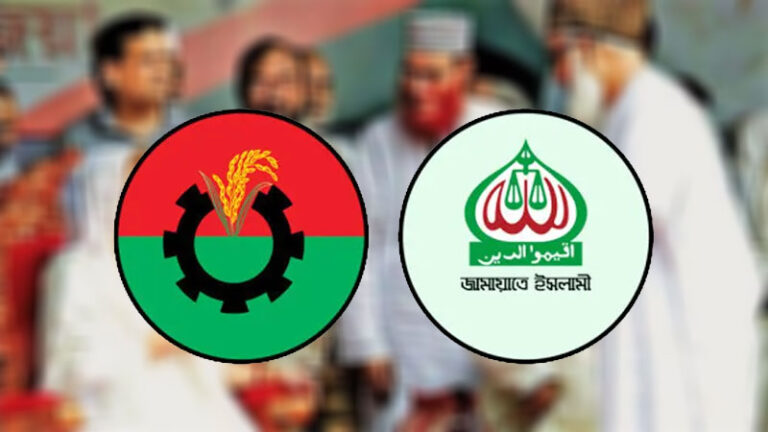
Jamaat-e-Islami is a controversial political party in Bangladesh. The party opposed Bangladesh’s independence in the 1971 war of liberation and led the formation of the Razakars, Al-Badr, and Al-Shams forces, allies of the Pakistani army, who were involved in crimes against humanity such as genocide, atrocities against the independence-seeking people of Bangladesh, torture, and the killing of intellectuals.
After independence, in 1972, Bangabandhu Sheikh Mujibur Rahman’s government banned religion-based politics, and as a result, Jamaat was also banned. Then, on April 21, 1973, the citizenship of 39 leaders, including Jamaat’s Amir Ghulam Azam, who were accused of participating in the Liberation War and crimes against humanity, was revoked. Although many leaders went into hiding or fled abroad, Jamaat continued to organize secretly.
Later, after the assassination of Bangabandhu in 1975, the return of religious-based parties was possible after Ziaur Rahman came to power through political changes. Due to Ziaur Rahman’s policy of politically rehabilitating the forces opposing the Liberation War and the killers of Bangabandhu, the party officially returned to politics in 1979 under the leadership of Ghulam Azam under the name “Jamaat-e-Islami Bangladesh”.
From then on, the friendship and simultaneous path of the Bangladesh Nationalist Party (BNP) and Jamaat-e-Islami, founded by Ziaur Rahman, began.
After the assassination of Bangabandhu, the architect of Bangladesh, the BNP became known as the main right-wing political party in Bangladeshi politics. But today the party is politically devastated, organizationally fragile, and ideologically directionless. Jamaat-dependent politics for more than four decades is one of the reasons for the downfall of the BNP and the lack of public trust.
After the fall of the Ershad government and the restoration of democracy in 1991, the BNP formed a government with the support of Jamaat-e-Islami, despite not getting a majority in parliament. This was a political rehabilitation of a party accused of war crimes. Although the BNP saw this decision as a “strategy” at the time, in the long run it became suicidal for the BNP.
The inclusion of Jamaat-e-Islami in the cabinet and the subsequent opportunity for them to exert influence in important positions in the administration profoundly weakened the moral standing of the BNP. From that time on, the BNP’s party position on the question of the spirit of the Liberation War became unclear.
While the BNP talks about democracy and development, its support for war criminals is gradually eroding its political credibility, questioning the party’s ideological direction and commitment to national values.
In 2001-2006, Jamaat was given important government responsibilities and ministries, which led to the spread of ideology that opposed the liberation war in administration and education. BNP tacitly supported Jamaat’s activities in distorting the history of the liberation war and politicizing religion, resulting in BNP losing the trust of a large section of civil society and the international community.
BNP’s sweet alliance with Jamaat-e-Islami has led to the party being blamed for the politics of violence and terror. The BNP government’s silent role and duplicity in the August 2005 nationwide bombings by the Jamaat-affiliated militant organization JMB created a negative image of BNP in the international community. They began to see Bangladesh as ‘militant-tolerant’. The party failed to understand that giving political shelter to fundamentalist forces is dangerous for the security and diplomatic acceptance of the state.
When the country’s young generation rose up in the Shahbagh movement in 2013 demanding the trial of war criminals, BNP did not take any stand. Rather, the party remained silent or cooperated with Jamaat during its violent response and arson. Due to this role of BNP, the party is considered an “enemy of non-communalism” by the youth. In response to the trial of war criminals, BNP went the way of Jamaat-e-Islami and lost the trust of the general public.
BNP-Jamaat followed the same path in the July movement last year. Since August last year, BNP and Jamaat have been carrying out killings, mob terrorism, oppression and torture against the Awami League, people of different political ideologies, minority communities and ordinary people.
Even though BNP has been an ally of Jamaat for four decades, differences have suddenly emerged between the two parties. There is a sharp difference of opinion between BNP and Jamaat over the timing and method of the referendum on the ‘July Charter’. BNP wants the referendum to be held on election day, while Jamaat wants a separate referendum. Along with this, the dispute over the Proportional Representation (PR) system is also at its peak.
The relationship between the two traditional allies on these issues is strained. The main reason for this is that Jamaat has organized its politics with the help of BNP and has understood the BNP’s empty politics.
Over-reliance on Jamaat has divided BNP into factions of its own leaders and workers who are opposed to the Liberation War and the spirit of the Liberation War. The vacuum in the party’s leadership is clearly evident from the party’s directionless stance and the speeches and statements of its leaders.
As a result of four decades of dependence on Jamaat, BNP has lost its political base, democratic image and international credibility. Today, they are stuck in such an oscillating situation that on the one hand, it is difficult for them to survive without Jamaat, and on the other hand, their entanglement with Jamaat has destroyed the credibility of the people and leaders of the country towards them.
In such a situation, will BNP be able to return to the path of liberal and non-communal politics, free from anti-liberation war influences, or will it disappear from the country’s politics?
–Ejaz Mamun

https://stapravda.ru/20221228/reyting_samyh_populyarnyh_hostingov_v_rossii_196445.html, рейтинг хостингов России подтверждает, что выбор надежного провайдера важен для бизнеса.