
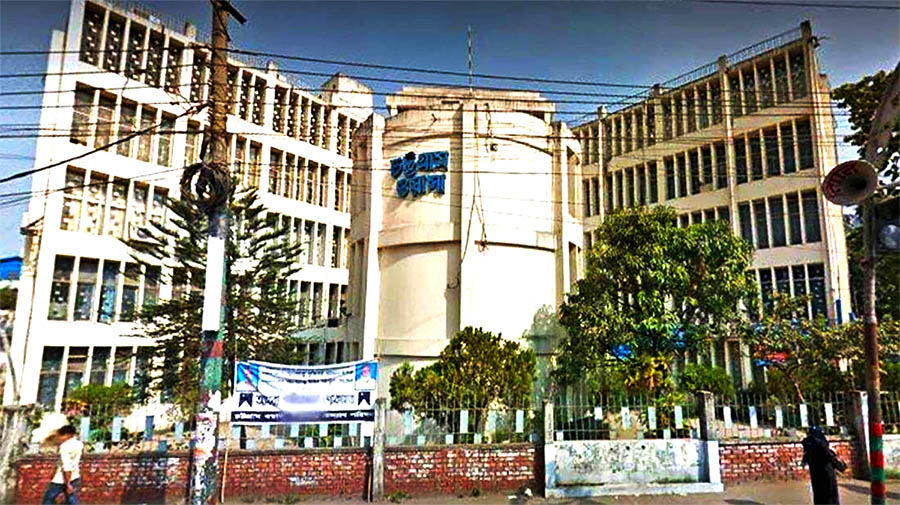
News report
Production and distribution – everything is fine on paper. There is no sign of a deficit in the accounts. However, huge sums of money are not being collected at the place of revenue collection. In the last fiscal year, about 80 crore taka of water has practically gone ‘air’ in Chittagong WASA. There is no clear trace of this huge amount of water with the organization itself. In a strange silence, WASA authorities are covering up this huge financial loss by calling it ‘system loss’.
Although the paper accounts of production, distribution and expenditure are shown to be accurate, huge amounts of water are not found in the sales and revenue collection accounts. Despite everything being ‘normal’, nearly 80 crore taka of water went out of revenue in Chittagong WASA in the last fiscal year. Where did this water go, who used it – the authorities are unable to give a specific answer to these questions.
This massive incident of theft and waste is being silently passed off as ‘system loss’.
In this situation, another 40 crore taka of water revenue has been lost in the first 6 months of the current fiscal year. Yet, the company is accepting the situation as normal. Even in the budget plan for the 2026-27 fiscal year, a 20 percent ‘system loss’ has been assumed in advance, which has a financial value of more than 72 crore.
The WASA authorities, as always, are blaming the manpower shortage and some dishonest employees. But even after years, the cruel reality of losing billions of taka in revenue remains within the same explanation.
According to the income and expenditure data of the Chittagong Water Supply and Sewerage Authority, the total water production in WASA in the 2024-25 fiscal year was 17,196 crore liters. On paper, this entire amount of water has been supplied. However, the sales figures say otherwise – only 12,715 crore liters of water came under revenue. That is, about 26 percent of the water produced was not included in the sales accounts.
The amount of this non-revenue water is 4,470.96 billion liters. Assuming a production cost of 18 taka per thousand liters of water, the financial value of the lost water stands at 800.48 billion taka.
The same picture is seen in the first six months of the current 2025-26 fiscal year. During this period, 9,131 crore liters of water were produced and distributed, but only 6,891 crore liters were sold. As a result, the rate of non-revenue water stood at 25 percent, which amounted to 2,282 crore 75 lakh liters. Its financial value according to production cost is 40 crore 23 lakh taka.
WASA officials have accepted this waste or theft as an inevitable reality for years.
The issue of crores of taka of water being lost in Chittagong WASA has been shown as ‘system loss’ for a long time. As a result, the government is losing huge revenue. In de facto recognition of this trend, the budget for the 2026-27 fiscal year has also been made assuming system loss.
The target for water production in that fiscal year has been set at 20,750 million liters. The target for sales against the equivalent distribution has been set at 16,600 million liters.
That is, 20 percent or 4,150 million liters of water has been previously assumed as system loss, the financial value of which stands at 722.7 million taka. Responsible officials are bringing up the old argument as the reason for this huge loss of revenue.
Rumon Dey, Chief Revenue Officer of Chittagong WASA, said that the main problem is the shortage of meter readers.
According to his information, WASA has a total of 86,309 connections. Of these, 78,542 are residential connections and 7,767 are commercial connections. Only 37 meter readers are responsible for meter reading and bill distribution for such a large number of customers in 41 wards of the city. Where at least 90 are needed, there is a shortage of 53.
He claims that due to lack of sufficient manpower, it is not possible to go door to door to take meter readings, resulting in a revenue deficit.
However, there are allegations at the field level that some dishonest officials and employees have formed a powerful syndicate. This gang is strategically stealing WASA water in different areas and selling it. WASA has installed 3,000 smart meters in the city to prevent these irregularities, but the expected benefits have not been achieved.
Despite the lack of results, a new initiative to install 100,000 more smart meters has been taken as a solution. Although 8 to 10 raids are conducted against illegal connections every month, according to the admissions of those concerned, it is completely insufficient compared to this huge theft.

https://stapravda.ru/20221228/reyting_samyh_populyarnyh_hostingov_v_rossii_196445.html, рейтинг хостингов России подтверждает, что выбор надежного провайдера важен для бизнеса.