
 ❐ International Desk
Signs of the collapse of the old liberal international order that emerged after World War II are becoming increasingly clear in world politics. The world is in turmoil today, with wars in the Middle East, a growing energy crisis, divided diplomacy, toxic trade relations, and supply chain disruptions. Not long ago, the United States, the sole superpower, was supposed to lead in such a crisis. But President Donald Trump’s “Make America Great Again” policy has changed that equation. Various crisis areas around the world are now left without American leadership, and new alliances are filling that void.
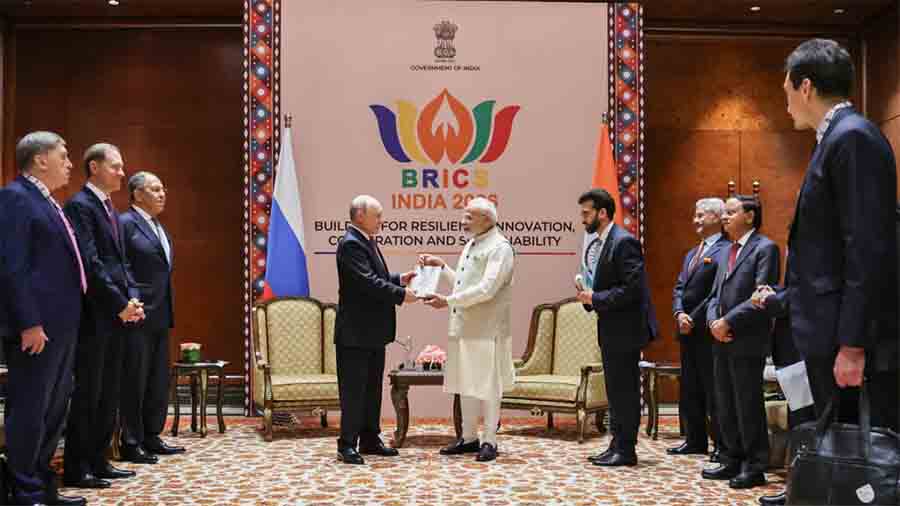
BRICS Summit in New Delhi: Call for a multipolar world order
The BRICS summit in New Delhi last weekend proposed a multipolar world order as an alternative to the Western-dominated world order. Chinese President Xi Jinping, Russian President Vladimir Putin and Iranian President Massoud Pjeshkian attended the summit. It was hosted by Indian Prime Minister Narendra Modi. The gathering of leaders who share a common grievance with the West is being portrayed as a powerful lineup.
The conference’s joint declaration called for major changes in global institutions and the financial system—a world free from US centrality.
Chinese President Xi Jinping said that BRICS is not just an alliance of a few countries, but a solution-oriented ecosystem. He called for an equal and orderly multipolar world, and inclusive and mutually beneficial economic globalization.
Russian President Vladimir Putin said that BRICS is serving as one of the most powerful driving forces in strengthening international relations and establishing genuine multilateralism.
Canada’s new turn: Leaning towards Europe
The Western world itself is at a critical juncture. For nearly 80 years, American power and leadership have held the global system together. But this bond is fraying most at the US-Canada border, now the frontline of a new trade war. In this context, Canadian Prime Minister Mark Carney is in Brussels trying to forge a new partnership with the European Union. He calls it a “unique alliance” and says he wants to forge this new relationship beyond regional allegiance to North America.
Mark Carney describes Canada as “the most European of non-European countries.” “We share the same values, we have the same priorities, and our strengths complement each other. We are stronger together. And at a time when the world is becoming more dangerous and divided, friends need to come together,” he said.
Trump: Tough stance on allies
According to analysts, President Trump has consistently taken a tough stance on his allies. His rhetoric has been largely focused on questions like where the allies were during the Iran crisis, why they aren’t spending more on defense, and how the Ukraine crisis is Europe’s problem, not the United States’. In reality, however, the Atlantic alliance is still considered to be intact. NATO is still in effect, with about 80,000 U.S. troops stationed in Europe, as well as several thousand in Korea and Japan.
However, Canada is being singled out as the only country to openly break ties with the US. One reason for this is that Canada is not a neighbor to Russia and is not close to China, giving it a relatively greater geopolitical opportunity to take a stand against the US and Trump’s “America First” policy.
Redistribution of power and the impact of the digital age
The analysis suggests that two major structural changes are at work behind the current instability. First, there is a global redistribution of power—from West to East and from North to South—that has not been seen in centuries. Second, the dawn of the digital age is breaking down the social contract built during the industrial age. These two changes are fueling voter discontent and leading to the rise of liberal populism in democracies on both sides of the Atlantic.
According to this analysis, Trump is not the cause of this situation, but only a symptom. The anger among voters in the United States is largely due to the socio-economic uncertainty caused by automation and free trade. Many working-class Americans have found their lives difficult, and Trump has told them that he is listening. But this problem has been going on for decades—from Clinton to Bush, Obama to Trump, Biden, and Trump again, American politics has changed direction repeatedly. The erosion of the middle class is also believed to have weakened the political center.
BRICS and Shanghai Cooperation Organization: Witnessing erosion from within
Observers say that alliances like the BRICS summit and the Shanghai Cooperation Organization are emerging as a kind of counterforce. But the point is not that Russia or China have suddenly started to control the world. Rather, they are essentially sitting back and watching as the old liberal world order is eroding from within. The biggest reasons for this erosion are said to be threats to the United States’ domestic democracy and growing distance from key allies—the trade war with Canada and the deep sense of isolation from European allies being prime examples.
India’s “multi-alignment” policy
In this changing world order, India is being held up as a model for countries pursuing a policy of “multi-alignment.” This means working with Russia and China one day, and maintaining ties with the European Union and the United States the next. Despite the Ukraine war and the Iran war, most countries in the world are taking sides in this new rivalry between the Russia-China alliance and the US-led alliance.
The rise of regional powers and the proposal for a new global governance system
The analysis suggests that this decentralization of power will make the 21st century world much more fluid, unpredictable, and centerless. It will not be the century of a single superpower—neither American nor Chinese—but rather a world of “no one.” As power spreads from the center to the periphery, regional powers are expected to exert greater influence in their respective regions.
However, rather than seeing this shift as a return to direct spheres of influence, it is being suggested that it be developed as a “benevolent” or non-coercive sphere of influence, where smaller powers would voluntarily organize around larger powers. At the same time, as the world has become more interdependent than ever before, there is a need to centralize global governance not only with democratic allies, but also with countries like China and Russia. In this context, there is also a proposal to develop a new “Concert System” modeled on the nineteenth-century “Concert of Europe” model, which could create a framework for coordination among the major powers.

https://stapravda.ru/20221228/reyting_samyh_populyarnyh_hostingov_v_rossii_196445.html, рейтинг хостингов России подтверждает, что выбор надежного провайдера важен для бизнеса.