
❐ Special Correspondent
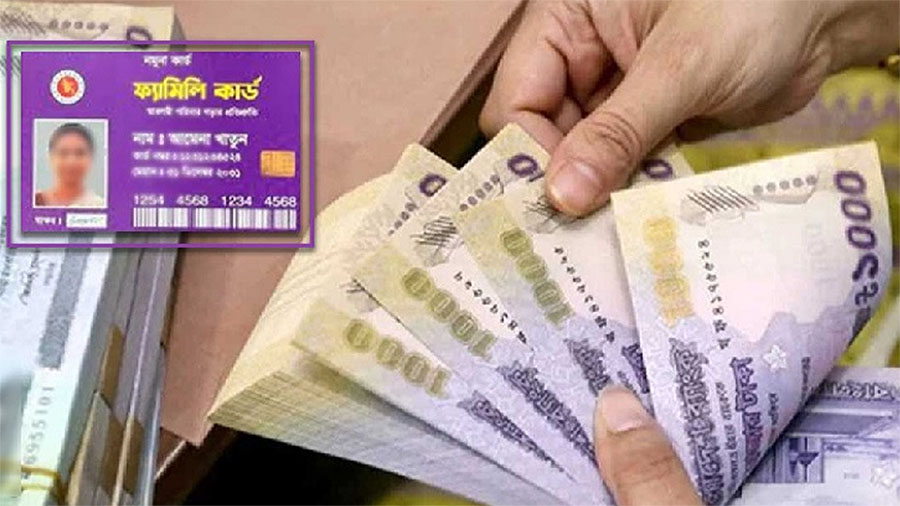
The government has planned to spend about Tk 2,000 crore on various activities, including card preparation, beneficiary selection and data collection, to implement the BNP’s election promise ‘Family Card’ program.
Of this, a proposal to spend Tk 50 crore has been made just to organize a card distribution ceremony in the presence of the Prime Minister, which has been questioned by good governance analysts.
On the one hand, the work on the overhead section of the Metrorail Line-5 (Northern Route) project, which is being implemented to ease traffic congestion in the capital and build a modern public transport system, has been stopped due to insufficient funds being allocated in the Development Project Proposal (DPP). On the other hand, this huge expenditure on the Family Card project has raised questions about the goodwill of the BNP government.
Badiul Alam Majumdar, a well-known confidant of the government, also raised questions about this.
According to the editor of the NGO Citizens for Good Governance (Sujon), even though the government is talking about cutting costs, the proposal to allocate such a large amount for organizing events is synonymous with the proverb ‘more music than rent’.
He said that this money could have directly helped a large number of people. According to him, if a large amount of money is spent on organizing the event, then there is a risk that the main purpose of the program will be disrupted.
However, Project Director Md. Mosharraf Hossain said that although 50 crore taka has been proposed for the event, it is not the case that the entire amount will be spent.
According to Planning Commission sources, the family card program has been added under the first amendment of the ‘Social Protection for Improved Resilience, Inclusion and Targeting (SSPIRIT)’ project being implemented by the Department of Social Services under the Ministry of Social Welfare.
Recently, after reviewing the revised proposal at the Project Evaluation Committee (PEC) meeting, it was recommended to reduce the expenditure in some sectors and approve it.
Although no allocation has been made for the family card program in the main budget for the current fiscal year 2026-27, on July 18, Director General of the Department of Social Services Shah Mohammad Mahbub requested the Secretary of the Ministry of Social Welfare to transfer Tk 1,511.34 crore from the lump sum allocation to the current fiscal year.
The next day, a letter was sent to the Planning Commission, Finance Department, and Economic Relations Department (ERD) to take necessary action in this regard.
According to the expenditure proposal, the cost of preparing and distributing smart family cards has been estimated at 550 crore 82 thousand taka. In addition, there is a plan to spend 221 crore 32 lakh 89 thousand taka to purchase 66 thousand 815 tabs and five super computers for collecting data nationwide.
In addition, it has been proposed to allocate 8 million taka for organizing seminars in eight departments, 47 million taka for training activities, and 80 million taka for travel allowances for officers in field supervision.
The cost of surveying, data collection, data entry, and processing by employing 60,000 surveyors to identify actual beneficiaries has been estimated at 676.5 million taka.
Officials from the Department of Social Services said that the project cost was increased to 2,813.78 crore taka in 2025 due to the addition of new programs under the SSPIRIT project approved at a cost of 904.17 crore taka.
Later, the project evaluation committee recommended reorganizing the expenditure in various sectors and setting the expenditure for the family card implementation at Tk 1,909 crore.
The project also proposes to outsource additional data entry and computing services, as well as rent two jeeps and eight microbuses.
Project Director Md. Mosharraf Hossain said that the target has been set to provide family cards to 4.1 million people in the first fiscal year. The scope of the program will be expanded in phases.
He said that the process of recruiting data collectors and supervisors has begun to complete the survey quickly, and there is a plan to complete the survey by August with the technical assistance of the Bangladesh Bureau of Statistics (BBS).
Meanwhile, allegations of irregularities have been raised in the pilot implementation of the program.
In the investigation, residents of the capital’s Karail slum complained that while many truly low-income families were excluded, relatively well-off people, even homeowners, received family cards.
Md. Shanto, an autorickshaw driver from Karail, said that he did not receive any assistance even though he went to the card distribution ceremony with his pregnant wife.
He complains that those who really need it are being left out, while his landlord has received the card.
In this context, Badiul Alam Majumder said that the Union Parishad Act has a provision to publicly select beneficiaries through ward meetings, so that transparency and accountability are ensured and the list of beneficiaries cannot be prepared through political influence.
But in reality, he commented that opportunities for irregularities are being created by not following those provisions.
Although government policies are supposed to give priority to landless, homeless, female-headed, and other marginalized families, locals complain that those policies have not been fully followed at the field level.
According to the ministry, in the first phase, 37,567 female-headed families in 14 areas have been given family cards. Of these, about 15,000 beneficiaries are from Karail, Sattala and Bhasantek areas, but separate statistics for Karail have not been released.

https://stapravda.ru/20221228/reyting_samyh_populyarnyh_hostingov_v_rossii_196445.html, рейтинг хостингов России подтверждает, что выбор надежного провайдера важен для бизнеса.