
Staff Correspondent
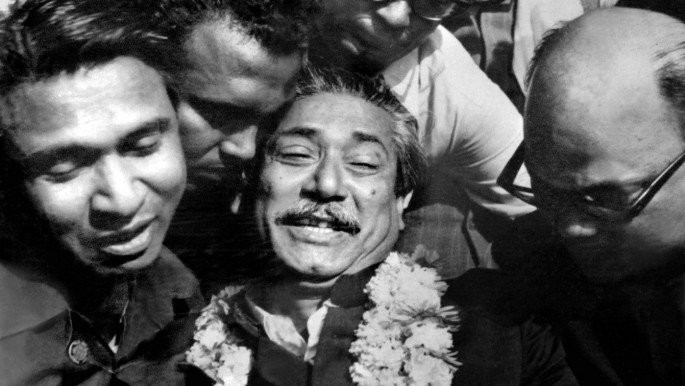
A controversial statement has been circulating for a long time surrounding Bangabandhu Sheikh Mujibur Rahman’s return to his homeland—after returning to the country, he allegedly whispered to Tajuddin Ahmed, “I will become the Prime Minister.”
Around this statement, attempts can also be seen on social media and in a certain political narrative to present Bangabandhu as a ‘power-hungry’ person.
However, a review of historical documents, the state system of the time, and the statements of relevant leaders reveals a different reality behind this claim.
When news reached Bangladesh that Bangabandhu Sheikh Mujibur Rahman was leaving for London after being released from a Pakistani prison on January 9, 1972, Acting President Syed Nazrul Islam spoke to reporters at Dhanmondi No. 32.
He said, “This is a happy moment for us. 75 million people have been waiting for Bangabandhu for the last nine months. He is free today. He will return home and take the lead in rebuilding and moving the country forward. With his extraordinary leadership, he will take Bangladesh to the ranks of the best countries in Asia and the world.”
It is clear from this statement that the leadership at the time viewed Bangabandhu’s return as a continuous part of running the state.
However, ‘I will be the Prime Minister’ – this statement came into the discussion many years later through Tajuddin’s daughter Sharmin Ahmed.
Writer and Liberation War researcher Hasan Morshed said that the claim to have heard this statement was made through Ali Tarek, an employee of the Mujibnagar government.
In his words, “Sheikh Mujib whispered to Tajuddin Ahmed as soon as he got off the plane and got into the truck—‘I will be the Prime Minister.’ Ali Tariq overheard the words. Many years later, this description appeared in a book edited by Tajuddin Ahmed’s daughter.”
However, Hasan Morshed believes that presenting this statement as evidence of greed for power is a distortion of historical reality.
He said, “Many forget that when Sheikh Mujib returned home, he was the President of independent Bangladesh. The government was formed on April 10, 1971, by declaring him the President and Commander-in-Chief of the war. In his absence, Syed Nazrul Islam was performing duties. That government was under presidential rule. That is, Sheikh Mujib was the head of state and government at that time.”
According to researchers, if Bangabandhu had maintained the presidential system after returning to the country, no one would have questioned him. But within two days, he abolished the presidential system, switched to a parliamentary system of government, and took oath as the Prime Minister himself.
In the words of Hasan Morshed, “Through this, Sheikh Mujib reduced his own power and empowered the parliament. If he had been the president, no one would have said anything. He chose the path of establishing parliamentary democracy by becoming the prime minister.”
Meanwhile, the role of Tajuddin Ahmed’s daughter Sharmin Ahmed in establishing this ‘hearsay’ as a rumor has also come under discussion.
According to critics, he gave this statement the form of a political explanation. After the fall of the government on August 5, 2024, he told the media, “Sheikh Hasina has fled the country like her father Sheikh Mujib.”
Politicians and analysts are viewing this comment as a political statement.
According to historians, at the time of Bangabandhu’s return to his homeland, Bangladesh was under a presidential system of government. His decision to return and transform it into a parliamentary democracy was not a reflection of centralization of power, but rather of decentralization of power and the establishment of constitutional rule.
In this context, regarding Bangabandhu’s return to his homeland, the Foreign Minister of the Bangabandhu government, Dr. Kamal Hossain, said in an interview, “Bangabandhu did not want to become the Prime Minister after returning home. He only wanted to be among the people.”

https://stapravda.ru/20221228/reyting_samyh_populyarnyh_hostingov_v_rossii_196445.html, рейтинг хостингов России подтверждает, что выбор надежного провайдера важен для бизнеса.