
BD Digest Report
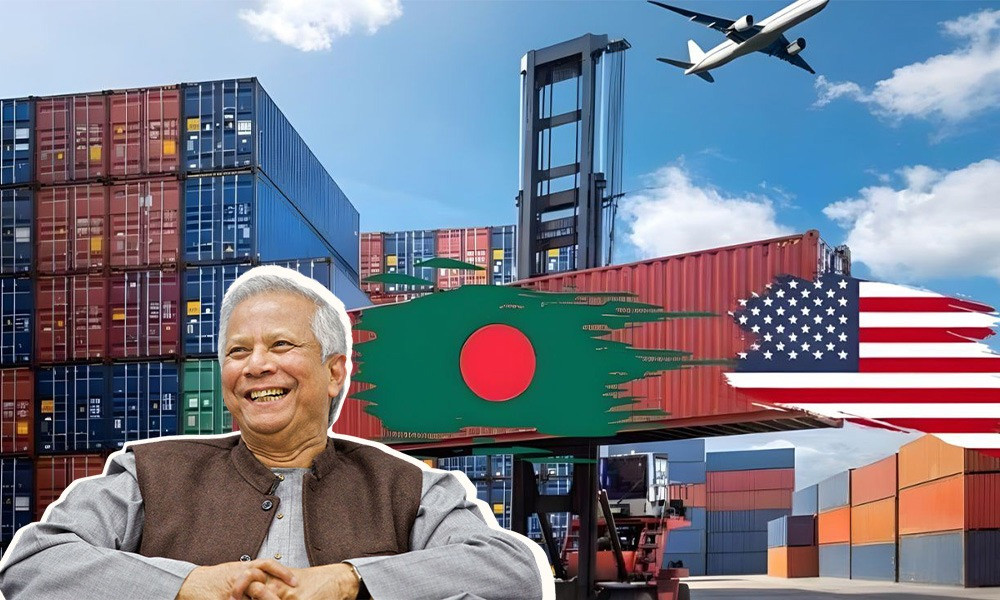
Just days before Dr. Muhammad Yunus’ interim government left power, it signed a horrendous unequal trade agreement with the United States. This agreement, which kept everyone in the country in the dark, is now a noose for Bangladesh.
From businessmen to economic experts, they say that through the unilateral trade agreement, Bangladesh has been turned into a free market for US products. Not only that, but the country’s sovereignty has been sold.
This agreement has turned Bangladesh into a commercial colony of the United States. Experts are also warning of a major disaster ahead.
Economist Professor Anu Muhammad said at a rally in the capital on Friday (April 17), “The trade agreement signed with the United States at the end of the interim government will harm Bangladesh and millions of people will lose their jobs.” Demanding a unanimous rejection of the agreement after discussion in parliament, he said, “The interim government has done many disastrous things.
Many of them may now be living abroad. Wherever they are, it is the responsibility of the current government to prosecute them.
Anu Muhammad made these remarks at a rally of the Democratic Rights Committee in front of the National Museum in Shahbagh, the capital, on Friday, demanding the cancellation of US trade agreements that are against national interests.
The next day, at an event in the capital, economist Dr. Debapriya Bhattacharya said, ‘The US trade deal with the interim government is a bigger obstacle to energy imports than the Strait of Hormuz.’
A trade agreement was signed between the interim government and the Trump administration on February 9, a few days before the national elections in Bangladesh. At that time, the interim government claimed that no terms of the agreement could be disclosed, citing a ‘non-disclosure’ agreement. However, the US government soon published the entire agreement on its website.
This shows that the US’s decision to reduce the counter-tariff rate on Bangladeshi ready-made garment products from 1 percent to 19 percent is a dangerous blunder. Bangladesh risks losing its independence in making its own decisions, especially in sensitive sectors such as trade, energy and security.
The agreement states that if Bangladesh enters into a digital trade agreement with another country and it harms US interests, Washington can cancel the trade agreement. In that case, a 37 percent tariff may be imposed on Bangladeshi products again.
Bangladesh will also not be able to enter into bilateral free trade or preferential agreements with countries that the United States does not recognize as ‘non-market countries’ or market economies. There is a clause in the trade agreement that prevents Bangladesh from purchasing nuclear reactors, fuel rods or enriched uranium from any country that ‘undermines US interests’.
A review of the agreement documents shows that under it, Bangladesh has given duty exemptions to 6,710 US products. On the other hand, Bangladesh has received counter-duty exemptions on 1,638 products. Of these, the US will receive duty-free benefits for exporting 4,500 products to Bangladesh from the date the agreement comes into effect. These include livestock, meat, fish, chemicals, textiles, machinery and various types of industrial products.
In addition, tariffs on 1,539 products will be reduced by half as soon as the agreement comes into effect. The remaining half will be reduced evenly over the next four years. These products will be completely duty-free from January 1 of the fifth year. In addition, tariffs on 672 US products will be reduced by half initially. The remaining half will be reduced in equal steps over the next nine years and will be completely duty-free from January 1 of the tenth year. Experts say that this huge tariff reduction could pose a serious threat to Bangladesh’s agricultural and industrial products.
Analysis of the National Board of Revenue (NBR) and trade statistics shows that most of the tariff exemption benefits have gone to the United States. According to import data for 2025, out of the 6,710 US products on which Bangladesh has agreed to exempt tariffs, at least 2,160 are already being imported by Bangladesh. The total import value of these products is about $650 million. If tariffs are reduced or withdrawn step by step on these products as per the agreement, the government could lose about Tk 419 million in revenue.
On the other hand, the actual exports of the products that Bangladesh has been told to give preferential treatment to in the US market are very limited. Out of the list of 1,638 products, only 14 products were exported to the US last year. The total export value of these products was only $670,000.
If these products were exempted from duty, the US government would have to give up a potential revenue concession of $125,000, which is about 15 million taka in Bangladeshi currency. That is, compared to the potential benefits and losses, it can be seen that while Bangladesh’s potential revenue loss is hundreds of millions of taka, the potential concession from the US is limited to a few million taka.
The FTA also opens up direct investment opportunities for the United States, which will allow them to explore, mine, extract, refine, process, transport, distribute, and export mineral resources.
In addition, Bangladesh will initially have to buy 14 Boeing aircraft. In addition, it will have to increase the purchase of liquefied natural gas (LNG) worth $15 billion and military equipment from the United States over the next 15 years. At the same time, limits have been imposed on the purchase of defense equipment from certain countries.
Due to the Yunus government’s agreement, Bangladesh will have to buy US agricultural products worth $3.5 billion. Of this, it will have to buy wheat at the rate of 700,000 tons per year for five years. It has also created an obligation to buy at least $1.2 billion or 2.6 million tons of soy and soy products and cotton every year.
The agreement emphasizes reducing non-tariff barriers to imports of US goods. It states that Bangladesh will not be able to apply import licensing policies to US goods in a way that hinders their import. Until now, US industrial and medical products were approved in that country, but they would have to be tested and approved for export to Bangladesh. As a result of the trade agreement, these products will now be directly marketed in Bangladesh.
In the name of removing non-tariff barriers, testing and inspection has also been eliminated for US agricultural and biotechnology products entering Bangladesh. As a result, US sanitary and phytosanitary measures and other standards will be recognized as alternatives to Bangladeshi standards for US food and agricultural products. For products like meat, poultry and eggs, the standards of the USDA Food Safety and Inspection Service will be considered final. In addition, biotechnology or biotechnology products recognized as safe in the United States will be able to enter Bangladesh without testing and without any additional labeling. The import of genetically modified products can no longer be blocked, and manufacturers cannot even be forced to add any kind of label.
According to the agreement, Bangladesh will have to cooperate with US investors in extracting and exporting mineral resources. Along with this, the country’s companies will have to be given equal facilities as Bangladeshi companies in the power generation, telecommunications, transportation and infrastructure sectors. No limit can be imposed on US financial investment in the oil and gas, insurance and telecommunications sectors. Currently, domestic and foreign private companies are obliged to provide 50 percent reinsurance to the state-owned General Insurance Corporation. However, this rule will not apply to US insurance companies.
The agreement also includes a clause on ‘Rules of Origin’, which states that if the benefits of the agreement are transferred to a significant extent to a third country or its nationals, then any party may determine rules of origin to implement the objectives of the agreement.
A large section of economists and researchers have called the agreement ‘unequal’ and ‘against national interest’ and have demanded its reconsideration or cancellation. They say that the agreement may create complications in expanding trade with countries like China and Russia or attracting their investments in the future. In addition, it has been said that conditions should be imposed on the formation of labor unions in export processing zones (EPZs). Such conditions could have a negative impact on attracting foreign investment.
Businessmen and economists say that the trade agreement signed with the United States will need the approval of the parliaments of both countries to be implemented. Before that, Bangladesh will also have to amend some related laws. Therefore, the new government should take more time to review the conflicting parts of the agreement.
Experts say that the financial and technological capabilities of US multinationals are much greater than those of Bangladeshi companies. Therefore, if these multinationals get equal opportunities, the domestic sector will suffer. In addition, the country’s sovereign control will also be reduced. Despite the gas crisis in the country, US companies must be allowed to export gas.
According to the agreement with the United States, Bangladesh will not be able to provide non-commercial assistance or any other type of subsidy to state-owned enterprises. Even the United States will have to report information on subsidies and incentives to all manufacturing enterprises within the country. Subsidies that affect market competition will also have to be stopped. Bangladesh will have to submit information on all types of subsidies to the World Trade Organization within six months of the agreement coming into effect.
Although it is a trade agreement in name, it has entangled Bangladesh with the US national security system. According to the terms, if the US takes border or trade measures to protect national security, Bangladesh will also have to adopt ‘complementary restrictions’ in line with them.
Bangladesh must comply with the US export ban and take effective measures to prevent violations of the country’s export control laws. In addition, Bangladesh must use special technology in its ports, terminals, and logistics networks to prevent information leakage to third countries. The use of software considered harmful to US national security must be reduced.
Based on the review of the agreement, experts say that Bangladesh will not be able to enter into any agreement or agreement with any third country that will harm US exports. Bangladesh will not be able to enter into any digital trade agreement with any other country by undermining US interests. In other words, Bangladesh is losing the status of an independent and sovereign country through this agreement.
Professor Mostafizur Rahman, an honorary fellow at the Center for Policy Dialogue, a private research organization, believes that “Bangladesh has been practically tied down in the name of trade agreements. This may make it difficult to make independent sovereign decisions in the future.”
CPD Research Director Khandaker Golam Moazzem said, “The trade agreement with the United States signed during the last years of the interim government is extremely discriminatory and a major threat to the country’s economic independence. We are shocked and appalled by the terms of the agreement. The government should withdraw from this agreement.”
Khandaker Golam Moazzem said, “Although tariff discussions began during the interim government, the general public was given the impression that the issue was limited to reducing countervailing duties (from 35 to 20 percent). However, in reality, the conditions included in the agreement are much more complex and one-sided. It is incomprehensible how an unelected government could make this agreement and it fell on the shoulders of an elected government.”
Dr. Masrur Riaz, Chairman of Policy Exchange Bangladesh, said, “Some of the terms of the agreement may conflict with Bangladesh’s policymaking independence. This may have implications, especially in defense procurement or future trade agreements with other countries.”

https://stapravda.ru/20221228/reyting_samyh_populyarnyh_hostingov_v_rossii_196445.html, рейтинг хостингов России подтверждает, что выбор надежного провайдера важен для бизнеса.