
Local Correspondent
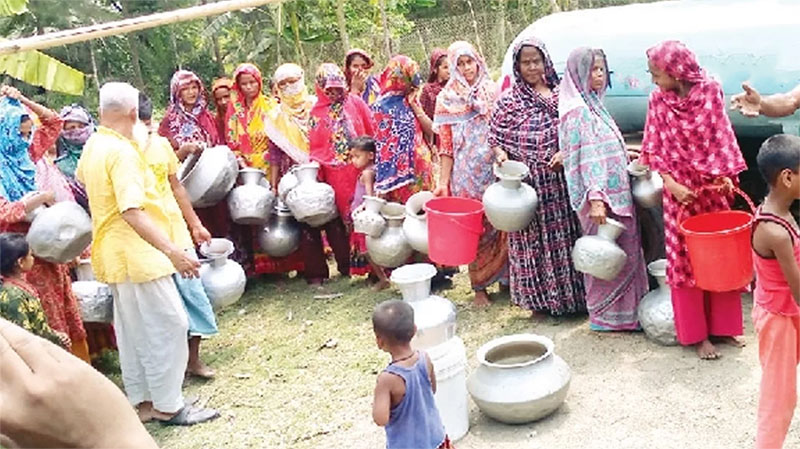
Residents of the char areas in Subarnachar Upazila, Noakhali, are facing an acute crisis of drinking water. Prolonged heatwaves, seven months of drought, and a drop in groundwater levels have rendered deep and shallow tube wells dry. People are forced to walk miles to fetch a single pitcher of water. The drying up of ponds, canals, and ditches has further exacerbated the water shortage for households and livestock.
Millions in the upazila are enduring severe hardships due to the lack of potable water. To address the crisis, the Department of Public Health Engineering has been delivering water daily to eight unions through mobile water carriers for the past two weeks. Additionally, a private organization, “Sagarika,” has joined the efforts, distributing drinking water for the past week.
Reports indicate that excessive use of groundwater for irrigation has intensified the crisis. During the dry season, farmers have shifted from cultivating rabi crops to boro paddy farming. Although the Bangladesh Agricultural Development Corporation (BADC) approved 245 deep tube wells for the upazila, farmers have installed over 3,000 unauthorized ones. Each pump extracts approximately 1,800 cubic feet of water per hour, causing groundwater levels to plummet.
According to the Upazila Agriculture Extension Department, 18,000 hectares of land have been planted with boro paddy this season, along with 2,750 hectares of rabi crops. Boro paddy consumes approximately 414,000 cubic feet of water per hectare, 80% of which is sourced from underground.
Upazila Agriculture Officer Md. Harun-Ur-Rashid stated that farmers are being encouraged to cultivate water-saving, profitable crops. A proposal has also been submitted to the government for measures to conserve natural water sources.
Md. Saiful Islam, Executive Engineer of the District Public Health Engineering Department, said that around 2,700 hand-pump and 300 submersible pumps, along with tube wells reaching depths of up to 900 feet, have been installed in the upazila. However, with water levels dropping by 40-50 feet, these tube wells are no longer functioning.
He further mentioned that 13,000 liters of pure water are being supplied daily, and this initiative will continue until the crisis subsides.

https://stapravda.ru/20221228/reyting_samyh_populyarnyh_hostingov_v_rossii_196445.html, рейтинг хостингов России подтверждает, что выбор надежного провайдера важен для бизнеса.