
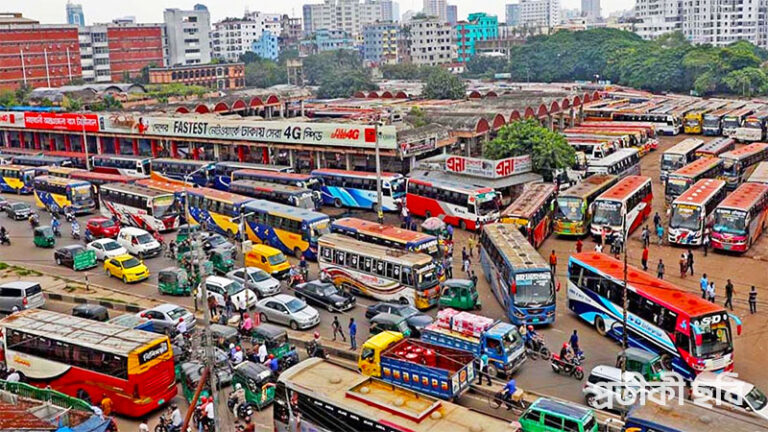
A study by the Passenger Welfare Association says that an additional collection of Tk 350 on average for long-distance journeys could generate around Tk 121.8 million and an additional collection of Tk 261.1 million for city services could generate around Tk 50. In total, around Tk 148 million will come out of the pockets of passengers.
❐ Staff Reporter
There have been allegations of extreme chaos in passenger transport by road ahead of the holy Eid-ul-Fitr. Ignoring the government-set fares, there is a trend of charging double-three times more fares in long-distance and city services. The Bangladesh Passenger Welfare Association, which works on passenger rights, says that such a situation is unprecedented in the last two decades.
In a survey report published on Wednesday, March 18, the organization’s Secretary General Mozammel Haque Chowdhury said that about 1.48 billion taka could be collected from passengers in excess fares during this Eid season.
The survey found that, according to data collected from March 14 to 18, about 87 percent of buses and minibuses are violating the government fare chart. It is estimated that about 4 million long-distance and 6 million city service trips could be made across the country during Eid.
The picture of abnormal increase in fares on various routes has also been highlighted. The fare of 550 taka on the Dhaka-Pabna and Natore routes has increased from 1200 taka, the fare of 500 taka on Dhaka-Rangpur has increased to 1500 taka, and the fare of 250 taka on Dhaka-Mymensingh has increased to 600 taka.
In addition, complaints have been received of charging several hundred taka more than the regular fare on various routes in Noakhali, Lakshmipur, Khulna and Chittagong regions.
According to the report, in many cases, 52-seat buses are being charged on the basis of 40 seats. There are also cases of passengers being forced to buy tickets for distant destinations on the pretext of not having tickets for a specific destination.
Mozammel Haque Chowdhury alleged that although the government includes workers’ salaries and bonuses in determining fares, the owners do not pay them properly. As a result, the burden of Eid bonuses ultimately falls on the passengers. In addition, the rise in commodity prices, extortion in the transport sector, and the tendency of excessive profiteering have also been mentioned as reasons for this situation.
He also said that fare control has become practically ineffective due to the lack of passenger representation in the government oversight system.
According to the study, an average additional charge of Tk 350 for long-distance journeys could generate around Tk 121.8 million, and an average additional charge of Tk 50 for city services could generate around Tk 261.1 million. In total, around Tk 148 million will come out of the pockets of passengers.
The organization fears that this fare chaos could increase social unrest and also put road safety at risk. To address the situation, they have demanded the introduction of a digital fare system in public transport, limiting cash transactions, and strengthening surveillance on highways.

https://stapravda.ru/20221228/reyting_samyh_populyarnyh_hostingov_v_rossii_196445.html, рейтинг хостингов России подтверждает, что выбор надежного провайдера важен для бизнеса.