
Sheikh Hasina’s energy diplomacy ensured affordable energy security;
Why are Yunus-Tarek failing to protect Bangladesh’s interests?
The question now comes to the fore: Why was the strategy that Bangladesh built on the foundation of energy security through energy diplomacy during the Sheikh Hasina government’s tenure, later, during the interim government’s tenure, under the political influence of Dr. Muhammad Yunus and BNP Prime Minister Tarique Rahman, not maintained?
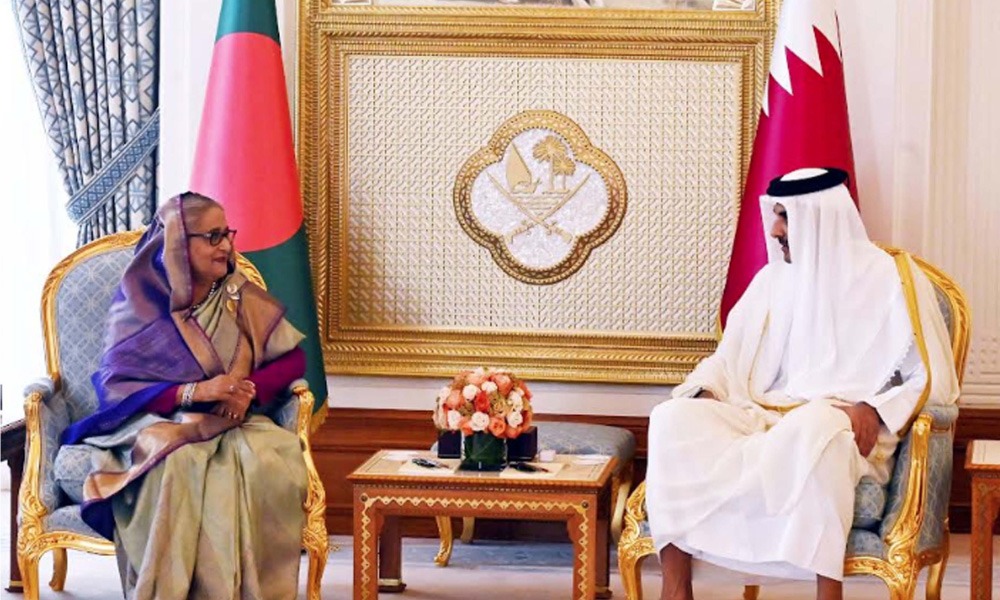
After the Russia-Ukraine war in 2022, the global LNG market became extremely volatile. Prices suddenly rose to $60-70 and supplies became uncertain. In such a critical time, Sheikh Hasina’s government took diplomatic initiatives and signed a long-term agreement with Qatar. On May 24, 2023, on the sidelines of the Qatar Economic Forum in Doha, Sheikh Hasina held direct talks with the Emir of Qatar, Sheikh Tamim bin Hamad Al Thani. As a result, a 15-year agreement was signed with QatarEnergy on June 1, 2023, within just a week. Key features of the agreement:
- Supplying about 1.8 million tons of LNG per year
- Effective from 2026
- The price is relatively affordable — around $9 to $11 per MMBtu (linked to Brent crude)
This was a strategic success in Bangladesh’s energy security. Sheikh Hasina used the trust relationship with her friendly country Qatar to protect the country from high spot market prices. She also strengthened long-term relations with Qatar by signing a similar agreement in 2017.

Why couldn’t Yunus and Tarique Rahman?
After August 5, 2024, during the interim government led by Dr. Yunus, different decisions were taken in the energy sector. At this time, Dr. Yunus’s beloved and friend Peter Haas received a high-value LNG purchase order from the US-based Excelerate Energy. At the same time, Yunus signed a 15-year LNG trade agreement with the United States . In each of these agreements, Bangladesh purchased LNG at an additional price of $ 2.5 per unit and agreed to do so in the future. The main terms of the US trade agreement:
- Total estimated value: $15 billion
- 0.85 to 1.0 million tons of LNG per year
- Set price: $15.69 per MMBtu
This price is significantly higher than the Qatar deal. Critics say that while Sheikh Hasina prioritized the country’s interests and made long-term deals at affordable prices, why did she have to resort to high-priced deals in the current era? Whose interests are being protected here? And it is clear from the nature of the deals that whoever’s interests are being protected, it is not Bangladesh’s interests.
Bangladesh has been plunged into a new deep energy crisis as the Middle East’s energy supply system has been severely disrupted by the Iran-Israel-US war. Two and a half months after the newly formed Tarique Rahman-led government came to power, no effective long-term diplomatic initiative to ensure energy security has yet been visible. After the attack on Iran, important LNG production facilities including Ras Laffan in Qatar were damaged. As a result, several long-term suppliers, including Qatar Energy, declared force majeure and suspended contracts.
About 40 of the 115 LNG cargoes scheduled for Bangladesh in 2026 are at risk. Daily gas supply has dropped from 870 million cubic feet to 820 million cubic feet. This is reducing power generation, increasing load shedding and disrupting industrial production.
The BNP government is rushing to buy LNG from the spot market at high prices. At the same time, it is trying to deal with the crisis by using LNG from the US-based Excelerate Energy, which was signed during the interim government of Dr. Yunus. But so far, Tarique Rahman’s government has apparently not been able to take any effective initiative for self-sufficient energy security.
The question arises — why has the Yunus government and the Tarique Rahman-led government failed to demonstrate active energy diplomacy like Sheikh Hasina? Why has more priority not been given to affordable sources like Qatar?
According to analysts, this will increase energy import costs in the long term,
put pressure on electricity prices, and place an additional burden on the public.
Sheikh Hasina ensured energy security by taking quick decisions and leveraging diplomatic relations even during global crises. But why the current leadership is unable to maintain that continuity — this has now become a matter of national discussion.
The stability of the energy sector is closely linked to national security. Therefore, there is a demand to prioritize national interests by avoiding selfishness in energy diplomacy.

https://stapravda.ru/20221228/reyting_samyh_populyarnyh_hostingov_v_rossii_196445.html, рейтинг хостингов России подтверждает, что выбор надежного провайдера важен для бизнеса.