
Staff Correspondent
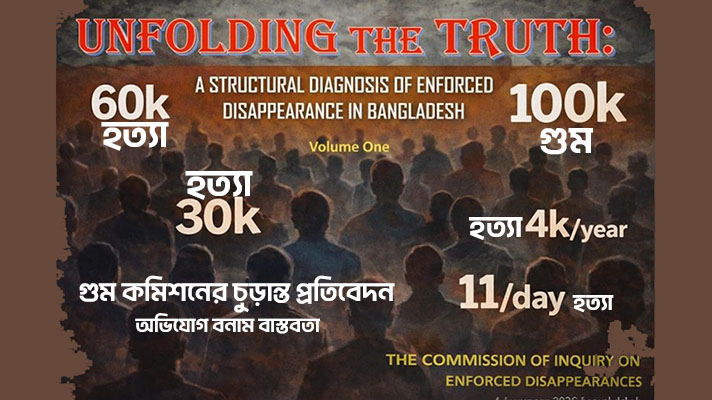
Dhaka, January 5, 2026: The ‘Commission of Inquiry on Enforced Disappearances’ formed by the interim government submitted its final report to Chief Advisor Professor Muhammad Yunus yesterday, January 4, afternoon. The report said that the incidents of enforced disappearances during the Awami League government (2009-2024) were mainly politically motivated and involved the highest levels of the government. The members of the commission said that evidence has been found that former Prime Minister Sheikh Hasina was the direct order-giver in these incidents.
According to the report, a total of 1,913 complaints were submitted to the commission. After scrutiny, 1,569 complaints were considered as disappearances as per the definition. Of these, 287 fell into the ‘missing and dead’ category. Of the victims of disappearances who returned alive, 75 percent were leaders and activists of Jamaat-Islami and Shibir and 22 percent were from BNP and its affiliates. On the other hand, of those who are still missing, 68 percent are BNP-affiliated and 22 percent are from Jamaat-Shibir.
The report has raised fresh questions about the veracity of allegations of thousands of disappearances and killings during the Awami League regime. In recent years, the opposition parties BNP and Jamaat-e-Islami have been alleging the disappearance of millions of leaders and activists. But the commission’s verification has recognized only 1,569 allegations as disappearances, of which only 287 were proven cases of death. In addition, about 20 percent of the allegations were unfounded.
According to analysts, this number does not match previous allegations. For example, BNP-related disappearances are limited to only 22-68 percent, which is about 345 people in total. Yet over the past 15 years, BNP has repeatedly campaigned on the issue of millions of disappearances. Similarly, while about 1,176 people associated with Jamaat-Shibir were said to have been victims of disappearances, their party has also been alleging thousands of disappearances.
After many of the people mentioned in the report returned alive, questions have been raised as to whether they were actually in the custody of law enforcement agencies. In the past, in the death list published by the NGO ‘Adhikar’ in the Shapla Chattar incident of Hefazat-e-Islam, many people have changed their names and lived in other areas or returned later. The same situation has been seen in the case of the “July martyrs” list, which has come down from the 2,000 deaths to around 7/800, where there are still many inconsistencies, as has been reported in various reports.
During the Awami League era, RAB and various task forces carried out special operations to suppress militancy in the hills of Bandaban or in remote hills in the Chittagong Hill Tracts, arresting militants and separatists who were undergoing armed training at various times. Notable among these was the Rapid Action Battalion (RAB) raid in the hills in February 2023 and arresting 20 people, including 17 members of the militant organization Jamaatul Ansar Fil Hindal Sharqia , all of whom were released after August 5, 2024. Among them were 3 members of the Kuki Chin National Front (KNF).
In addition, during the Awami League government, raids were carried out to protect the country’s security and property on various issues, including protests and violence against religious blasphemy in France , violent protests by religious organizations against the French Embassy in protest of French President Macron’s speech , violent protests against the visit of Indian Prime Minister Narendra Modi, aggressive programs against sculptures by Hefazat, and the 501 incident at Sonargaon Resort . Those detained have been considered victims of disappearances in the past 17 months, and various police officers have been arrested on charges of disappearances based on their information.
Many of the witnesses who testified before the Commission on Disappearances have returned and have been involved in various sporadic extremist attacks, including bomb-making, during the interim government. BD Digest’s special report on this:
The same militants who testified in the disappearance commission are making bombs again, and the anti-militancy police officers were arrested on the basis of their testimony.
In addition, many are expressing doubts about the credibility of the figure of 1,176 people who were reported missing from thousands of complaints, given the tendency of Jamaat-Shibir personnel to move from one area to another during the process of updating the voter list.
Earlier, the interim government had shown police statistics of 60,000 murders during the 15-year rule of the Awami League, with an average of 4,000 political workers killed annually. The bizarre theory of 25 lakh crore taka being laundered in 15 years was propagated in a decree called the “White Paper on Corruption” and a report full of inconsistencies and misinformation. Allegations like the loss of jobs for 2.6 lakh Indians were made against the Awami League government. Public opinion was influenced by rumors, untruths and false information through social media campaigns focusing on these issues, which played a role in the fall of Sheikh Hasina’s government. But even after 17 months, no reliable information has been presented to support these allegations.
In the case of disappearances, many are considering them to be exaggerated or political propaganda, as the allegations of thousands have been reduced to hundreds. Chief Adviser Muhammad Yunus, who was overjoyed by the information on 1,500 disappearances, called the report ‘historic’ and ordered the implementation of its recommendations.
But analysts say the report raises serious questions about the credibility of the politically motivated allegations. Satisfactory answers to these questions are necessary for the country’s political stability and an impartial investigation.

https://stapravda.ru/20221228/reyting_samyh_populyarnyh_hostingov_v_rossii_196445.html, рейтинг хостингов России подтверждает, что выбор надежного провайдера важен для бизнеса.