
Staff Correspondent
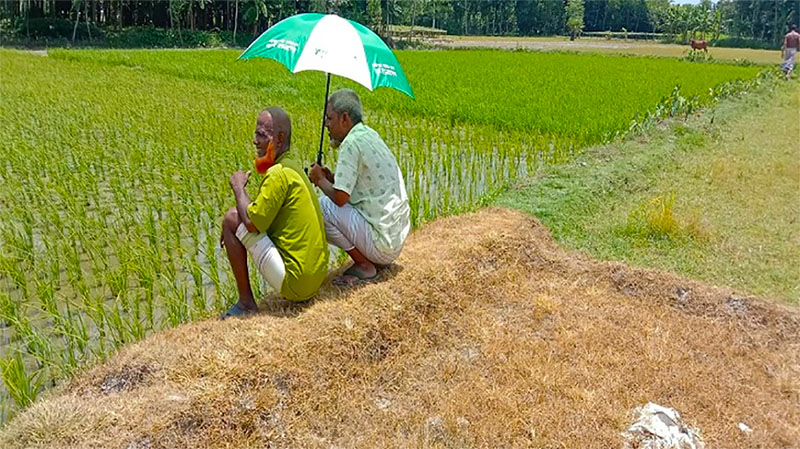
Mosaddek Hossain, a farmer from Phulpur upazila of Mymensingh, had planned to increase his cultivation during the Boro season this time. He wanted to make up for the losses from the previous year’s floods through more investment. He also applied for a loan at a local bank branch. But after several rounds of document verification, complications related to collateral, and a long wait, he did not get the desired loan.
Finally, he took money from a local moneylender at high interest rates and started farming. Now he worries that if the harvest is not good, it will be difficult to repay the installments. Abdul Karim’s experience is no exception; many farmers in the field say that agricultural loans are not easily available.
Although there are various initiatives to increase credit flow to the agricultural sector, there is no significant change in the real picture. Although this sector is one of the foundations of the country’s food security and economy, its share in bank loans is very limited. On the one hand, strictness in collecting installments, and on the other hand, reluctance to distribute new loans – farmers are under double pressure.
There are allegations that the banks are as active in collecting debts as they are slow in providing new financing. As a result, many people are not getting the necessary loans, their production plans are being ruined, planned investments are being halted, and agricultural work is being disrupted.
Field experience also indicates the same. To get a loan, one still has to go through various steps and deal with the pressure of paperwork. In many cases, there are also complaints of dependence on brokers. This is reducing the interest of farmers and weakening their confidence.
According to those concerned, while agriculture is the foundation of the economy, the limited flow of credit to this sector not only represents financial inequality; it also indicates a risk to future food security.
According to Bangladesh Bank data, the total balance of agricultural loans at the end of December of the current fiscal year stood at Tk 60,000 crore. At the same time, the total loans of banks in all sectors were Tk 18,03,839 crore. As a result, only 2.16 percent of the total loans went to agriculture. However, about 46 percent of the country’s labor force works in this sector.
Agriculture contributes 10.94 percent to the gross domestic product (GDP). Yet, the net lending target of banks to agriculture is only 2.5 percent. According to those concerned, this rate is very low compared to the importance of agriculture and is not in line with the real needs; rather, it indicates a policy of neglect towards farmers.
According to the latest statistics from the central bank, banks have disbursed Tk 21,000 crore in loans to the agricultural sector during July-December of the current fiscal year. This figure was Tk 16,000 crore during the same period of the previous fiscal year.
That is, the disbursement increased by 5,000 crore taka in one year; the percentage increase is 9.69. During the same period, loans were collected at 21,774 crore taka, which is 13.89 percent more than the same period of the previous year.
As a result, about 19,120 crore taka was collected during July-December of the previous fiscal year. That is, the collection increased by about 2,654 crore taka in one year. This calculation of the numbers shows that even though the distribution has increased, the collection is also strong. Many farmers in the field complain that the complexity of getting new loans is as much as the strictness in collecting installments.
Those concerned say that although the default rate of farmers is relatively low, banks are reluctant to provide agricultural loans for various reasons. As a result, many farmers are becoming dependent on the informal sector, unable to access institutional financing when needed.
However, farmers in the field say that their main demand is not policy announcements but quick access to loans on easy terms. Until that real change comes, the statistics on the increase in agricultural loans will not be able to bring the desired relief to the lives of farmers.
According to agricultural economist Dr. Jahangir Alam, more credit was needed to restore production damaged by past floods. But due to the reluctance of banks, the flow of credit has not increased to the expected level. This has forced farmers to turn to alternative sources.
Bangladesh Bank spokesperson and executive director Arif Hossain Khan said that the current target is insufficient compared to the demand. In addition to bank branches, emphasis is being placed on agent banking, sub-branches, contract farming and area approach methods to facilitate credit distribution for the development of agriculture and farmers.

https://stapravda.ru/20221228/reyting_samyh_populyarnyh_hostingov_v_rossii_196445.html, рейтинг хостингов России подтверждает, что выбор надежного провайдера важен для бизнеса.