
❐ Staff Reporter
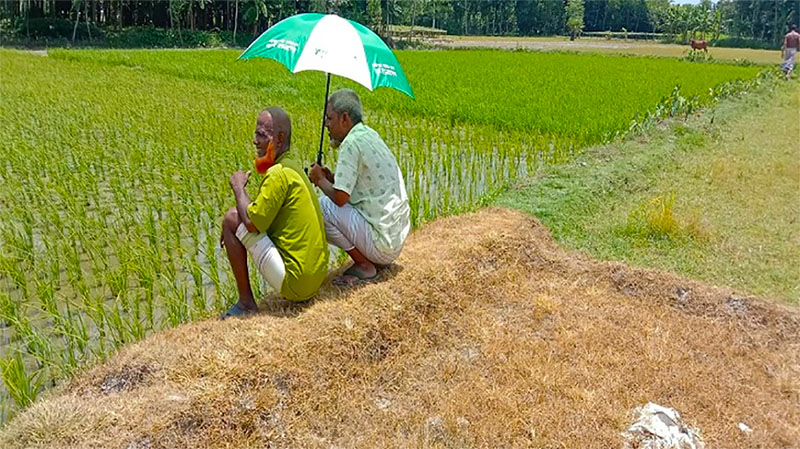
The country’s biggest rice production season, Iri-Boro, is now in full swing. Although the government says there is adequate stock of fertilizer and fuel, a different picture is being seen on the ground. There have been allegations of disruption of irrigation due to artificial shortage of fertilizer, sale at high prices and shortage of diesel in different parts of the country. This has left farmers worried about production.
It has been found that fertilizer is not available at the fixed price in several districts, including the northern region. Although dealers claim that there is ‘no supply’ in many cases, it is being sold at higher prices in the retail market. This forces farmers to buy fertilizer at higher prices.
A farmer from Naogaon Sadar Upazila said that due to the diesel shortage for the past few days, water has not been supplied to the fields on time. Even though a little oil is available occasionally, it is insufficient compared to the requirement.
The situation has been somewhat manageable due to some recent rainfall, but there is a risk of damage if the weather becomes adverse.
A pump driver from the same area said that the supply of oil at local filling stations is limited. Despite waiting for a long time, the required diesel is not available. As a result, it has become difficult to maintain regular irrigation activities.
Farmers have complained that there has been an abnormality in the fertilizer market. In various areas, urea, TSP, DAP and MOP fertilizers are being sold at prices higher than the fixed prices. In some places, they are being charged Tk 3 to Tk 10 more per kg.
Some farmers have said that they are having to buy fertilizer at an additional cost of Tk 150 to Tk 200 per bag.
According to government estimates, there is currently a significant amount of fertilizer in the country. Officials concerned say there will be no shortage of fertilizer in the current Boro season. However, in case of long-term supply disruption, initiatives are being taken to import from alternative sources and reopen closed factories.
Those involved in the agricultural sector say that a large part of the country’s fertilizer is dependent on imports. A significant amount of fertilizer is imported, especially from Middle Eastern countries. At the same time, since domestic production is also dependent on gas, the instability of the international energy market is having a direct impact.
The ongoing war situation has created uncertainty in the supply and transportation system, which is starting to affect the market.
Similar pressures are being seen in the irrigation sector. Boro cultivation in the country is largely irrigated, a large part of which is diesel-powered. Currently, long lines are seen at filling stations for fuel oil. In many cases, diesel is not being sold beyond a certain amount.
In this situation, there are also complaints of diesel being sold at higher prices at the retail level. This is increasing irrigation costs. Farmers say that the increase in the price of diesel by a few taka per liter is increasing the cost by several hundred taka per hectare.
However, government officials say there is no fuel crisis in the country and no situation has arisen that would cause irrigation activities to be stopped anywhere. According to them, this situation is arising due to increased demand among farmers due to fears of a future crisis.
According to agricultural economists, the real situation needs to be considered more carefully. More than 60 percent of the country’s boro cultivation is dependent on diesel for irrigation. As a result, even a minor disruption in fuel supply can have a major impact on production.
They say that while it is possible to handle the current season with current stocks, the crisis could be more severe in the next Aman season if the supply system is not normal.
This year, the target for Boro cultivation has been set at more than 5 million hectares of land. Those concerned believe that ensuring the supply of fertilizer and fuel is essential to ensure smooth cultivation of this huge crop.
In the words of the farmers, “Even if everything looks good on paper, if fertilizer and oil are not available in the field, then there is no point in having those stocks.”
The current situation is therefore not only a challenge to the supply system, but also becoming an important test for the country’s food security.

https://stapravda.ru/20221228/reyting_samyh_populyarnyh_hostingov_v_rossii_196445.html, рейтинг хостингов России подтверждает, что выбор надежного провайдера важен для бизнеса.