
Allegations of violation of the constitution and criminal law, silent government and law enforcement agencies
 ❐ Staff Reporter
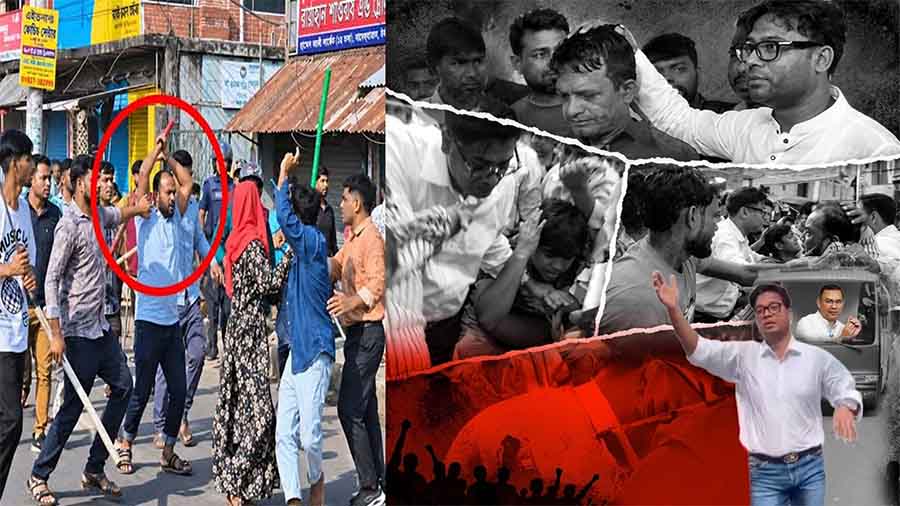
From government officials to lawyers, businessmen, and ordinary people, the leaders and activists of BNP and its affiliates are detaining one person after another on charges of political affiliation and affiliation and handing them over to the police. In some cases, houses are surrounded and searched, in others, they are stopped on the streets for questioning, and in others, they are publicly beaten and humiliated. In these cases, a kind of mass detention is taking place before the truth of the allegations is verified or legal proceedings are followed. Such activities by political leaders and activists outside the presence of law enforcement agencies have raised new questions about the security of citizens and the rule of law.
Last Wednesday night, Chhatra Dal leaders and activists detained former Prime Minister Sheikh Hasina’s deputy press secretary KM Shakhawat Moon, former Chittagong Deputy Commissioner (DC) Mohammad Ilias Hossain and income tax lawyer Sufi Md. Al Mamun in the capital’s Dhanmondi area and handed them over to the police. They were also beaten after being detained at around 1 am on November 26. A video circulating on social media showed Shakhawat Moon being interrogated, slapped and forced to hold his ears. Former DC Ilias Hossain was also seen being beaten after being taken into a police car.
Chhatra Dal leaders and activists claim that they arrested the three after receiving information about the December-centered sabotage plan of the banned Awami League leaders. However, it is the responsibility of the police to verify the truth of the allegations against them and take legal action. Mohammadpur Police Station Officer-in-Charge (OC) Abdul Halim told the media that when Chhatra Dal leaders and activists detained them and informed the police, the police brought them to the police station from the scene. What kind of legal action can be taken against them is being verified. That is, the judicial truth of the allegations was not established at the time of the arrest.
Earlier, Dhaka Metropolitan South Jubo Dal member secretary Rabiul Islam Nayan carried out similar activities in the capital. On Tuesday night, he and his followers detained Javed Didar, general secretary of Ward 26 of Lalbagh Police Station, from Paltan area. Later, they fed him boiled eggs, water and coffee and handed him over to the police. Nayan published the video of the incident on his Facebook account. He claimed that Javed Didar was planning sabotage around the return of former Prime Minister Sheikh Hasina to the country. However, it is the responsibility of the police to verify the truth of the allegations.
Then on Wednesday afternoon, Nayan and his followers surrounded a house on Road No. 41 in the capital’s Gulshan and arrested 20 people suspected of being Awami League leaders and activists and handed them over to the police. They searched various rooms of the house and brought the people out. The video also shows the scene of climbing the wall of the house and entering. Nayan handed over the passports, mobile phones and wallets of the detainees to the police. Gulshan Police Station OC Abu Zayed Mohammad Najmun Noor told the media that the leaders and activists of the Jubo Dal arrested them and informed the police. The police went and brought them to the police station. It is being verified whether there is any case against them.
In the same vein, Nayan also arrested a person named Rahmatullah Shanto, who was identified as a ward-level leader of the Jubo League, and handed him over to the police. A video of him feeding him cheese and persimmons was released before he was handed over to the police. In these incidents, the videos published by Nayan on his own social media have become visible evidence of the tendency to arrest political leaders and activists.
Contradictory to the fundamental rights of the Constitution
These incidents of arresting, beating or publicly insulting someone on the grounds of political identity or affiliation with a party may conflict with the fundamental rights of the Constitution. Article 27 of the Constitution guarantees the equality of all citizens before the law and the right to equal protection of the law. Article 31 states that every citizen has the inalienable right to be treated according to the law. The same article clarifies that no person shall be deprived of his life, liberty, body, reputation or property except in accordance with the law.
Article 32 of the Constitution guarantees that no person shall be deprived of life and personal liberty except in accordance with law. Article 33 guarantees the right to be informed of the reasons for arrest and to be given the opportunity to consult with a lawyer and defend oneself. On the other hand, Article 35, sub-section 3, guarantees the right to trial by an independent and impartial tribunal, and Article 4 guarantees that no one shall be compelled to testify against himself. Sub-section 5 of the same Article prohibits torture and cruel, inhuman or degrading treatment.
Therefore, surrounding someone for interrogation, beating, forcing them to cover their ears, or pressuring them to confess to a crime raises serious questions about their constitutional rights. In particular, the behavior seen in the video of the beating of Shakhawat Moon and Ilyas Hossain could be considered to be in conflict with Article 35(5) of the Constitution.
Not only personal freedom, but the incident of entering and searching the house in Gulshan is also related to Article 43 of the Constitution. This article guarantees the right of citizens to be protected from unlawful entry, search and seizure in their homes. Without legal authority or process, leaders and activists of any political organization have no right to enter and search the homes of political leaders and activists.
The power of citizen detention is also limited in the Criminal Procedure Code.
Section 59 of the Criminal Procedure Code of Bangladesh, 1898, specifies the power of arrest of a general person. According to this section, a person may be arrested if he has committed a non-bailable and cognizable offence before him or if he is a declared offender. However, he must be handed over to a police officer or the nearest police station without undue delay.
That is, this section does not give a general power to detain someone based on suspicion of affiliation with a political party, past political role, or future subversion. The legality of such detention may be questioned if the direct circumstances of the commission of a crime or the legal conditions of being a declared criminal are not met.
In addition, sections 339 and 340 of the Penal Code, 1860, define unlawful restraint and unlawful detention as offences respectively. Sections 341 and 342 provide for the punishment of unlawful restraint and detention. These sections may be applicable to cases of detaining someone against their will, preventing their movement or detaining them for questioning, depending on the circumstances.
Section 350 of the Penal Code defines criminal force and section 351 defines assault. Section 352 provides for the punishment of such assault or criminal force. Section 355 may also apply if the assault or force is done with the intention of insulting someone. Sections 503 and 506 may also be considered in cases of intimidating or threatening a person.
Therefore, incidents of beating after arrest, forcing someone to hold their ears, publicly humiliating them, and unauthorized entry into a home require separate investigation. However, which section will apply to which incident will depend on the specific facts, evidence, and investigation.
Even the top levels of BNP have acknowledged the problem.
Concerns have also been raised at the party’s central level about such activities by BNP leaders and activists. A report in The Daily Star published on November 17 said that allegations have been made at the top levels of the party that some BNP leaders and activists are themselves detaining and beating people on suspicion of being Awami League-related. The party has also received allegations against leaders and activists in eight districts of sheltering Awami League-related people and trying to free arrested people.
The report quotes senior BNP leaders as saying that taking the law into their own hands by detaining and beating suspects is illegal and could tarnish the party’s image. Leaders and activists have been instructed to refrain from such activities and report suspicious activities to law enforcement agencies. It has even been suggested that the police be given a chance to perform their duties instead of holding anti-Awami League counter-programs or guarding neighborhoods.
Despite such instructions from the party’s central level, one after another arrests are taking place in the capital. This also raises questions about the implementation of party instructions and the effectiveness of taking organizational action against the relevant leaders.
IGP urges people not to take law into their own hands
Inspector General of Police (IGP) Md. Ali Hossain Fakir had earlier warned against taking the law into one’s own hands. At a program in Dhaka’s Chawkbazar on October 26, he said that law enforcement agencies will work according to the law and the constitution. At the same program, he urged the general public not to take the law into their own hands. He said that there is no alternative to the police in establishing peace and order.
But despite the IGP’s call, incidents of arrests by leaders and activists of the ruling party’s affiliate organizations are happening one after another. Questions are also being raised about the role of the police in these incidents. Does their responsibility end when leaders and activists of a political organization hand someone over to the police after arresting them? If there is any incident of beating, insulting, or illegal search during the arrest, the police are also responsible for investigating and determining responsibility.
Mob risk increases due to government silence
The current situation is presenting the opposite picture of the public desire that was created during the Awami League government’s tenure against the abuse of power, suppression of the opposition, and partisan use of law enforcement agencies. After the change of power, one of the main responsibilities of the new government was to ensure the security of citizens and equal application of the law. But such a series of incidents of arrests by the ruling party’s leaders and activists raises questions about its ability to fulfill that responsibility.
There has been no visible and concrete accountability initiative from the government in such incidents. The police also mainly talk about taking people to the police station after detention and checking whether there are any cases against them. But a clear statement is needed on what action is being taken against them before and after detention regarding allegations of torture, humiliation and unauthorized entry into private spaces.
It is the responsibility of political party leaders and activists to provide information to the police, cooperate in the investigation, and bring criminals to justice through legal processes if there are allegations of crime. But they do not have the power to detain, interrogate, or punish anyone. If an opportunity is created to publicly harass someone based on their political identity, considering them a criminal, it not only violates the fundamental rights of the individual, but also questions the authority of the state to enforce the law.

https://stapravda.ru/20221228/reyting_samyh_populyarnyh_hostingov_v_rossii_196445.html, рейтинг хостингов России подтверждает, что выбор надежного провайдера важен для бизнеса.