
❐ Special Correspondent
The ongoing tension and war situation in the Middle East has begun to affect the global energy market. Due to the military conflict between Iran and Israel and the United States, there is a fear that the price of fuel oil in the global market will increase rapidly and get out of control.
Experts say that this conflict is no longer limited to military or regional limits; it is directly affecting the global economy and the cost of living of ordinary people, because the Strait of Hormuz, the most important oil transportation route in the Middle East, has been almost paralyzed due to the war situation.
A new price record was seen in the international energy market yesterday. After a long three and a half years, the price of crude oil has exceeded $100 per barrel. The Associated Press (AP) reported this information.
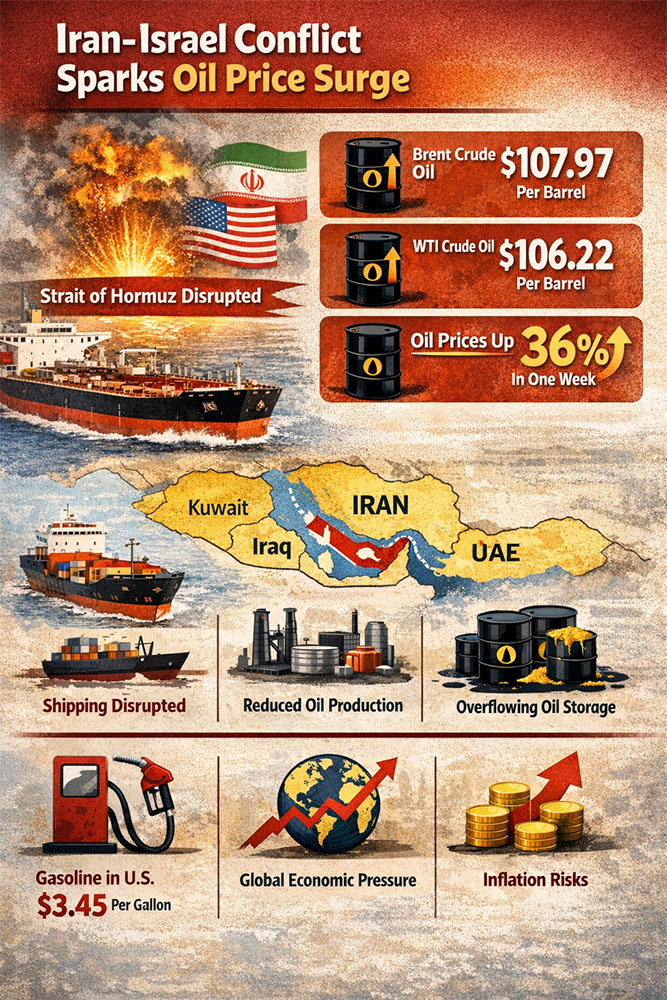
In the international market, the price of Brent crude oil jumped by about 16.5 percent to $107.97 per barrel. Similarly, the price of West Texas Intermediate (WTI) oil in the US market stood at $106.22. It is reported that oil prices in the global market have increased by about 36 percent in the last one week.
Research firm Rystad Energy says that about 20 percent of the world’s oil supply passes through the Strait of Hormuz. But the ongoing war has severely disrupted shipping through the route. Many ships are avoiding the route for fear of attack.
This has also complicated the situation for several oil-exporting countries in the Middle East. Oil storage tanks in Kuwait, Iraq and the United Arab Emirates are almost full due to reduced exports. At the same time, some countries have also reduced production due to security risks.
On the other hand, there are also reports of damage to oil and gas infrastructure in retaliatory attacks by Iran and Israel, which has created new uncertainty about supply in the global market.
The impact of this increase in oil prices is starting to be felt directly by the common man. In the United States, the price of gasoline has increased by about 47 cents per gallon in the past week, reaching $3.45. At the same time, the price of diesel has increased by 83 cents, which could increase transportation costs.
Economists warn that if oil prices remain above $100 for a long time, it could put major pressure on the global economy. This would make it difficult to control inflation and could lead to economic crises in many countries.
Meanwhile, Iranian officials said at least four people were killed in an Israeli attack on an oil depot and petroleum transfer terminal in Tehran early Sunday. The Israeli military claims that the facilities were being used to fuel the Iranian military’s missile systems.
Iranian Parliament Speaker Mohammad Bagher Ghalibaf warned that if the impact of the war spreads to the oil industry, the global energy crisis could worsen. In particular, if China does not receive oil supplies from Iran, it will turn to alternative markets – which will put further pressure on prices in the international market.
Iran currently exports about 1.6 million barrels of oil per day, most of which goes to China. There are fears that disruptions to these supplies could create a new imbalance in global demand and supply.
However, US Energy Secretary Chris Wright expressed optimism that oil prices could stabilize again within weeks if the situation normalizes, although there remains uncertainty about how quickly the current war situation will calm down.
Meanwhile, the price of natural gas has also increased slightly due to the impact of the war. On Sunday, the price of gas per 1,000 cubic feet in the international market was about $3.33, which is about 4.6 percent higher than Friday’s $3.19.

https://stapravda.ru/20221228/reyting_samyh_populyarnyh_hostingov_v_rossii_196445.html, рейтинг хостингов России подтверждает, что выбор надежного провайдера важен для бизнеса.