
.. Gangaridi – Story or truth?..
– Hasan Murshed
When Alexander wanted to advance eastward after conquering Punjab, his invincible army did not dare to advance further after hearing the stories of the bravery of a powerful nation or kingdom called ‘Gangaridai’ or ‘Gangaridai’. A long-standing boast of Bengalis interested in history is that Gangaridai is the ancestor or birthplace of Bengalis. Is this boast consistent with historical and archaeological research?
In 326 BC, Alexander led his army to the banks of the Jhelum or Hydaspis (Hydaspis in Greek) river in Punjab and defeated King Porus there. King Porus was an Aryan Kshatriya of the lunar dynasty. After defeating Porus, Alexander wanted to advance further east, but his army mutinied at the banks of the Hyphasis river. In fact, the accounts of the historians Diodorus, Plutarch and Megasthenes state that:
On the other side of the Ganges was a large force called the ‘Gangaridai’ and the ‘Prasii’ (Nanda dynasty of Magadha), who had 4 to 6 thousand well-trained war elephants. Where the Greek army had struggled to break the siege of King Puru’s army of only 200 elephants, the campaign of several thousand elephants created terror in their minds. The long journey, the fatigue of the battle and the news of this unknown and invincible force discouraged them.
We have learned earlier that a unified Bengal was not yet formed; Bengal, Radha, Pundra, and Gaur were separate territories. So why would Alexander turn back from Punjab out of fear of a power so far away?
Originally, a strong strategic alliance developed between the Nanda kings of Magadha and the lower kingdoms of the Ganges basin in northern India. Although northern India was dominated by Aryans, Magadha was the final destination of Aryanization, while the Bengali districts beyond it were non-Aryan or Mlechcha. The Nanda dynasty was also not of the upper caste; in the Puranas and Jain texts, the Parishishtaparvan, they are described as ‘barbers’ or Shudra children and are viewed in a very derogatory manner. Perhaps it was because of this Bratya or non-Aryan identity that the Nandas developed a close military alliance with the non-Aryan rulers of the Gangetic districts.
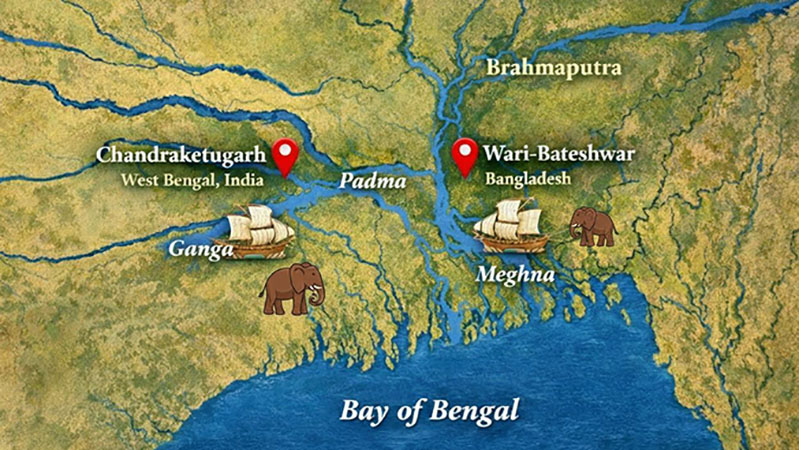
The evidence that the bravery of Bengal at that time was not just a story is found in the archaeological remains of Wari-Bateshwar and Chandraketugarh. Wari-Bateshwar, built 2500 years ago on the ancient course of the Brahmaputra in the Bengali region, was a well-planned fort-city. The thousands of ‘stamped silver coins’ and brick roads found here prove that it was the administrative center of a vast commercial empire. On the other hand, Chandraketugarh, the gateway to the border of Radha and Bengal, was a world-famous port, where coins from the time of the Roman Emperor Tiberius have been found.
The thousands of elephants described by the Greeks were not a fantasy, because the deep forests of the Bengal and Brahmaputra basins were a natural storehouse of elephants. These elephants were sent by boat to the western borders via the Ganges. The images of war equipment and seagoing boats carved on the terracotta tablets of Chandraketugarh prove that they were very skilled on both water and land. Therefore, the wealth of powerful towns and ports like Wari-Bateswar and Chandraketugarh on the other side of the Ganges was the basis of that great ‘Gangaridi’ power.
The question is – the names of Alexander, King Puru, and the Nanda kings of Magadha are found. Why don’t we find any information about the people of that land, Gangaridi or later Bengal, which includes Bengal, Radha, etc.?
Source:
1. India – Megasthenes (translation and explanation).
2. History of the United Bengal – Nihar Ranjan Roy (History of the Bengalis: Early Period).
3. Wari-Bateshwar: In Search of Roots – Sufi Mostafizur Rahman.
4. The Classical Accounts of India – RC Majumdar (Dr. Ramesh Chandra Majumdar).
5. The Rise of Civilization in India and Pakistan – Bridget and Raymond Allchin.
Visited 169 times, 1 visit(s) today

https://stapravda.ru/20221228/reyting_samyh_populyarnyh_hostingov_v_rossii_196445.html, рейтинг хостингов России подтверждает, что выбор надежного провайдера важен для бизнеса.