
❐ Special Correspondent
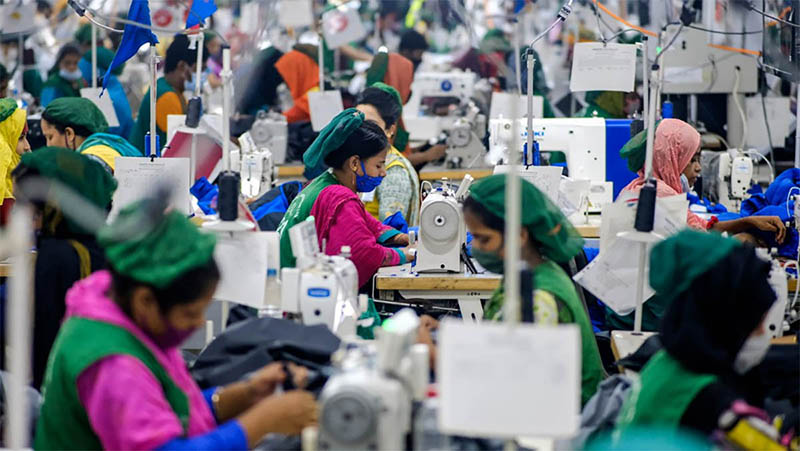
Bangladesh’s ready-made garment exports continue to decline. According to the Export Promotion Bureau (EPB), exports in this sector have been declining for more than eight consecutive months.
Nine of the top 10 exporting countries saw negative trends—the United States, Germany, the United Kingdom, France, Italy, Canada, Japan, the Netherlands, and Denmark all saw exports decline; the only exception was Spain, where exports increased by about 2 percent.
The total export revenue of the ready-made garment sector in the 9 months from July to March of the 2025-26 fiscal year stood at $28.58 billion, compared to $30.24 billion in the same period of the previous fiscal year.
That is, overall exports decreased by 5.51 percent. Of this, the export revenue of the knitwear sector was $15.11 billion, which is 6.42 percent less; on the other hand, the export revenue of the oven sector stood at $13.47 billion, which is 4.48 percent less.
Country-wise figures show that exports to the United States fell from $5.73 billion to $5.59 billion, a decrease of 2.54 percent. Exports to the United Kingdom fell from $3.35 billion to $3.30 billion, a decrease of 1.61 percent.
Exports to Germany, one of the largest markets in the European Union, fell from $3.80 billion to $3.26 billion, a 14 percent decline.
In addition, exports to France fell from $1.64 billion to $1.44 billion (a decrease of 12.26 percent). Exports to Italy fell by 10.61 percent; the Netherlands by 0.85 percent; Canada by 0.26 percent; Japan by 7.11 percent and Denmark by 13.72 percent.
Traders say that Bangladesh is lagging behind in the international market due to rising production costs, gas and electricity shortages, and long lead times in product supply. At the same time, the global situation is also having a negative impact on the export sector.
According to Mohammad Hatem, president of the Bangladesh Knitwear Manufacturers and Exporters Association, instability in the Strait of Hormuz has led to a surge in fuel prices in the international market and a supply crisis. This has resulted in a shortage of diesel in the country, which is disrupting factory production and affecting exports.
He added that this negative trend began after the Donald Trump administration imposed retaliatory tariffs. As a result, US and European Union buyers reduced their purchase orders as import costs increased. Later, the war situation in the Middle East further complicated the global supply chain. Overall, the purchase order situation is not showing much improvement at present.

https://stapravda.ru/20221228/reyting_samyh_populyarnyh_hostingov_v_rossii_196445.html, рейтинг хостингов России подтверждает, что выбор надежного провайдера важен для бизнеса.