
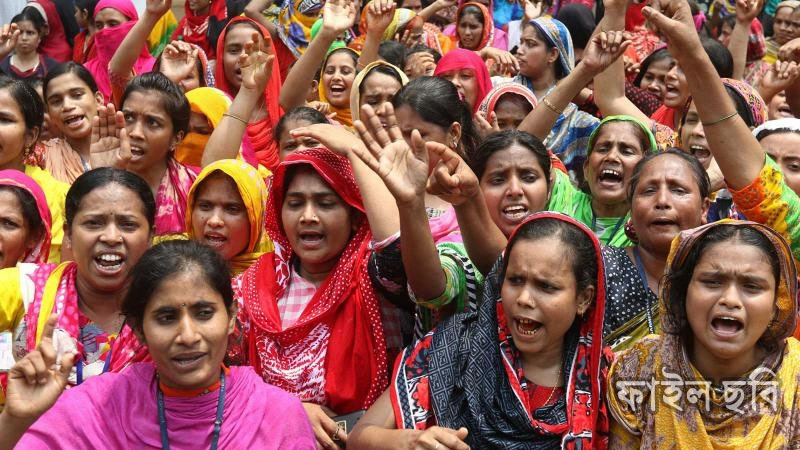
Despite two assurances, uncertainty over wage implementation, allegations of force being used to suppress the movement; Anger growing among unemployed workers as hundreds of factories close

Gazipur Correspondent. Gazipur, November 17, 2026.
Discontent among garment workers with the government is growing over the government’s delay in setting the minimum wage and its failure to implement its demands despite repeated assurances. The workers see the postponement of the third meeting of the latest wage board as another waste of time by the government. Although the workers were earlier returned to work with various assurances in the face of the movement, there has been no visible progress in increasing wages in reality, which has created distrust among them.
On the one hand, the police and BGB have been accused of using force against workers protesting for a wage increase, and on the other hand, the financial crisis of workers who have been unemployed as hundreds of garment factories have closed due to worker dissatisfaction – all of this is making the situation in the industrial area more complicated. Anger towards the government is also growing among a section of those who have lost their jobs or are not receiving regular wages due to the factories being closed for a long time.
Wage Board meeting postponed, workers see it as a time-wasting tactic
The third meeting of the wage board formed to determine the new minimum wage for garment workers was scheduled to be held on November 16. At that meeting, the employer’s representative was supposed to submit a proposal for the new wage structure. But the meeting was postponed at the last minute.
Although the board cited unavoidable reasons, it was later learned that the meeting was postponed due to the board’s permanent workers’ representative Anwar Hossain falling ill and being admitted to the hospital. BGMEA and BKMEA also expressed disappointment over the postponement of the meeting in a joint statement and demanded an immediate announcement of a new date.
However, the question from the worker representatives was whether it was possible to accept the wage offer prepared by the employer or to proceed with the process in another way even if a member was sick.
Babul Akhter, a worker representative of the wage board, has demanded that the meeting be held quickly. On the other hand, leaders of labor organizations believe that the decision to postpone the meeting amid the ongoing agitation and unrest has sent the wrong message to the workers.
In the face of protests from labor organizations, the new date of the Wage Board meeting has been announced for Tuesday (November 17). The meeting will be held at 11:30 am on November 23 at the Wage Board office in Segunbagicha, Dhaka. The proposal from the employers is expected to be presented there.
But the question has also arisen as to whether the doubts and mistrust that have already arisen among the workers will be dispelled simply by announcing a new date.
Distrust is growing as demands are not implemented despite two rounds of assurances
The workers allege that when the movement started earlier demanding a wage increase, the government and the concerned parties gave various assurances. After the promise of forming a wage board and determining a new salary structure, the workers were called to return to work. But despite the complaints and assurances, a section of the workers were forced to stop the movement and return to work through pressure and force from the law enforcement agencies.
They say that when the movement intensifies, promises of talks are made; when the situation normalizes, the implementation of those talks and promises is postponed again. They fear a repeat of the previous experience as the wage board meeting has been postponed again.
The workers claim that if the assurances given in exchange for ending the agitation and returning to work are not implemented, it will be difficult to trust any future promises of the government.
Hundreds of factories are closed, laboring families are in crisis of jobs and livelihood
Anger towards the government is building not only among working workers, but also among workers who have been left unemployed due to factory closures.
Since the beginning of November, hundreds of garment factories in Savar, Ashulia and Gazipur have been closed for several periods, with production suspended and production suspended indefinitely.
On November 2, about 400 factories were declared closed. Information was published that production was closed in 146 to 204 factories at different times between November 10 and 12. On November 14, there were reports of production being closed in 147 factories in Savar and Ashulia. The latest information was published on November 17 that 67 new factories were closed in Gazipur, Savar and Ashulia.
These numbers are based on individual days; since the same factory has multiple days of data, they cannot be added together to determine the total number of closed factories.
Due to the closure of factories, a large number of workers are being deprived of regular work and income. Especially, the situation of workers not receiving wages if the factory is closed under Section 13(1) of the Labor Act is further exacerbating their financial crisis.
For workers whose sole breadwinners work in garment factories, losing income for a few days or weeks means struggling to pay rent, food, medical care, and their children’s education.
In this situation, a question has arisen among a section of workers: who will take responsibility if the factory closes and workers become unemployed without resolving the wage dispute?
Demand for 30 thousand taka to offer 32 thousand taka
Currently, the minimum monthly wage for garment workers is Tk 12,500. This wage, announced in November 2023, came into effect from December of the same year.
Labor organizations have long been demanding a minimum wage of Tk 30,000, citing rising commodity prices, housing rent, medical care, and living costs.
In the second meeting of the latest wage board, the workers’ representatives proposed a minimum wage of Tk 32,000 for grade 4 workers. The proposal also includes higher wages for other grades of workers. On the other hand, the employers have not yet presented their full proposal to the board.
The government formed a six-member wage board on November 1 to determine the new wage. The board’s first meeting discussed the implementation of the new wage structure from December. But the failure to submit proposals from the employers on time and the postponement of the third meeting have created uncertainty about the process.
Will workers’ anger create a bigger crisis?
The garment industry is a major export earner for Bangladesh and a source of employment for about 4 million workers. The production of this industry and the livelihood of its workers are deeply intertwined.
But the protracted wage dispute, allegations of forceful use of force by law enforcement to suppress protests, factory closures, and workers becoming unemployed are creating a crisis of trust in the government in industrial areas.
The owners are urging workers to return to work quickly in order to keep production and export activities running. On the other hand, the workers say that it is not possible to establish long-term stability by simply pressuring them to return to work without ensuring fair wages.
The anger that has arisen among workers is not just a reaction to the postponement of a wage board meeting; rather, it is a combined reflection of long-standing demands, repeated assurances, the experience of the movement, and the fear of losing their livelihoods.
The future situation largely depends on what the employers propose at the meeting on November 23 and how quickly the government can take effective decisions on wage determination. However, to restore the confidence of the workers, not only the announcement of a new meeting date is needed, but also an acceptable wage proposal, a specific implementation timeframe, and practical steps to ensure the safety and rights of the workers.

https://stapravda.ru/20221228/reyting_samyh_populyarnyh_hostingov_v_rossii_196445.html, рейтинг хостингов России подтверждает, что выбор надежного провайдера важен для бизнеса.