
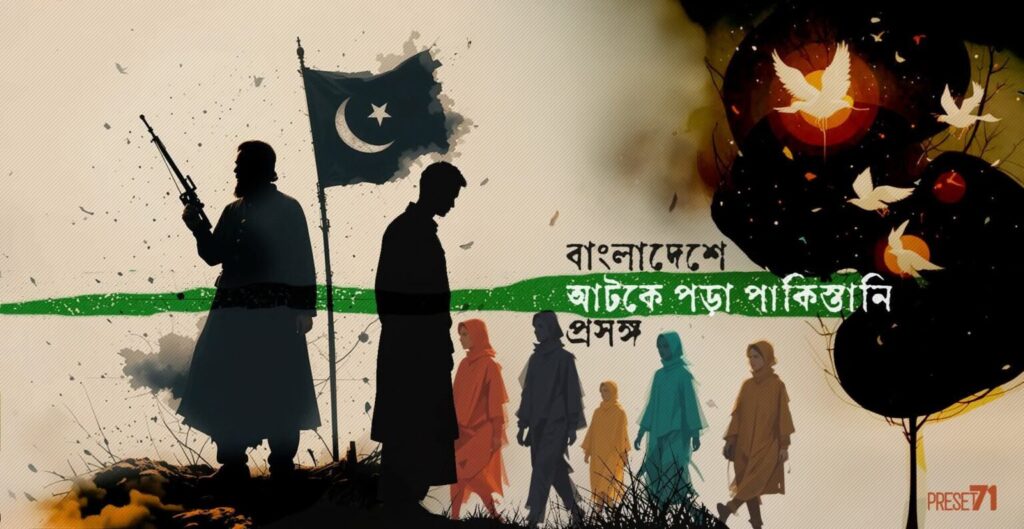
Preset 71
In 1870, the British government established a railway factory in Saidpur, East Bengal, and brought 7,000 workers from the then undivided Bihar. Just as Bengali Hindus were victims of communal violence in Noakhali in August 1946, Bihari Muslims were victims of violence in Bhagalpur, Bihar in September. When Pakistan was created the following year, 5.1 million Urdu-speaking Muslims from various parts of India, including Bihar, went to West Pakistan. There, they were known as Muhajirs. Out of these, 1 million were later sent to East Pakistan. They were identified as Biharis by the Bengalis.
Most of the owners of jute mills, including Adamji, the largest jute mill in East Pakistan at that time, and the officials of the seaports and industrial areas of Chittagong and Khulna were Urdu-speaking. As a result, Biharis were employed in these areas. The central government of Pakistan was also more sympathetic towards them than the Bengalis. In 1958, the Pakistan government arranged housing from South Gabtoli to Mirpur Section No. 12 on the model of a model town for the permanent rehabilitation of Biharis. In 1962, the government acquired land in Mohammadpur and Mirpur and started building houses for Biharis. They started living in these houses from 1964. To rehabilitate Biharis, the Pakistan government imposed a ‘Muhajir’ tax. Bengalis also had to pay that tax.
But the Biharis, under the instigation of the central government, developed an anti-Bengali sentiment. In 1964, the Adamji Jutt led to Bengali-Bihari riots, which later turned into communal riots. Under the leadership of Sheikh Mujibur Rahman, the Bengali civil society of Dhaka played a strong role in preventing the riots. Before the 1970 elections, Sheikh Mujib proposed to nominate leaders of the Bihari community to a few seats so that they could also participate in the movement for autonomy for East Pakistan. Although this talk went far, it ultimately collapsed due to the intervention of Pakistani military intelligence.
The Non-Cooperation Movement began on March 2, 1971, at the call of Bangabandhu. This movement was against the central government of Pakistan. Biharis were not relevant here. But as part of the central plan, the military government made the Biharis face the Bengali movement. Bengali-Bihari clashes began in places where Biharis were present, such as Mirpur and Mohammadpur in Dhaka, as well as Chittagong, Khulna, Syedpur, and Ishwardi. The Pakistani rulers had planned that if the Bengali-Bihari riots reached a terrible level, they would kill the Bengalis through military operations under the pretext of suppressing the riots. For this, before March 25, they delivered firearms to the Biharis, installed a wireless system in Mirpur, and Pakistani commandos in white uniforms took positions in the Bihari Colony in Chittagong and opened indiscriminate fire on the Bengali procession.
When the full-scale genocide began on the night of March 25, the Biharis worked as armed collaborators of the Pakistan Army. They trained 20,000 Biharis and formed the notorious Al-Shams army and the Civil Armed Force (CSF). The Biharis killed numerous people, including 347 Marwari traders, in Golahat, Syedpur. According to eyewitnesses, the Biharis made it a festival to slaughter Bengalis every Friday after Jumma prayers in Mohammadpur and the adjacent areas of Dhaka.
Mirpur was the strongest base of armed Biharis. Before the war, Biharis were in the majority in Mirpur. After the war, more Biharis from different regions came and took refuge here. The Biharis’ Al-Shams were also associated with the Al-Badr Bahini of Jamaat-e-Islami in the killing of intellectuals.
However, in a rare example, a Bihari EPR member, Subedar Syed Khan, participated in the Liberation War with his Bengali colleagues in the Rangpur region. Another Bihari, Subedar Major T.M. Ali of the 8th East Bengal Regiment, fought against Pakistan with the Bengalis and was martyred in a frontal battle in Rowangchhari Upazila of Bandarban on December 13. Both were awarded the title of Bir Pratik by the Bangladesh government.
Knowing that defeat was certain, the Pakistan Army supplied a large amount of heavy weapons to the Biharis of Mirpur before December 16. A number of soldiers did not surrender and took refuge in Mirpur with their weapons. Al-Shams, Al-Badr and Razakars from other areas also came here. They turned Mirpur into a strong cantonment by making women and children shields. To protect them from the Mukti Bahini’s operations, 10 Bihar Regiments of the Indian Army were deployed in Mirpur after December 16.
After about a month and a half, the armed Biharis sent a proposal to surrender their weapons through the Bihar Regiment. Accordingly, on January 30, 1972, when a team of Bangladesh police and army went to Mirpur to receive weapons, they attacked them with heavy weapons. The Bangladesh army, which suffered huge losses in the sudden attack, carried out a full-force operation the next day. Finally, in the afternoon, the Biharis were forced to surrender. One and a half months later, on December 16, Mirpur, the last battlefield of the Liberation War, was liberated.
The truth that was discovered after Mirpur was liberated was horrific. At least 23 massacre sites were discovered. The bones and skulls of countless people were still lying around. It is estimated that at least 25,000 Bengalis were killed by Biharis in Mirpur alone. Not all of them were residents of Mirpur, but they were captured and killed from various places in and around Dhaka. Most of the drivers and assistants of Dhaka’s bus service were Biharis. There is also evidence that many buses on the Dhaka-Mymensingh route were brought to Mirpur and killed Bengali passengers.
In the changed situation, the Bengalis, angered by the situation, began to take revenge on the Biharis in many places. The Switzerland-based International Commission of Jurists (ICJ) collected information from all sides and published a report on the events of 1971. It was written about the repression of the Biharis at the hands of the Bengalis – “These reprisal actions became all the more understandable when it was learned how large numbers of intellectuals and leading Bengali figures had been rounded up and put to death within the last few days before the surrender of the Pakistan Army.”
But the Pakistani government capitalized on these and spread propaganda to the outside world that Bangladesh was torturing the stranded Pakistanis. In view of this, the Bangladesh government set up 116 camps across the country, including 45 in Dhaka, to bring these stranded Pakistanis and ensure their safety. The stranded Pakistanis also demanded that international organizations send them back to their country as soon as possible.
One of the issues that began to be discussed between Bangladesh and Pakistan under the mediation of India was the repatriation of over 400,000 Bengalis stranded in Pakistan and the repatriation of over 1 million Pakistanis stranded in Bangladesh. In addition to creating international pressure to bring back the Bengalis, Bangladesh made maximum concessions on demands such as the trial of Pakistani war criminals – except for a few pro-Pakistanists, all Bengalis returned to independent Bangladesh. But Bangladesh was surprised to see that the Pakistani government refused to take back the Biharis. Pakistan expressed its reluctance to take back the Biharis who had participated in the massacre of Bengalis at the instigation of the Pakistani government and became refugees. After long diplomatic negotiations, it took back 127,000 Biharis in 1982. The remaining about 1 million Biharis formed organizations and demanded repatriation from Pakistan. But Pakistan did not respond to these.
Finally, in 2003, 10 Biharis born in Bangladesh were granted citizenship by the High Court. Based on this, the remaining Biharis began to obtain Bangladeshi citizenship from 2008. The matter was last heard in the Supreme Court of Pakistan in March 2015, following a petition by a repatriation committee. At the hearing, Deputy Attorney General Sohail Mahmud, representing the government, said that there are currently 4 to 5 million stranded Pakistanis living in Bangladesh. He said, “The responsibility of these people lies solely with Bangladesh.”
Thus, Biharis transformed from ‘stuck Pakistanis’ to ‘rejected Pakistanis’. However, in Bangladesh they now enjoy all civil rights, including voting rights, government jobs, and participation in politics, just like other Bangladeshis.
Source:
======
1. Jayasa Ke Main Janata Hu Hu Sheikh Mujibur Rahman. Muhammad Badar Munir, translated by Syed Mobnu. Nagar. August 2022
2. In exchange for lakhs of lives. Rafiqul Islam, Bir Uttam. Ananya Prakashani.
3. The arrival of Biharis and their past. Rafsanjani Pritam. bdnews24.com. 16 May 2016
4. What to do about the ‘stuck Pakistanis’. Altaf Parvez. Prothom Alo. 23 October 2021
5. Pakistan did not accept any of Bangladesh’s 3 demands. Sheikh Shahriar Zaman. Bangla Tribune. 09 December 2020
6. A Bihari freedom fighter on the battlefield of 1971. Abul Kalam Muhammad Azad. Prothom Alo. 18 September 2021
7. Wars of the Chittagong Hill Tracts: 1971. Yasin Rana Sohel.
8. Mirpur: The last battlefield of the liberation war. Ahmad Ishtiaq. The Daily Star. January 30, 2023
9. Pakistan will not take responsibility for the stranded. News Desk, Banglanews24.com. March 31, 2015
10. The Events in East Pakistan, 1971. A Legal Study by The Secretariat of the International Commission of Jurists. Geneva 1972
~~~~~~~~~~~~~~~~~~~~~
The text is copyright of Preset71.
~~~~~~~~~~~~~~~~~~~~~~

https://stapravda.ru/20221228/reyting_samyh_populyarnyh_hostingov_v_rossii_196445.html, рейтинг хостингов России подтверждает, что выбор надежного провайдера важен для бизнеса.