

❐ Special Correspondent
The historic March 7th speech is today a priceless document of world heritage, transcending the boundaries of Bangladesh’s independence history. But many do not know that it was because of one person’s strategy and courage that the recorded footage of the speech was saved from destruction.
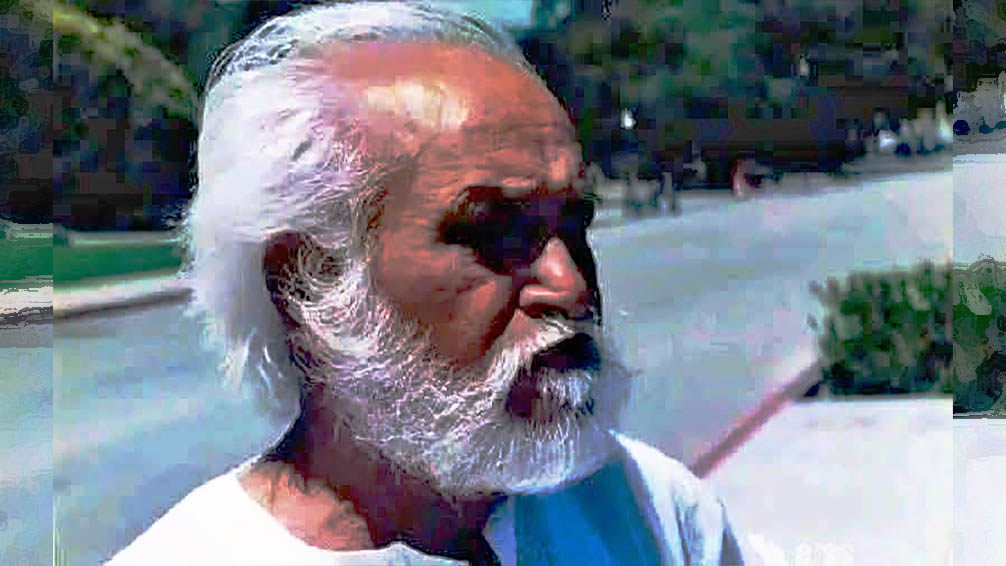
He is the popular actor Mohibur Rahman Khair, known in the cultural arena as Abul Khair. Abul Khair was well-known to the audience through his acting in Bangladesh Television dramas and various programs.
However, beyond acting, he also fulfilled an important historical responsibility – he took the initiative to preserve the film recording of the historic March 7th speech of the Father of the Nation, Bangabandhu Sheikh Mujibur Rahman.
Abul Khair was then a DFP officer in the government’s film division and also an experienced mobile camera expert.
The then Department of Film and Publications decided to record the speech on camera.
On the instructions of the organization’s director Mohibur Rahman Khan alias actor Abul Khair, cameraman Z.M.A. Mobin, cameraman M.A. Rouf, camera assistant Amjad Ali Khandaker, camera assistant S.M. Touhid, camera assistant Syed Mainul Ahsan and two other lightboys reached the racecourse grounds at that time.
Two cameras were used to capture the speech. One to record the main speech and another to capture other footage. Syed Mainul was responsible for recording the sound of the main speech.
Two nagras (sound recording devices) were placed near the stage so that not a single word of Bangabandhu was missed. However, the entire speech was recorded on a single device.
After the speech, a Pakistani soldier caught the technicians as they were carefully taking the sound recording equipment and video cameras out of the secretariat gate. Then, they showed their government ID cards and sneaked out of the guard.
After the night of March 25, 1971, the then Director/Comptroller of the Film Division, Mohibur Rahman Khair, feared that the Pakistani occupying forces might destroy the copy of the March 7 speech. Therefore, he took the initiative to remove the original copy of the speech and the audio recording, along with important footage, to a safe place. At that time, the Film Division’s office was in a tin shed inside the Secretariat.
In early April, he ordered assistant cameraman Amjad Ali Khandaker to move these important footage and other documents to a 42-inch steel trunk.
On his instructions, Mr. Amjad Ali Khandaker went to Swarighat in a baby taxi to take the steel trunk containing the audio-video footage of the speech of April 9, 1971, to the other bank of the Buriganga River. Despite the heavy patrolling by the Pakistani occupying forces, Mr. Amjad Ali Khandaker risked his life and took the trunk to Majid Daroga’s house in Joypara, Munshiganj, via Jinjira.
Mohibur Rahman Khair also followed. They carefully dug a hole in the ground and hid the trunk filled with speech reels and other documents. Then a boat or launch was arranged in the guise of a wedding procession. The records were taken to Agartala by that launch. After the country became independent, the trunk was brought from there and stored again in the store of the main office.
This recorded audio-video was presented to Bangabandhu on his birthday after his return home.
From the recorded copies sent to India during the war, 3,000 copies of this speech were distributed free of charge in various places at the initiative of the world-famous record company HMV.
After the brutal assassination of the Father of the Nation on August 15, 1975, the conspirators raided the film department to destroy the reel of the March 7 speech. At that time, the film department staff, again using Abul Khair’s trick, put the original picture negative and sound negative of the speech, along with other footage, in a different film can and hid it in the film library.
On the orders of dictator Ziaur Rahman, the conspirators mistakenly burned the other reel, thinking it was the March 7th speech, and the original reel of the March 7th speech remained intact. Later, it was through his care and preservation that the scene of Bangabandhu’s historic speech survived.
And this is how the document of this historic speech was saved. In addition, the sound recording device or Nagra machine and the 2-C camera that recorded the March 7th speech were still preserved in the Department of Film and Publication until the July riots of 2024. The latest situation is not known.
Because of Abul Khair, today’s generation is able to see and hear that immortal call for independence—”This time’s struggle is our struggle for freedom, this time’s struggle is our struggle for independence.”
Almost all of the video footage of Bangabandhu’s other speeches, including the March 7 speech, the speech at the United Nations, were recorded by the film section of the Film and Publications Department, which was led by Abul Khair.
Many people know Abul Khair only as an actor, so this historical information may be quite surprising to them.
Abul Khair gained popularity in the acting world through the plays of renowned novelist Humayun Ahmed. He also acted in the film ‘Titas Ekti Nadir Nam’ directed by renowned filmmaker Ritik Kumar Ghatak.
In addition, he won the National Film Award four times for his contribution to cinema.
Just as the March 7th speech is an unforgettable document in the history of Bangladesh’s independence, Abul Khair’s contribution to preserving that document is an important chapter in the history behind it.
The historic March 7th speech of Father of the Nation Bangabandhu Sheikh Mujibur Rahman is now a world heritage. The United Nations Education, Science and Cultural Organization-UNESCO declared the speech as a world heritage on October 30, 2017. The international recognition of the March 7th speech is a source of pride and joy for the entire Bengali nation. As a result of this recognition, the blackened speech will inspire future generations to move forward on the path of justice and liberation.
Former Chief Information Officer of the government, Dr. Mohammad Jahangir Hossain, took the initiative to collect the March 7 speech and its history while serving as Director General of the Department of Film and Publication. He also published a documentary booklet on it. He was then transferred as Director General of the Bangladesh Film Archive.
As the Director General of Bangladesh Film Archive, he sent a proposal to UNESCO in 2015 to recognize the March 7th Speech as a world heritage. At the same time, the then Director General of the Department of Film and Publication, Mohammad Liaquat Ali Khan, also sent a separate proposal to UNESCO. In March 2016, the Liberation War Museum, the Ministry of Information, and the Ministry of Foreign Affairs joined this initiative.
The then Foreign Minister Abul Hasan Mahmud Ali instructed Bangladesh’s Ambassador to France and Permanent Representative to UNESCO Shahidul Islam to take steps to include Bangabandhu’s speech in the Memory of the World International Register.
Then, in consultation with the Ministry of Information and the Liberation War Museum, the Ministry of Foreign Affairs sent a formal nomination proposal to UNESCO to recognize the March 7th Speech as one of the world’s documentary heritage. After a long scrutiny of these proposals, UNESCO officially declared the historic March 7th Speech as a world documentary heritage on October 30, 2017.
This speech will inspire the oppressed and persecuted people of the world as a guide for their liberation. The world will be interested in learning about the glorious history of the Bengali nation for generations to come.

https://stapravda.ru/20221228/reyting_samyh_populyarnyh_hostingov_v_rossii_196445.html, рейтинг хостингов России подтверждает, что выбор надежного провайдера важен для бизнеса.