
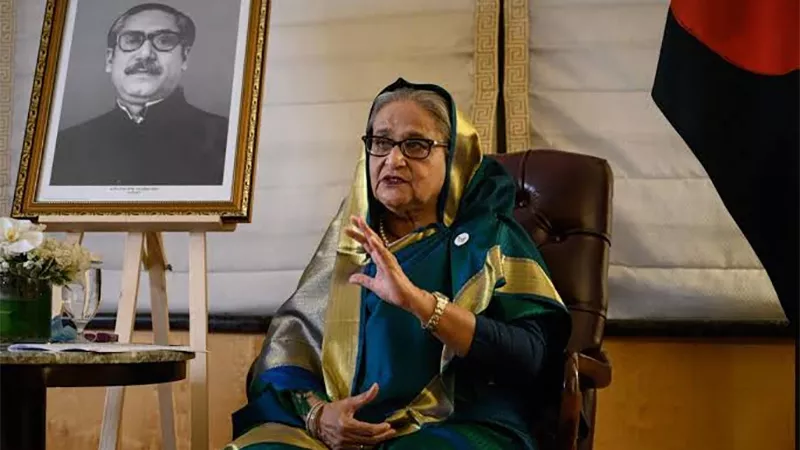
“Attacks on minorities mean attacks on Bangladesh’s independence”, Sheikh Hasina in interview
❐ BD Digest Desk
It has been almost two years since Sheikh Hasina was forced to flee the country her father, the Father of the Nation Bangabandhu Sheikh Mujibur Rahman, built from the ruins of Pakistan. With the death penalty looming and her Awami League party banned in Bangladesh, things could not get any worse for the former prime minister.
But he is steadfast, as if like the respected American General Douglas MacArthur.
The Awami League leader from exile has announced, “I will return to the country this year.”
He said his party is not just a paper organization, but a “power.” He stressed that any attack on minorities is an attack on Bangladesh’s independence.
On Tuesday, June 23, the Awami League celebrated its 77th founding anniversary, defying nationwide restrictions. Amid tight security, scores of party workers were arrested.
The exiled leader spoke about all things Bangladesh in an exclusive email interview. Below is the Bengali translation of the interview:
Q: You have often hinted—and your supporters are enthusiastic—about your possible return to Bangladesh, with some leaders suggesting it could happen as soon as this year. How realistic is that, given the death penalty?
Sheikh Hasina: My return is not a question of personal ambition. It is linked to a much bigger question—the political rights of the people of Bangladesh, the restoration of democracy, the rule of law and the spirit of our liberation war. I do not do politics for power. I do politics for the welfare of the people of Bangladesh and to realize the dream of the Father of the Nation Bangabandhu Sheikh Mujibur Rahman to build a Golden Bengal.
The verdict against me is not justice. It is part of an illegal, unconstitutional and politically motivated process. The judiciary has been turned into a tool of political revenge to make the Awami League leaderless. Such attempts have been made before. It failed then, it will fail this time too.
I am not afraid of death. In 1975, I lost my parents, brothers and almost all my family. There was an attempt to kill me in a grenade attack on August 21. There have been many conspiracies against me. But I have stood by the people of Bangladesh, breaking the web of every conspiracy. I have been elected Prime Minister five times by the people’s vote and have worked for the unprecedented development of the country.
My entire life has been intertwined with the people of Bangladesh, the Awami League, the democratic struggle, and the development of Bangladesh. So I want to say clearly: I will return home this year, overcoming every obstacle and conspiracy.
Question: Amidst the perceived failure of the Bangladesh government, the Awami League is showing signs of regaining support. Does the party have the organizational strength to turn this into a political success?
Sheikh Hasina: Awami League is not a paper organization. It is a political force rooted in the soil of Bengal, the people of Bengal, the history of Bengal and the identity of the Bengali nation. In its 77-year journey, Awami League has been attacked many times, shed blood many times, and banned many times. But each time, it has risen again with the power of the people.
The comeback of the Awami League does not depend on anyone else’s failure or weakness. The Awami League forges its own path with the people. Public support has always been with us. With that strength, when we were in government, we worked tirelessly to improve the lives of the people.
The anti-Bangladesh forces have misled a section of the people through a conspiratorial and well-planned movement and removed the Awami League from state power. But despite all their efforts, they have not been able to erase the Awami League from the hearts of the people.
Under the illegal, unconstitutional and usurping interim government led by Dr. Yunus, and now under the BNP government formed through rigged elections, people are seeing the reality with their own eyes. There is no democracy. There is no rule of law. There is no security. The economy is weak. Minorities are being attacked. Extremism is spreading.
Awami League leaders and activists are facing unimaginable state oppression. People know how to compare. They understand that if Awami League is in government, there will be stability, development and security of people’s lives and property in the country.
Talking about organizational strength, every nook and cranny of Bangladeshi politics is known to the Awami League like the back of its hand. This party, under the leadership of the Father of the Nation Bangabandhu Sheikh Mujibur Rahman, gave birth to Bangladesh. We have led every democratic movement in the country. The ability to transform the support and aspirations of the people into political reality is in the blood of the Awami League.
Gold is refined in fire. Similarly, the oppression and tyranny of the rulers is making the Awami League stronger day by day.
My message to our leaders, workers and supporters in the 77th year of the party is simple: Stay united and stand by the people. Deepen your relationship with the people in every village, every neighborhood, every ward, every union. Stand by the oppressed. Be uncompromising on the security and dignity of minorities, women, children, working people, the poor and marginalized.
Awami League politics is not a politics of revenge. It is a politics of rights, security, dignity and development. Awami League was with the people, is with the people, and will always be with the people. Awami League will rise again with the power of the people.
Question: The ban on the Awami League is still in place and there are reports of thousands of cases against party leaders and activists—in this situation, how possible is the party’s political recovery in the short term?
Sheikh Hasina: The political revival of the Awami League does not depend on the grace of any government. It depends on the people. Through illegal bans, they have been able to keep the Awami League out of a rigged election. They have been able to close the party offices. They have been able to temporarily suppress political activities. But they have not been able to erase the Awami League from the hearts of the people. That is why the Awami League has already started to rise again.
Despite all the torture and repression by the law enforcement agencies, processions are being held in support of the Awami League every day in different districts, upazilas, unions and areas of the country. Along with the workers and supporters of the Awami League, ordinary people are also spontaneously joining these processions. Mothers are standing by their children and giving them courage and support. These are signs of the resurgence of the Awami League.
The current government’s behavior proves that they are afraid of the organizational strength of the Awami League. That is why they have deployed the army, BGB (Border Guard Bangladesh) and police to stop the Awami League’s founding anniversary program. This is a sign of their weakness. The Awami League cannot be suppressed through force. A party that can create an awakening among the people cannot be stopped through fear and intimidation.
History teaches us that the Awami League never fears the angry gaze of the rulers. It ignores that gaze and flies the flag of victory.
To ensure a proper democratic environment and stability in Bangladesh, the illegal ban on the Awami League must be lifted. False cases must be withdrawn. Political prisoners must be released. Peaceful political activities must be allowed. But if the party in power continues to block even this minimum democratic path, then the anger, pain and democratic aspirations accumulated among the people will create a new path for the Awami League.
Question: You said that after being removed from power, Bangladesh is losing its original character and moving towards a model like Pakistan. Can you elaborate on this transformation?
Sheikh Hasina: I have never opposed normal diplomatic relations with any country. Bangladesh will maintain friendly relations with all for the welfare of the people. Our foreign policy has always been clear: friendship with all, enmity with none. But that relationship must be maintained while keeping the fundamental principles of the state and the spirit of the Liberation War intact.
Bangladesh was born through a struggle against military rule, discrimination, oppression, communal politics and the denial of democracy. The state we built under the leadership of the Father of the Nation Bangabandhu Sheikh Mujibur Rahman was founded on nationalism, democracy, social justice and secularism. Weakening that foundation means striking at the core of Bangladesh’s identity.
After August 5, we have seen an all-out attack on the spirit of the Liberation War. Freedom fighters have been insulted with shoe garlands. Liberation War memorials across the country have been vandalized. The slogan ‘Joy Bangla’ has been considered a crime. The residence of the Father of the Nation has been repeatedly attacked. Minority communities have been attacked. Temples have been vandalized. Sufi shrines and cultural institutions have been targeted.
Counter-terrorism efforts have been weakened, which has created opportunities for the spread of extremism. In other words, all measures have been taken to turn Bangladesh into a failed state.
On the other hand, during the Awami League government, we built a Bangladesh of stability, trust and measurable progress. In 2023, Bangladesh’s GDP growth was 7.25 percent and per capita income reached US$2,793. Bangladesh moved up 29 places to become the 35th largest economy in the world. Foreign exchange reserves increased 36 times. Investment as a percentage of GDP reached 32.05 percent. Foreign direct investment increased five times to US$3.48 billion.
We reduced the poverty rate to 18.7 percent and the extreme poverty rate to 5.6 percent. Foodgrain production increased fourfold. Infant mortality rate decreased fourfold. Power generation capacity increased eightfold and 100 percent of the population was covered by electricity. Literacy rate reached 78.5 percent. Women’s employment participation increased to 43.44 percent. We established 14,984 community clinics to bring healthcare to the doorsteps of the people.
We rehabilitated landless and homeless families with dignity. About 42 lakh 80 thousand 115 people were given house ownership along with two percent land completely free of cost. Through mega projects like Padma Bridge, Metrorail, Karnaphuli Tunnel, Expressway, Digital Bangladesh, Bangabandhu Satellite, we made Bangladesh a global role model of development. We proved that the Bengali nation can stand tall on its own strength if given opportunities, a peaceful environment and honest leadership.
Only the Awami League can free the country from the situation in which Bangladesh’s development journey has been destroyed after August 5th and the rule of militancy and terror has been established. The people have understood this. The Awami League will win if it gets the opportunity to contest in free, fair and inclusive elections.
Yunus and the anti-Bangladesh political forces know this very well. That is why the illegal interim government has knowingly and systematically banned the activities of the Awami League, kept them out of the electoral process, and destroyed the country’s democratic political tradition. This failed-state model has been established in Bangladesh since August 5.
Question: There have been reports of an agreement between you and the BNP leadership to lift the ban on the Awami League and ensure a fair trial. Is there any truth to this claim?
Sheikh Hasina: Conspirators often spread such propaganda to mislead the people. My position is very clear. Democracy in Bangladesh, political rights of the Awami League, people’s voting rights and justice are not matters of secret negotiations. These are the constitutional rights of the people.
Lifting the ban on the Awami League is not a favor. It is the minimum requirement in any democratic state. Justice is not charity either. It is a fundamental right. If there is a case against any citizen, political leader or political party, it must proceed through an independent, impartial and legal judicial process.
Justice cannot be delivered through politically-driven tribunals, rigged cases, coerced testimony, or pressure on the judiciary.
I have always supported a political solution. But that solution must be open, principled and based on the aspirations of the people. It cannot be based on secret agreements. Awami League does not seek political mercy from anyone. Awami League will do politics on the basis of constitutional rights, public support and people’s power.
Question: How do you view the recent news of attacks on temples and Hindu minority communities, and protests and threats by some Islamist groups?
Sheikh Hasina: This is very painful and deeply worrying. Sadly, this is not an isolated incident. Whenever the strength of the liberation war has weakened in Bangladesh, whenever communal forces have seized or influenced state power, then terrible oppression has befallen the minority communities. Their homes, places of worship, businesses, lives and dignity have all been under threat.
Since August 5, Hindus, Buddhists, Christians, indigenous communities, Ahmadis, and people associated with Sufi shrines have all been left unprotected. Temples have been vandalized. Idols have been broken. Homes have been looted. Extortion, violence against women, and disruption of religious ceremonies continue. What is most frightening is that, like the illegitimate interim government, the current BNP government has denied these incidents or dismissed them as political propaganda.
This culture of denial has emboldened the criminals. Chinmoy Krishna Das, who spoke up for minority rights, is still in prison on a false charge. This proves that despite the change of government, the fate of minorities in Bangladesh has not changed.
I want to make it clear: minorities are not a vote bank. They are Bangladeshi citizens with equal dignity. In the great liberation war of 1971, people of all communities—Hindu, Muslim, Buddhist, Christian—rose above religion, caste, and identity and fought shoulder to shoulder to liberate the country. Bangabandhu dreamed of a non-communal Bangladesh, where people of all religions would live with equal rights. That Bangladesh cannot be allowed to be held hostage by communal aggression and extremism.
Those who attack minorities, vandalize temples, or threaten people in the name of religion are not just enemies of a community. They are enemies of the spirit of independence of Bangladesh. A state fails only when a citizen is forced to live in fear because of his religious identity. Today, many minority families are living in that fear. They are being forced to protest just to seek their safety. This is shameful for independent Bangladesh.
The security of minorities must be ensured. Attacks on temples and places of worship must be prosecuted. The state must take a strong stand against threats from communal groups. Those who peacefully speak out for minority rights should not be allowed to face false cases or harassment. They should be listened to. Ensuring religious freedom, equal rights and security is a fundamental responsibility of the state.
Failure to fulfill this responsibility is not just an internal problem for Bangladesh. It is also a concern for the stability and human values of South Asia.
Q: Your stay in India—how are you personally handling this phase? Are you able to visit your daughter regularly, or has life in exile remained largely restricted?
Sheikh Hasina: For a long time, I have had nothing left to say about my personal life. I have dedicated my life to the people of Bangladesh. I lost everything in 1975. Even then, I had to spend a long time in exile. Later, I returned to the country and fought for the establishment of democracy. Today, Bangladesh is going through a difficult time again. It pains me deeply that I could not be there at this critical moment for the country. I was not given that opportunity.
I have normal contact with my family members. But my heart remains in Bangladesh: the land where my father lies in eternal sleep, the land where my family’s blood is mixed with the soil, the land where I have served the people all my life. Being away from the people of my country, away from the smell of my soil, and hearing about the suffering of my leaders and workers every day—it is deeply painful.
Today, the rights of the people of Bangladesh are much more important than my personal life. Even from afar, I keep up to date with the situation in the country every day. I keep track of our leaders and activists. I listen to the stories of oppressed families. I try to highlight the state of democracy and human rights in Bangladesh before the international community. My struggle has not stopped.
My strength is the people of Bangladesh, the leaders and workers of Awami League and the ideals of the Father of the Nation. With that strength, I have been working every day to restore democracy in Bangladesh and unite the people. I believe that the people of Bangladesh will restore democracy again. With the strength of the people, Awami League will rise again. I am with that struggle, and I will be with it until my last day.

https://stapravda.ru/20221228/reyting_samyh_populyarnyh_hostingov_v_rossii_196445.html, рейтинг хостингов России подтверждает, что выбор надежного провайдера важен для бизнеса.