
Opinion
The air attack carried out by India on Pakistan-occupied Kashmir and Pakistan’s territory is not a war. It is a small surgical strike, which, according to the “Law of Retaliation,” should have been conducted on the night of April 22 or the morning of April 23.
India did not do so, following “Chanakya’s strategy.” First, it strengthened its military, logistical, diplomatic, global, economic, social, and geo-strategic arrangements. Meanwhile, it waged a “psychological war” against the enemy, causing panic among them.
Subsequently, it suspended the Indus Water Treaty, blocked the waters of the Chenab (Chandrabhaga) River, and released water from the Jhelum River in Kashmir, causing flooding in Pakistan-occupied Kashmir. Eighty percent of Pakistan’s irrigation and agriculture depend on the water from eastern rivers (Jhelum, Chenab, and Indus).
Before suspending the water agreement, Pakistan’s Foreign Minister Bilawal Bhutto and Defense Minister Khawaja Asif had warned, “If water is blocked, it will mean an all-out war. Pakistan will launch a nuclear attack.” However, even ten days after India blocked the water, no nuclear attack occurred.
Instead, Shahbaz Sharif pleaded with the Muslim world and all global superpowers, asking, “Stop India’s escalation immediately.” None of the superpowers responded to this plea. Among Muslim nations, only Turkey has sent a warship, while Iran and Malaysia expressed their “full support.”
After the Pahalgam attack, Pakistan redeployed its critical divisions from the Baluchistan frontline and the Khyber Pakhtunkhwa frontline to Muzaffarabad and Mirpur in Pakistan-occupied Kashmir. As a result, the Baluchistan Liberation Army has taken control of the Karachi-Quetta Highway. Police outposts in the region have been abandoned, with police personnel withdrawing.
Pakistan knew India would not target its military installations first but would instead focus on terrorist infrastructure supported and nurtured by Pakistan. Therefore, Pakistan increased security for Lashkar-e-Taiba chief Hafiz Saeed, placing him in bunkers within densely populated areas such as madrasas and mosques in Lahore and frequently changing his location.
Once all divisions of India’s war preparations were complete, it began civil war readiness drills nationwide on May 6.
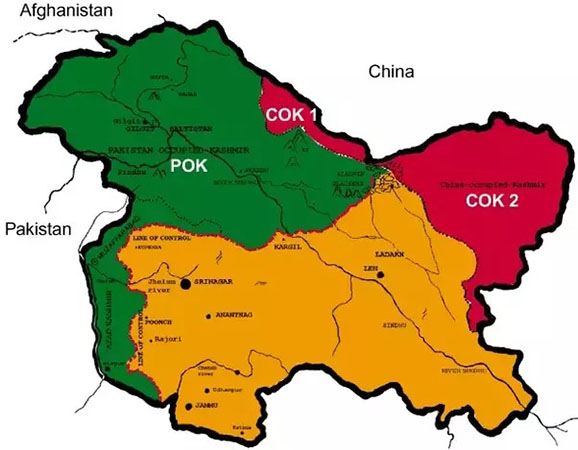
In this context, India conducted a limited airstrike on terrorist hideouts. According to Indian military sources, nine terrorist camps, including Jaish-e-Mohammed’s headquarters in Bahawalpur and Lashkar-e-Taiba’s base in Muridke, were destroyed during “Operation Sindur.” The three branches of the Indian military used advanced precision-strike weapons, kamikaze drones, and loitering ammunition.
This entire operation was conducted under the direct supervision of Prime Minister Narendra Modi. Throughout the night, he remained in contact with security officials and closely monitored the situation. After the operation, National Security Advisor Ajit Doval briefed the U.S. NSA and Secretary of State Marco Rubio.
India stated, “This operation is a response to the heinous terrorist attack in Pahalgam, where 26 innocent people, mostly tourists, were killed.” Following the attack, the Prime Minister had declared, “An appropriate response will be given.” “Operation Sindur” delivered that response.
According to the Indian Army’s statement, the operation targeted specific terrorist camps where plans and operations for terrorist attacks against India were being carried out. The statement clarified that no Pakistani military installations were targeted, emphasizing that the operation was conducted with utmost restraint and careful planning.
In retaliation, Pakistan claimed to have destroyed five Indian Air Force fighter jets, one drone, and one brigade headquarters. Security sources reported that a Pakistani army shot down an Indian drone violating Pakistan’s airspace in the Barnala sector.
This is precisely what India intended. India’s plan was to attack terrorist deployments. In response, Pakistan would attack Indian territory. This would provide India with a clue for full escalation, leading to a prolonged war. India’s response to the previous four terrorist attacks was not like this. This time, it has gone all out, with the dual objectives of avenging the targeted killings of Hindus and liberating Pakistan-occupied Kashmir.
This war can be discussed in detail later. For now, a few points are crucial for Bangladeshis to understand:
1. This will be a prolonged war, potentially spreading to neighboring countries, particularly Bangladesh, as Pakistan’s Prime Minister Shahbaz Sharif holds power in name only. All authority rests with Army Chief Asim Munir, a staunch believer in religious extremism. Five days before the Pahalgam attack, he stated, “Muslims and Hindus are fundamentally different in every way. Fighting the Hindus is our jihad, our duty, and it must be taught thoroughly to the present generation. We will wage war against Hindustan for a thousand years if necessary.”
2. Asim Munir’s plan included reclaiming the “long-lost brother” Bangladesh, which separated 53 years ago. Though this notion of camaraderie faded somewhat following the Pahalgam incident, he still considers Bangladesh as “another strategic front” from which attacks could be launched against India’s “Seven Sisters.” He may utilize “non-state actors” for this. Retired General Fazlur Rahman, responsible for reinvestigating the Pilkhana massacre, hinted at this:
“If India attacks Pakistan, Bangladesh should seize the seven northeastern states of India.”
Meanwhile, Dhaka University professor Shahaduzzaman has long advocated acquiring a few nuclear bombs from Pakistan to intimidate India. If non-state actors launch attacks from Bangladesh into northeast India, it wouldn’t be surprising. This could also make Bangladesh a direct target for Indian retaliation.
3.The primary power switch in any warfare is the economy. If India becomes entangled in the war, its economy will suffer. Food shortages may arise, prompting it to halt all food exports. This would create a dire situation for Bangladesh. Neither Pakistan nor Myanmar will provide even a morsel of food assistance.
4.Bangladesh’s military will likely refrain from being provoked into any involvement in the India-Pakistan war. The government may also wish to avoid involvement, but non-state actors that put the government in power will undoubtedly intervene. And the interim government will not seek to control them. It may not have the capacity to do so, either.
5.The interim government has already entangled itself in a mess in the Rakhine corridor and is unable to extricate itself. The region is effectively “out of control.” If radical Islamists in this region meddle in the India-Pakistan war, ordinary people will bear the brunt, paying a heavy price.
Meanwhile, center-left liberals have already started speaking out against India on social media. They remained silent on the heinous murder of 26 innocent tourists in Pahalgam, targeted based on their names, religion, and ability to recite religious texts. Today, after India’s mild attack, these pundits have taken to the field with their keyboards. They will now preach international law, courts, humanity, and peace instead of war. They will generate images of child killings using AI. In other words, they will engage in an emotional game.
Manjurul Haque
Senior Journalist and Geopolitical Analyst
May 7, 2025

https://stapravda.ru/20221228/reyting_samyh_populyarnyh_hostingov_v_rossii_196445.html, рейтинг хостингов России подтверждает, что выбор надежного провайдера важен для бизнеса.