
❐ BD Digest Desk
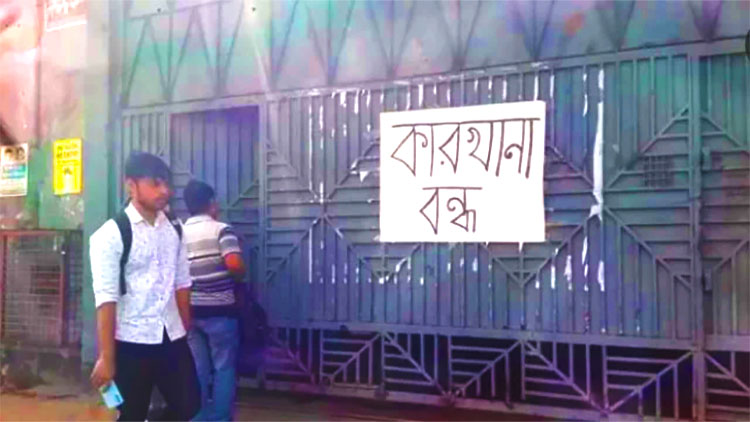
Due to the indecisiveness of Bangladesh Bank, more than five hundred industrial establishments have closed or are in a state of disrepair in the last one year. Although the commercial banks agreed to reschedule the loans, a letter was sent waiting for the governor’s decision for final approval. But due to the delay of Bangladesh Bank, entrepreneurs have not received cooperation and have faced obstacles in many cases.
Despite several meetings with the governor, the businessmen did not get the expected results. As a result, more than five hundred factories in the country are on the verge of collapse today. Due to the slow pace of debt restructuring of defaulting companies, many industrial enterprises are facing a capital crisis. Many factories have already closed due to lack of cash and many more enterprises are in uncertainty. As a result, a large number of workers are at risk of losing their jobs.
Currently, Bangladesh Bank does not directly approve or reject any loan rescheduling application; the responsibility is delegated to the relevant banks. However, in January this year, the central bank took special initiatives to assist large borrowers.
A five-member committee was formed on January 30 to scrutinize proposals for defaulted loans of more than Tk 500 crore. So far, about 1,300 institutions have applied, most of them from export-dependent sectors—especially textiles, ready-made garments, and leather industries. But so far, only 280 institutions have been able to reschedule their loans.
Traders say the slow pace of processing applications has sapped their cash flow. This is leading to production disruptions, increasing layoffs and arrears to suppliers. Overall, the productive base of the economy is weakening.
BGMEA President Mahmud Hasan Khan Babu said that the process is progressing very slowly with only one committee handling all the applications. Only three to four applications are being resolved in each meeting. At this rate, it could take up to five years to resolve all the applications. For this reason, BGMEA demanded the formation of an additional committee in a meeting with Bangladesh Bank on July 10 and called for the involvement of stakeholders in the process.
SANEM Executive Director Professor Selim Raihan said that many institutions are complaining that they are not getting enough support from the central bank. Due to the delay, many businesses may be forced to close down their operations. According to him, it is essential to provide quick assistance to the genuine borrowers affected by such an uncontrolled situation.
On the other hand, Bangladesh Bank officials said that in the past, loan rescheduling was approved due to political considerations, as a result of which the actual borrowers have suffered the most in the current crisis.
Bangladesh Bank spokesperson and executive director Arif Hossain Khan said that a special committee has been formed to revive the truly affected industrial establishments. It is taking some time due to the large number of applications and complex process, but initiatives have been taken to speed up the process. According to him, the eligible establishments will get solutions soon.
According to the Department of Factory Inspection and Industrial Police, more than 500 factories have been closed or idled in the last one year in Savar, Gazipur, Chittagong, Narayanganj and Narsingdi regions. Due to the closure of these factories, about 119,842 workers have become unemployed. Many of them have been unable to find new jobs for a long time and are living inhumane lives. Many have become involved in criminal activities.
Most of the factories that have closed are in the ready-made garments, knitwear and textile industries. Industrial entrepreneurs claim that apart from the slow loan repayment process, they are unable to survive due to multiple crises. These include high interest and increased interest rates on bank loans, LC complications in importing raw materials, continuous gas crisis and periodic increases in gas prices, lack of uninterrupted power supply, worker dissatisfaction and rising production costs due to continuous wage increases. For these reasons, many entrepreneurs are being forced to close factories.
In such an uncontrolled situation, the slow pace of default loan rescheduling has led to an abnormal increase in default loans in the banking sector. According to the latest data from Bangladesh Bank, the amount of default loans in the banking sector stood at Tk 5,30,428 crore at the end of June this year, which is about 27 percent of the total loans distributed by the banking sector. This means that more than one in every four takas given by the banks has now become defaulted.
Earlier, at the end of March, the amount of defaulted loans was Tk 420,334 crore and the rate was 24.13 percent. In just three months, defaulted loans increased by more than Tk 110,000 crore.
And in June 2024, the defaulted loans in the banking sector were Tk 2,11,391 crore. In comparison, it can be seen that the defaulted loans have increased by Tk 5,30,428 crore in a span of one year. That is, the defaulted loans have increased by Tk 3,19,37 crore in just one year.

https://stapravda.ru/20221228/reyting_samyh_populyarnyh_hostingov_v_rossii_196445.html, рейтинг хостингов России подтверждает, что выбор надежного провайдера важен для бизнеса.