

Staff Reporter
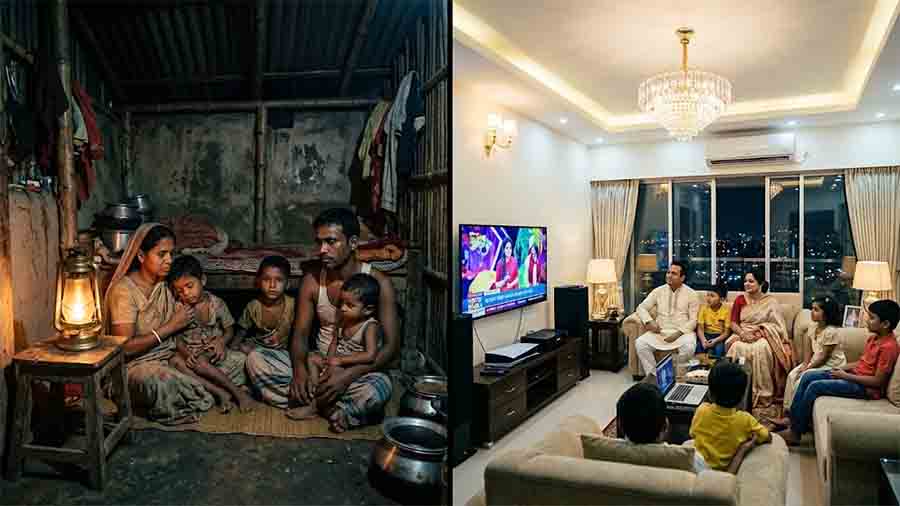
Relatively well-off families receive a large share of the electricity subsidy. While the richest 20 percent of families receive 33 percent of the total electricity subsidy, the poorest 20 percent of families receive only 15.4 percent. As a result, wealthy families receive more than double the electricity subsidy benefits compared to the poor. This picture has emerged in the World Bank’s latest ‘Bangladesh Development Update’ report.
The report released on Tuesday said that Bangladesh’s economy has been sluggish for a long time. This has affected employment and people’s income. Along with this, high prices of daily necessities have created additional pressure on people’s living standards. In such a situation, the burden of government subsidies in the energy sector is also gradually increasing.
In fiscal year 2014, the government’s subsidy on electricity and gas was Tk 8,580 crore. In fiscal year 2025, it has increased to Tk 83,600 crore, which is equivalent to 1.5 percent of GDP. 70 to 90 percent of this is spent on the electricity sector.
Currently, the average price of electricity per unit at the consumer level is 10 taka 63 paisa. However, if the subsidy on gas used in electricity generation is calculated, the actual cost of electricity per unit is 15 taka 16 paisa. This means that the government has to pay 4 taka 53 paisa as subsidy per unit.
According to the World Bank, residential consumers receive about 72 percent of the total electricity subsidy. Of this, the richest 20 percent of households receive 33 percent, while the poorest 20 percent of households receive 15.4 percent. The poorest 40 percent of households receive only 30 percent of the subsidy.
However, the electricity subsidy is more important than the income of poor households. The direct benefit of lower electricity prices and the indirect benefit of lower prices of goods produced using subsidized electricity are worth 18.1 percent of their pre-tax income for the poorest 20 percent of households. For the richest 20 percent of households, it is only 2.3 percent.
Removing subsidies will increase poverty
The World Bank estimates that if electricity subsidies are completely removed without any alternative social protection measures, the poverty rate could increase by 2.8 percentage points. This could immediately push about 4.7 million people below the poverty line. At the same time, the Gini coefficient, a measure of income inequality, could increase by 1.6 points.
However, eliminating large electricity subsidies would save the government about 1.9 percent of GDP. According to the World Bank, even if the subsidy were removed and the additional costs of the poorest 40 percent of the population were fully covered, the government would save about 0.6 percent of GDP.
Urgent call for reforms in the energy sector
Reliable and affordable energy supplies are crucial for industrial production, export capacity, private investment and employment. But despite the increase in power generation capacity in the past few years, the World Bank believes that the sector’s fundamentals are weak, blaming weak management and consistent policy failures.
Domestic gas has long been the mainstay of Bangladesh’s energy system. Production has declined as reserves in older gas fields have dwindled. At the same time, new gas exploration has not kept pace with demand.
Even in 2017, Bangladesh could meet almost its entire natural gas demand through its own production. Now, it has to rely on imported LNG to meet one-third of its total gas demand.
The increase in private power plants has also increased production capacity. Currently, 43 percent of total electricity generation comes from the private sector. However, the power sector is still under pressure due to the energy supply crisis and transmission system limitations.
According to the World Bank, the most urgent issue at this time is stabilizing energy supplies and improving the management and governance of the power and energy sectors.
The commissioning of the Rooppur Nuclear Power Plant will increase electricity supply to the national grid, which is expected to reduce pressure on gas-based power generation.
Tax pressure again by helping the poor
In addition to the economic crisis, the World Bank has also highlighted the weaknesses of Bangladesh’s revenue system. According to the organization, the protection that is supposed to be provided to the poor through government taxes and assistance systems is not being sufficient in reality.
Analyzing data from 2022, the World Bank found that direct taxes and various support programs reduced poverty and inequality. This led to a decrease in the Gini coefficient from 52.4 to 50.7. The poverty rate also fell from 19.6 percent to 18.8 percent.
However, indirect taxes erode a large part of that benefit. When the impact of indirect taxes is taken into account, the Gini coefficient increases to 51.4 and the poverty rate rises to 20.6 percent.
In other words, the government is providing assistance to the poor, while at the same time creating additional pressure on them through indirect taxes. According to the World Bank’s analysis, as a result, poor families are paying more in taxes than they receive from the government.

https://stapravda.ru/20221228/reyting_samyh_populyarnyh_hostingov_v_rossii_196445.html, рейтинг хостингов России подтверждает, что выбор надежного провайдера важен для бизнеса.