
Staff Correspondent
The various trade and financial benefits that Bangladesh has been receiving in the international arena as a least developed country (LDC) will gradually decrease after its graduation from LDC status. Therefore, preparations must be made now, said Dr. Anisuzzaman Chowdhury, Special Assistant to the Ministry of Finance.
Speaking as the chief guest at a seminar titled ‘LDC Graduation and Structural Transformation’ organized by the Support to Sustainable Graduation Project (SSGP) of the Economic Relations Department (ERD) yesterday, he said that even though the LDC facility has ended, it is important to create alternative paths to maintain the competitiveness of export-oriented industries.
He emphasized the need to increase workers’ salaries and training opportunities, as well as the use of affordable and environmentally friendly fuel. According to him, this will not only increase productivity, but also increase the international acceptance of export products.
President of the event and ERD Secretary Md. Shahriar Quader Siddiqui said that international cooperation is essential for structural transformation. For this, a coordinated effort is needed to implement the adopted ‘Smooth Transition Strategy’.
The keynote speaker at the seminar was Dr. Zulfan Tajuddin, Associate Professor at Western Sydney University, Australia. He said that in many countries in South and Southeast Asia, weak democratic practices, distrust in government, and geopolitical complexities have become obstacles to structural transformation. In this situation, he called for emphasis on people’s empowerment and addressing geopolitical challenges alongside economic and social reforms.
In the panel discussion, former Secretary Abdul Baki, CPD Fellow Professor Mustafizur Rahman, and BIDS Research Director Dr. Kazi Iqbal emphasized on accelerating policy reforms and structural transformation.
BGMEA President Mahmudul Hasan Khan and private sector representatives called for an extension of the deadline for transitioning from LDC status to three more years. At the same time, they proposed prioritizing energy security and infrastructure development.
Bangladesh will officially graduate from the Least Developed Country (LDC) status in November 2026, after a five-year preparatory period. According to experts, the main challenges to make this transition sustainable and inclusive will be to increase industrial productivity, develop technological capabilities, and diversify the economy.
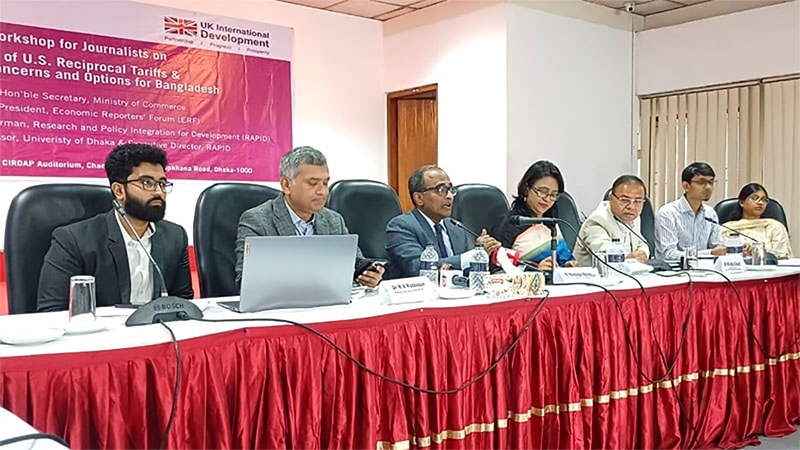
Efforts are being made to postpone transition from LDC by 3 years: Commerce Secretary
Commerce Secretary Mahbubur Rahman said, “Efforts are being made to postpone the transition from LDC status by three years. Discussions are underway with the relevant UN agencies on the issue. However, our close friends, including the US, Turkey, Japan, and India, are opposing it. So, there is no room for optimism about the postponement. However, the government will continue to try.”
It is worth noting that Bangladesh is scheduled to transition in November 2026. The transition will entail the loss of duty-free market benefits. After the transition, duties of up to 12 percent may be imposed on Bangladeshi products in major markets including the European Union and the United Kingdom. As a result, exports may decrease by 6 to 14 percent. The rules of origin of raw materials will be stricter. As a result, the ready-made garment sector will be the most affected. Therefore, the country’s top 16 business organizations recently demanded that the transition be postponed.

https://stapravda.ru/20221228/reyting_samyh_populyarnyh_hostingov_v_rossii_196445.html, рейтинг хостингов России подтверждает, что выбор надежного провайдера важен для бизнеса.