
Staff Correspondent
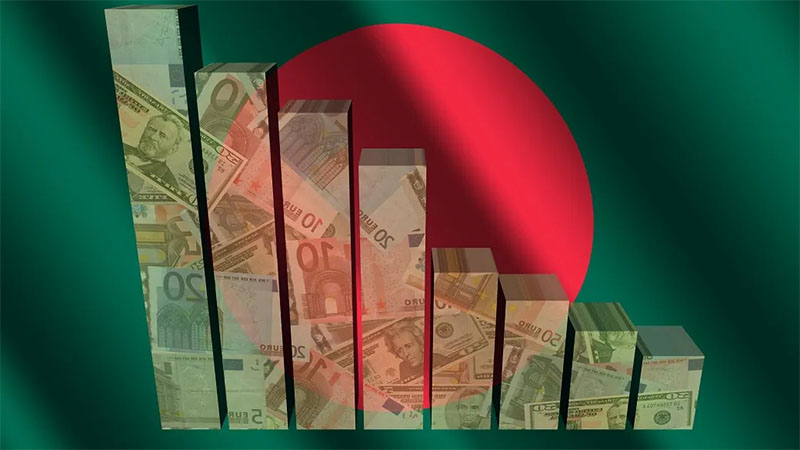
The country’s economy is now facing an uncomfortable reality—private investment has fallen to its lowest level in 11 years. Private investment as a share of gross domestic product (GDP) stood at 22.03 percent in the fiscal year 2024-25. This downward trend, for the third consecutive year, is not just a statistical decline; it is a clear indication of the future strength of the economy.
According to data from the Bangladesh Bureau of Statistics (BBS), government investment has also shrunk in a similar manner. In the 2024-25 fiscal year, government investment as a percentage of GDP stood at 6.51 percent, down from 6.74 percent the previous year. This is the lowest since 2013. This means that investment is now in recession in both sectors – private and government.
Employment signal red
According to economists, the direct result of reduced investment is the lack of new job creation. Although millions of young people join the labor market every year, not enough jobs are being created for them. This not only risks social instability, but also weakens the foundation for long-term growth.
Dr. M. Masrur Riaz, Chairman of Policy Exchange Bangladesh, said that increasing investment is now not just a question of growth, but also of employment and export capacity. According to him, comprehensive reforms were needed a decade ago to improve the ease of doing business, but they were implemented piecemeal—resulting in structural problems that remained.
The price of indiscipline
Bangladesh was once ranked 176th out of 190 countries in the global Ease of Doing Business Index. Longstanding complexities in basic sectors like licensing, land, energy, and policy consistency have now become major obstacles to investment. The gap between the promise of creating an investment-friendly environment and the reality has become increasingly clear.
Macroeconomic pressures, the dollar crisis, import contraction, and political uncertainty that began in 2023 have dealt a major blow to investor confidence. The instability that followed the fall of the Sheikh Hasina government in July 2024 has further complicated the situation. The delayed announcement of the election date and policy uncertainty have encouraged entrepreneurs to postpone investment decisions.
Chaos in the banking sector
According to Dr. Ashiqur Rahman, senior economist at the Policy Research Institute (PRI), since 2020, the lack of good governance in the banking sector has created serious distortions in credit distribution. Money has flowed to big borrowers and influential people instead of productive small and medium enterprises. Large-scale loan scams and weak supervision have cornered genuine entrepreneurs.
In his words, reduced investment means narrowing the path for the economy’s productivity, skill development, and export diversification. If small and medium enterprises cannot get loans on easy terms, the main source of employment creation dries up.
High interest, low confidence
Syed Akhtar Mahmud, a former regulatory reforms expert at the World Bank Group, believes that high interest rates, liquidity crunch and risk aversion have all reduced the supply of credit. Many large investors are now burdened with additional liabilities from taking on huge loans during the previous low interest rate era. As a result, they are reluctant to make new large investments.
The energy crisis and policy uncertainty have further weakened investor confidence. According to him, low investment means that production capacity is not increasing, and existing capacity is not being fully utilized. This has a direct impact on growth and employment.
The foundation of growth is fragile.
GDP growth in the current fiscal year is estimated at 3.49 percent—the lowest in the post-COVID period. This growth is largely consumption-driven and driven by private demand. Without strong investment, this growth has little chance of being sustainable.
Economists say the investment slowdown is a major warning sign for Bangladesh, which is on its way to becoming an LDC. Weak investment today means slower growth tomorrow; and slower growth means increased risks of unemployment and poverty.
Policymaking in the face of questions
The continued decline in investment proves that the problem is not temporary; it is structural. A combination of fragmented initiatives, partial reforms, and political uncertainty has created a fragile investment environment. The question now is—will policymakers acknowledge the reality and embark on a path of coherent and credible reforms, or will the economy continue to slide into further uncertainty on a fragile path of investment-less growth?
This decline in investment is not just an indicator of the economy, but also of the prospects of future generations. Policy firmness and structural reforms are now the need of the hour to protect that prospect.

https://stapravda.ru/20221228/reyting_samyh_populyarnyh_hostingov_v_rossii_196445.html, рейтинг хостингов России подтверждает, что выбор надежного провайдера важен для бизнеса.