
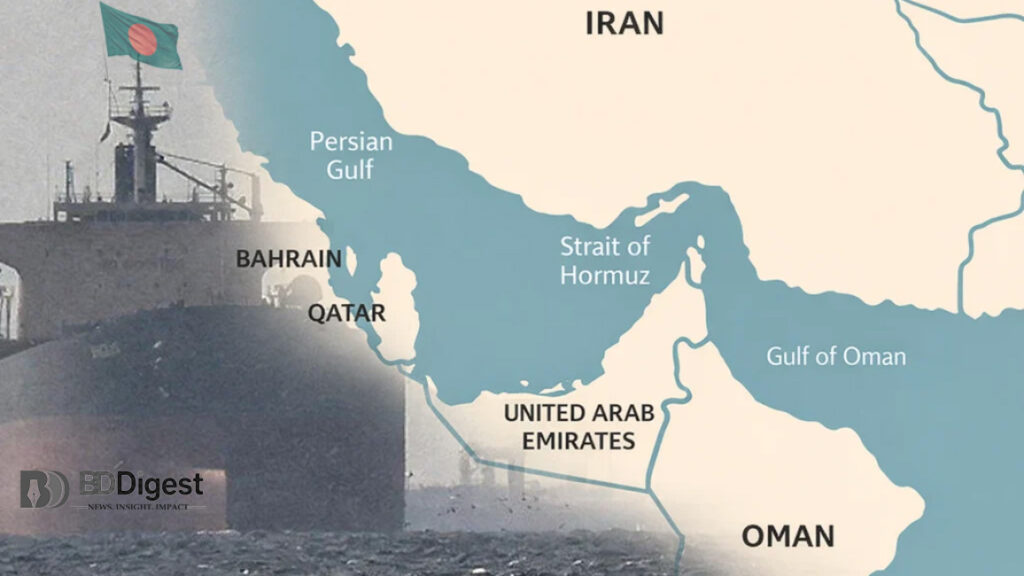
Earlier yesterday, Iran allowed India, China, Iraq and Qatar to use the Strait of Hormuz,
none of which have a US ‘reciprocal tariff agreement’ with them!

Special Correspondent. Dhaka, November 6, 2026.
Tehran has promised to help Bangladeshi ships safely transport fuel through the Strait of Hormuz; in return, it will coordinate with Iran and follow a set route. But new questions have arisen about a clause in the Reciprocal Trade Agreement signed with the United States at the end of the interim government. If Dhaka tries to increase trade or economic cooperation with Iran, it could face Washington’s objections and counter-tariffs—although the relevant clause in the agreement does not directly impose restrictions on all types of communication or fuel transport.
Iran has announced new possibilities for Bangladesh to use the Strait of Hormuz for its energy imports. The country is ready to assist Bangladeshi flagged ships in transiting the Strait of Hormuz if they coordinate with Iran in advance and follow Tehran’s designated safe waterways. However, Bangladesh may face diplomatic and commercial complications while taking advantage of this opportunity due to some conditions of the reciprocal trade agreement signed with the United States.
At a press conference held at the Iranian Embassy in Dhaka on Wednesday (November 4), Iranian Ambassador to Bangladesh Jalil Rahimi Jahanabadi outlined Tehran’s position on the issue.
The ambassador said that if any Bangladeshi ship wants to pass through the Strait of Hormuz, two things must be ensured. First, it must move in coordination with Iran. Second, it must follow the safe waterway determined by Iran. If these two conditions are met, there will be no problem from Iran in the movement of Bangladeshi ships.
He said that ships are currently passing through the Strait of Hormuz every day. He claimed that the ships that are being attacked or mine-blasted are traveling outside Iran’s designated route. If they follow the designated route and inform Iran, there should be no problem in the movement of ships.
However, he said that it is not possible to give any country full assurance about the safety of shipping in the Persian Gulf while the war is ongoing.
Iran offers special privileges to ships from four countries
The issue of Iran’s special concessions for shipping through the Strait of Hormuz has already been raised in the international media.
On November 3, Amir Hayat Moqaddam, deputy head of the Iranian parliament’s National Security and Foreign Policy Committee, said that ships from India, China, Iraq, and Qatar have been granted special exemptions to navigate the Strait of Hormuz. According to him, ships from these four countries are able to pass through the strait without being subject to Iran’s restrictions on movement.
According to the Anadolu Agency report, Iran is charging transit fees from Indian and Chinese ships, but Qatari ships are being allowed to pass through free of charge. The official said that these concessions were made on the basis of mutual interest and cooperation with Iran.
It is not certain whether Bangladesh has received any special privileges like these four countries. However, the Iranian ambassador’s statement made it clear that Bangladesh is interested in cooperating in the safe passage of Bangladeshi ships.
Two clauses of the US trade agreement are tied to coordination with Iran!
The most important question for Bangladesh has arisen regarding Article 4.3.4 of the ‘Agreement on Reciprocal Trade’ signed with the United States.
Article 4.3, Paragraph 4 of this agreement, signed with the United States on February 9, 2026, states:
“If Bangladesh enters into a new bilateral free trade agreement or preferential economic agreement with a non-market country that undermines this Agreement, the United States may, if consultations with Bangladesh fail to resolve its concerns, terminate this Agreement and reimpose the applicable reciprocal tariff rate set forth in Executive Order 14257 of April 2, 2025.”
That is, if Bangladesh enters into a new bilateral free trade agreement (FTA) or preferential economic agreement with a non-market country that undermines the interests of the agreement with the United States, the United States can first negotiate with Bangladesh. If those negotiations do not resolve the concerns, Washington can terminate the existing agreement and reinstate the applicable countervailing duties as per the executive order of April 2, 2025.
It is noteworthy that the clause does not simply state that a deal with Iran will automatically result in punitive measures. Rather, it stipulates that a new bilateral free trade or preferential economic agreement must treat the country concerned as a ‘non-market country’ and that the agreement must not affect existing trade agreements with the United States.
Article 4.2(2) of the US trade agreement could create new complications for Bangladesh in using the Strait of Hormuz. Under this clause, Bangladesh has agreed to cooperate with the United States in a way that limits transactions that violate US sanctions and export controls.
Bangladesh shall cooperate in a manner consistent with, and permitted by, applicable requirements of domestic law, with the United States with a view to restricting transactions that would be violations of US sanctions or export controls if they occurred in the United States or by a US person. (7)
Reference No. 7 of this article mentions which US departments Bangladesh has to comply with in its “reciprocal customs agreements” with:
(7) These transactions include those involving individuals and entities included on the Department of Commerce, Bureau of Industry and Security’s Entity List (Supplement No.4 of Part 744 of the Export Administration Regulations), as well as the Department of the Treasury, Office of Foreign Assets Control?s Specially Designated Nationals and Blocked Persons List (SDN List) and Non-SDN Consolidated Sanctions List.
These transactions include individuals and entities listed on the U.S. Department of Commerce’s Bureau of Industry and Security’s Entity List (Supplement No. 4 to Part 744 of the Export Administration Regulations); and individuals and entities included on the U.S. Department of the Treasury’s Office of Foreign Assets Control’s Specially Designated Nationals and Blocked Persons List (SDN List) and the Non-SDN Consolidated Sanctions List.
As a result, Bangladesh must be careful when transporting energy through the Strait of Hormuz in coordination with Iran. In particular, any agreement with Iran or transactions with any sanctioned Iranian institution, ship, bank or financial system may fall under US sanctions. In such a situation, there is a risk of violating the terms of the US agreement while cooperating with Bangladesh in transporting energy.
In other words, even if Iran offers Bangladesh cooperation in using the Strait of Hormuz, this contractual obligation to comply with US sanctions could become a diplomatic and commercial obstacle to implementing that cooperation.
US sanctions on Iran and the possible consequences for countries that violate them
The United States has imposed extensive economic and trade sanctions on Iran for decades. These sanctions cover Iran’s oil and gas industry, banking and financial system, shipping, petrochemicals, military equipment, missile and drone technology, and related individuals and entities. These sanctions are administered by the U.S. Treasury Department’s Office of Foreign Assets Control (OFAC).
Most importantly, US sanctions are not limited to US citizens or entities. In certain cases, third-country individuals, entities, banks, or shipping companies doing business with Iran may also be at risk of US secondary sanctions.
Iran not opening Hormuz until war ends
Ambassador Jalil Rahimi said at a press conference that discussions have been held with Oman and Qatar about reopening the Strait of Hormuz. However, there are no plans to reopen the strait normally for now.
According to him, progress on the issue of opening the Strait of Hormuz is not possible without the lifting of the US naval blockade and guarantees that Iran will not attack again in the future.
He said Iran’s proposals and conditions have been conveyed to the United States through intermediaries. Tehran is ready to open the Strait of Hormuz if Iran’s announced conditions, including lifting the blockade and promising not to attack again, are accepted.
The ambassador further alleged that the US and Israel attacked Iran just as the Oman-mediated talks were moving towards success. He claimed that the aim of the ongoing war against Iran was to change the country’s political system, destroy its missile capabilities and take uranium out of the country. But these goals were not achieved.
Expressing concern about possible new attacks, he said that the conflict with the United States and Israel could escalate. He commented that even the threat of a nuclear attack cannot be ruled out. However, these statements are the Iranian ambassador’s own assessment and allegations.
Bangladesh faces challenges of energy security and diplomatic balance
The Strait of Hormuz is a crucial waterway for Bangladesh’s energy imports. If the passage through this route becomes uncertain, it could put pressure on the timing, transportation costs, insurance and supply of energy imports.
The opportunity to use a safe route in coordination with Iran creates a possibility for Bangladesh to continue using the existing important waterway instead of alternative supply routes. However, there is no confirmed information yet on how much transportation costs will be reduced as a result, what the transit fees will be, or whether there will be any special financial benefits for Bangladesh.
On the other hand, the trade agreement signed with the United States is important for Bangladesh’s exports and bilateral trade. Therefore, the potential impact on US trade relations must also be taken into account while ensuring energy security.
The question is, to what extent can Dhaka utilize the necessary coordination and cooperation opportunities with Iran for the sake of Bangladesh’s energy security? And what kind of legal and diplomatic measures will be taken to ensure that this cooperation does not conflict with the terms of the agreement signed with the United States or with US sanctions?
The ongoing crisis over the Strait of Hormuz is not just an energy transportation issue for Bangladesh;
it is also a critical test of the country’s commercial freedom, energy security, and foreign policy balance.

https://stapravda.ru/20221228/reyting_samyh_populyarnyh_hostingov_v_rossii_196445.html, рейтинг хостингов России подтверждает, что выбор надежного провайдера важен для бизнеса.