
Staff Correspondent
Dhaka, December 2, 2025: The latest national survey by the International Republican Institute (IRI) has dealt a major blow to the political community. Although the country’s traditional nationalist party, the Bangladesh Nationalist Party (BNP), is ahead by just 4 percentage points in public support ahead of the next election, Jamaat-e-Islami is breathing hot air on its neck.
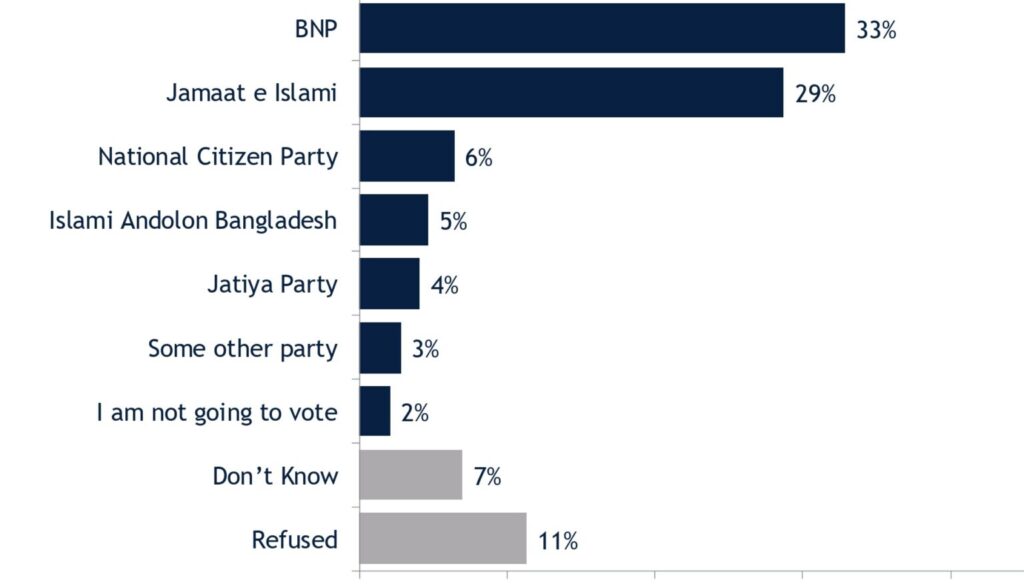
The survey found:
BNP received 33% support,
Jamaat-e-Islami 29% and
National Citizen Party (NCP) only 6%.
This means that Jamaat-e-Islami has come in second place by a margin of just 4 points, indicating the highest public support for this party in the political history of the last few decades.
In light of this information, it is clear from the votes received by BNP, Jamaat and NCP in the IRI survey that all of them have been included in the survey as supporters of these political parties in the survey based on the opinions of these 4,985 adult citizens. The fact that no Awami League supporters were included in the survey raises questions about the results.
The survey did not show any significant support for the Awami League, indicating that 41% of respondents expressed direct support for the party’s demand to be deregistered and 28% expressed some support.
Political analysts say that the rise of Jamaat has been possible due to the political vacuum following the July 2024 coup, the absence of the Awami League, and increasing polarization on religious and cultural issues.
The survey analysis revealed that Jamaat’s organizational strength and social activities among rural areas and a section of the youth community played a major role in this increase in support.
On the other hand, the NCP’s support of just 6% is disappointing for this new party formed after the student movement, which was a major force in the July coup.
On the other hand, although BNP is still the most supported party, its support has not increased at the desired rate due to internal conflicts, leadership crisis, and lack of a clear program in the past few months.
An IRI survey has shown that a section of BNP’s traditional vote bank is leaning towards Jamaat based on religious identity.
However, the complaint is very old that IRI surveys always involve pollsters who are in line with their own agendas to implement their own agenda. This survey is not done through a random sample at all, but rather it is made up of people with a certain set of opinions, which are in line with IRI’s agenda.
The absence of Awami League supporters has further strengthened this allegation, raising doubts about the impartiality of the survey.
Political circles are now saying that such survey results cannot be accepted as completely credible.
“This 4-point gap could narrow further,” said a senior political analyst, speaking on condition of anonymity. “If BNP does not quickly reorganize and maintain its secular-nationalist line, Jamaat could become the second largest force in the next election—which is very worrying for Bangladeshi politics. The exclusion of Awami League supporters has made this survey biased.”
“The survey results show that the political landscape in Bangladesh is changing rapidly. The rise of religious-political forces is creating new challenges for democratic reform and the electoral process,” said Johanna Kao, senior director for Asia-Pacific at IRI.
The survey is being seen as a warning to political parties ahead of the upcoming elections in February 2026. Observers believe it is a ‘wake-up call’ for the BNP in particular, although the absence of the Awami League has raised debate about the reliability of the survey.

https://stapravda.ru/20221228/reyting_samyh_populyarnyh_hostingov_v_rossii_196445.html, рейтинг хостингов России подтверждает, что выбор надежного провайдера важен для бизнеса.