

Staff Correspondent
The results of Bangladesh’s recent national election (12 February 2026) have seen the BNP-led coalition secure a landslide majority and move towards forming a government, but Jamaat-e-Islami’s (Jamaat) win of 68 seats (77 seats including the alliance) has created a serious regional security concern, especially in the India-border area.
Jamaat’s near-monopoly victory in areas adjacent to the Siliguri Corridor (Chicken Neck) including Satkhira, Kushtia, Rangpur, Sherpur, Naogaon, Joypurhat, Gaibandha, Dinajpur, Chapainawabganj (e.g. all 4 out of 4 in Satkhira, 3 out of 4 in Kushtia) could pose a serious threat to regional stability, according to national security analysts.
More than 51 of these seats are located in border districts, which form a continuous belt that is directly connected to West Bengal, Assam, Tripura and Chicken Neck.
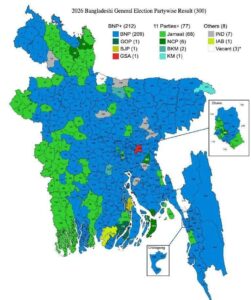
This success of Jamaat is not a sudden event; it is the result of long-term strategic efforts. In the border districts, Jamaat has long built local support through madrasa networks, mosque-based organizations, and economic assistance (welfare programs in poverty-stricken areas, job/business opportunities).
These networks have deep roots in rural and border communities, which have served as their vote bank in elections. Political analysts have noted that Jamaat’s strength in this area is not just electoral—it is based on a mosque-madrasa-based patronage system.
In this context, the reluctance to share the water of the Teesta river in Bhoyart, the border killings have played an influential role for Jamaat, making it easier to gain support. The people of the Teesta banks (Rangpur, Lalmonirhat, Nilphamari, etc.) have been suffering from drought, crop failure and water shortage for a long time. Local anger is growing due to the lack of a Teesta agreement with India, which Jamaat has exploited in its anti-India campaign.
Border killings, the unresolved water sharing of 53 rivers, and other grievances have fueled hatred and opposition among locals by portraying Jamaat as “Indian hegemony.” This anger has further consolidated their position, especially in the northern region adjacent to Chicken Neck.
This socio-political context, coupled with the recent India-Bangladesh regional security report, has created extreme regional security concerns.
Bangladesh’s National Security Advisor Khalilur Rahman met with India’s National Security Advisor Ajit Doval in Delhi in November 2025. There, Indian intelligence agencies informed Bangladesh about the existence of at least 12 militant camps/training camps in the border districts (from Rangpur to Chittagong Hill Tracts). India sees these as a threat to regional security, and Bangladesh was urged to take action in this regard.
Khalilur Rahman later discussed this issue with Ajit Doval at the Indo-Pacific Security Summit in Qatar (Doha), where Khalilur Rahman evaded responsibility by saying that all those militant bases were created during the Awami League era, which has added complexity to the context of India-Bangladesh security cooperation.
An invisible link is becoming increasingly apparent between Jamaat’s border dominance and allegations of militant camps. International and national security analysts are expressing concern that Jamaat’s madrasa-mosque network and economic influence could act as a pipeline for radicalization in the area.
Security analysts have noted that many militants emerge from Jamaat’s grassroots (madrasas, student organizations), although there is ideological overlap, even if there is no direct control. This network can provide recruitment and logistical support for militant groups (such as JMB or Ansarul Islam or Hizb ut Tahrir).
Jamaat’s political control over the border areas could help secure these camps, which would jeopardize the security of India’s northeast, West Bengal, and Chicken Neck.
Jamaat has also been observed networking with internal separatist groups (such as ULFA, NDFB, NSCN, NLFT, ATTF, etc.) and fundamentalist fronts in India during its time in power.
India alleges that separatist groups in India’s northeast were given shelter, training camps and logistical support in Bangladesh during the BNP-Jamaat coalition government in the 1990s and 2000s. This is evidenced by the seizure of 10 weapons during unloading at the Chittagong Urea Fertilizer Factory (CUFL) jetty on the midnight of April 1, 2004, which entered Bangladesh through Jamaat connections and were destined for separatist groups in Assam.

Besides, during the Jamaat regime, many ULFA leaders were reported to be safely residing in Bangladesh and conducting their operations from Bangladesh. Around 2009-2010, the Bangladesh government took a tough stance against ULFA and arrested many top leaders and handed them over to India. Among them were ULFA Chairman Arvind Rajkhowa, General Secretary Anup Chetia, Chitraban Hazarika, Mithinga Daimari, Shashadhar Chowdhury and many others.
This network was established with Jamaat through Pakistan’s ISI and separatist groups in the northeast of India, which facilitated the establishment of camps in the Chittagong Hill Tracts and border areas. Now, the establishment of Jamaat’s stronghold in the border area will facilitate communication with this old network, which can pose a threat to both Bangladesh and India. August 2024 Many members of the ISI, starting from the Pakistani army, have been secretly moving around in northern Bangladesh, which security analysts see as an attempt to re-establish the old network. Which can create the possibility of increasing instability especially in the narrow corridor like Chicken Neck and isolating northeast India.
Jamaat’s main goal—to create instability in India-Bangladesh relations and threaten regional security—is to create instability in the same way that LeT was creating instability in Jammu and Kashmir with the help of Pakistan. Similarly, Jamaat-e-Islami has strengthened its foundation to create instability in the border areas through its anti-India propaganda, inciting anger over the Teesta/border issue, and establishing political-religious control over the border through the 13th election of 2026.
If the Bangladesh government and security forces (BGB, RAB, police) do not immediately undertake effective operations, intelligence surveillance, madrasa regulation, and local economic development in the border areas, then Jamaat’s hatred, extremism, and local anti-India sentiment could take the form of border conflicts, infiltration, or transnational militant activities at any time.
This situation poses a threat not only to Bangladesh-India relations but also to the stability of the entire South Asia. This will probably be the biggest challenge for the newly formed BNP government, which is to maintain stability in the region by securing the 4,097 km border between India and Bangladesh. Joint intelligence operations with India, strengthening border security and dismantling militant networks must be taken now, otherwise Jamaat’s border dominance could sow the seeds of regional war.

https://stapravda.ru/20221228/reyting_samyh_populyarnyh_hostingov_v_rossii_196445.html, рейтинг хостингов России подтверждает, что выбор надежного провайдера важен для бизнеса.