
Ajay Bengali, Dhaka
A long-standing reality in Dhaka politics is that Jamaat-e-Islami has been particularly focused on expanding its influence in certain areas of the capital. In the past decade, financially capable members of the organization have been encouraged to buy flats or houses in these three areas – Jatrabari, Rampura and Uttara. New madrasas, dawah centers and organizational hubs have also been established in these areas.
A strong presence of Jamaat-e-Shibir activists was seen in these areas during the July 2024 movement. At that time, Jamaat-e-Islami deployed its manpower from all over the country.
But the inability of Jamaat-e-Islami’s local force in Dhaka, outside of its nationwide manpower, to hold public gatherings to ‘resist the lockdown’, or the negligible attendance at the rally demanding a referendum on Dhaka and surrounding districts on November 11, has raised new questions.
According to political observers, Jamaat was able to demonstrate a visible force in the besieged areas of the capital in July 2014 through processions, sit-ins and overnight resistance. But with the departure of outside workers from Dhaka, the organizational status of Jamaat-Shibir is not in a strong state. This was the long-standing discussion of Jamaat-Islami’s dismal defeat in the Awami League-Jamaat-e-Islami battle on October 28, 2006.
July to November—Big difference in rally participation
A senior journalist who has been monitoring the party’s activities for a long time believes that the picture has changed in 2025. According to him, lakhs of people gathered in Dhaka for the rally announced by Jamaat-e-Islami on July 19 this year—which is considered the party’s biggest show in recent times. But about 10,000 people attended the rally organized on November 11 demanding a referendum.
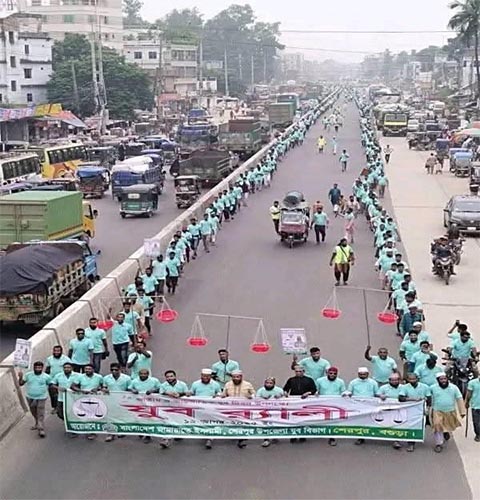
Social media mocks Jamaat’s attempt to occupy the road at youth rally as ‘a packet of chips filled with air’
According to the news-observer journalist, “The participation in the November rally has decreased dramatically compared to July. This clearly highlights the gap between the organization’s current capacity and its field mobilization capacity.”
Collapsed organizational structure takes to the field to resist Dhaka lockdown
On November 13, Jamaat-e-Islami attempted to hold processions and rallies in various places in Dhaka to protest the lockdown called by the Awami League. But the size and number of people at the rally revealed the party’s fragile organizational state.
Observations have revealed that 40-50 people were present at the Mohammadpur intersection, 20-25 at Shyamoli intersection, 100 at Uttara, and 100 at Badda in the Jamaat-e-Islami procession and rally.
According to political analysts, such a low presence indicates Jamaat’s organizational weakness in strategically important areas like Dhaka city.
Only in two places were relatively large processions seen – 250-300 people led by DUCSU VP Sadek Kayem in the Dhaka University area, and when they went from there to occupy and set fire to the Awami League office jointly with the Inquilab Manch on Bangabandhu Avenue, there were about 200-300 leaders and activists present.
Motorcycle showdown a week ago—but a different picture on the field
In contrast, another issue discussed in political circles is Jamaat’s heavily armed motorcycle showdown last week during the election campaign for Dhaka-5 and Dhaka-9 constituencies, which was seen as a new display of their organizational strength. But when the party’s actual cadres and field presence are tested in the face of the November 13 lockdown, they appear alarmingly low.
According to political analysts, “The power that has been seen in the campaign showdowns is mainly the power of the demonstrative organizations. Many of the workers hired from outside are involved in these election showdowns. However, the permanent mobilization power of the organizations in the real political arena has greatly diminished.”
Many analysts believe that Jamaat’s visible strength in the capital depends on bringing in workers from all over the country.
Apart from this, the party still retains some social and financial foothold in the Jatrabari-Rampura-Uttara belt. However, the continuous decline in attendance at recent protests and rallies and the failure of field mobilization during the lockdown indicate that Jamaat’s position in the capital is much weaker than before, according to analysis by political observers.
Security analyst Aminul Haque said the party’s central leadership’s organizational coordination is weak, long-term negative pressure and a section of the younger generation have created political distance. He said, “Jamaat’s organizational strength in Dhaka is now mainly limited to online zones, electoral showdowns and some small and large cell-based activities of student organizations.”
He commented that due to these reasons, Jamaat’s direct field organization in Dhaka has rapidly shrunk.

https://stapravda.ru/20221228/reyting_samyh_populyarnyh_hostingov_v_rossii_196445.html, рейтинг хостингов России подтверждает, что выбор надежного провайдера важен для бизнеса.