
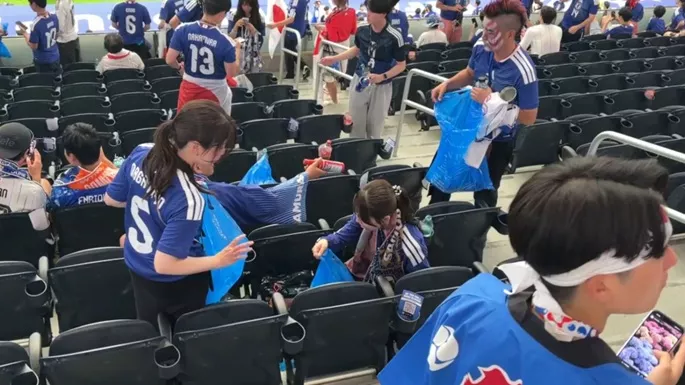
The final whistle had just blown on the field. The incredible skill with which Japan, despite falling behind by two goals against the Netherlands, managed to draw 2-2 was, in a word, a fairy tale. The Dutch and Japanese fans were still in a frenzy in the Texas gallery. But as soon as the familiar frenzy of the end of the match subsided, a completely different scene emerged, one that once again flooded the World Cup with human beauty.
The players on the field did indeed stand up, but the Japanese fans took over the gallery after the match. They left the field only after their seats in the stadium’s gallery were spotlessly clean. The spectators described cleaning their own space in this way as part of “Japanese culture.”
The story of staying in the stadium even after the match
After the thrilling 2-2 draw, while the general public was busy leaving the field, the Japanese fans remained in the gallery. They carefully started picking up all the litter scattered around, ensuring that the entire stadium was as clean as when they arrived. They were seen carefully picking up every water bottle and piece of paper and stuffing it into blue plastic bags.
This habit is not for show, but a lifelong habit they have learned since elementary school. “We have to think about everyone,” 20-year-old Japanese fan Eita Tanaka told AFP, wearing Japan’s traditional blue jersey and stuffing cups into a bag. “The Japanese believe that when we use a certain place, we should leave it cleaner than when we arrived. That’s what we’ve been taught. For example, at school we clean our classrooms ourselves without any instructions from the teacher.”
A unique ‘calling card’ in the international arena
Japan is participating in the World Cup for the eighth time in a row. And each time, along with their on-field performances, the cleanliness of their fans has become a unique identity or ‘calling card’ in the international arena. After Sunday’s match, the opposing Dutch fans were impressed by the Japanese’s actions. Even NFL quarterback Jameis Winston was seen participating in the clean-up effort, wearing a blue Japan jersey with his name on it.
Japanese supporter Futo Hagiwara said he was proud that his countrymen’s behavior was being positively evaluated worldwide. “It’s our culture,” he said. “It means that wherever we go, we have to clean up after ourselves. It’s our spiritual path and attitude.”
Social responsibility or environmental circumstances?
According to sociologist and philosopher Masachi Osawa, a combination of social responsibility and peer pressure is behind this behavior of supporters. “While the Japanese generally don’t worry much about large-scale global issues, they are very sensitive to small-scale morality. When it comes to people they share the same space with, they feel a strong urge not to get them into trouble,” he says.
Scott North, emeritus professor of sociology at Osaka University, says that this group behavior is very common in Japanese society. When leaders pull out the bag and say, “Here, let’s start,” no one can say no. Sociologist Osawa explains this behavior with a special Japanese proverb—’reading the air.’ According to him, if even one person in Japan starts picking up trash, the people around them feel that they have no choice but to join in.
Life’s lesson
In the Japanese education system, cleanliness is a major part of education from a young age. Children are seen wiping down school floors and tables every day. Additionally, public dustbins are rare in Japan, so people are usually accustomed to bringing their own garbage home.
Whatever the reason, it goes without saying that as long as Japan is in the tournament, the clean-up festival in the stands will continue, as well as the football on the field. Their next match is against Tunisia in Mexico next Saturday. Supporter Hagiwara is very happy to lead by example. “We don’t usually tell children what they should do. We just show our actions and behavior, and other people follow us,” he said with a smile as he left.

https://stapravda.ru/20221228/reyting_samyh_populyarnyh_hostingov_v_rossii_196445.html, рейтинг хостингов России подтверждает, что выбор надежного провайдера важен для бизнеса.