

BD Digest Desk
Justice Makers Bangladesh in France (JMBF) has expressed concern at the United Nations Minority Affairs Forum over the ongoing repression of minority communities, human rights defenders, journalists, and Awami League leaders and activists in Bangladesh.
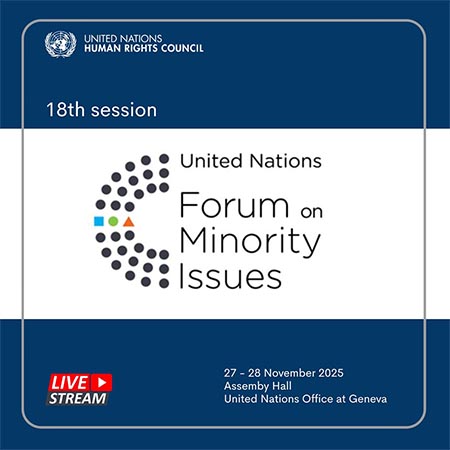
Advocate Shahanur Islam raised these allegations in an oral statement presented on behalf of the organization at the 18th United Nations Forum on Minority Issues held in Geneva on Thursday, November 27.
He said that despite protections in the constitution, gender-diverse populations, including religious, linguistic, and indigenous minorities—especially LGBTQI+ individuals—are subject to discrimination, intimidation, and persecution.
He also commented that these human rights violations are weakening the country’s social harmony and reducing people’s trust in the state.
Presenting the findings of the JMBF investigation, Advocate Islam said that nearly 400 gender-diverse individuals have been subjected to torture in the past year.
He mentioned the arrest of Dhaka University Professor Md. Ershad Halim on November 13, the dismissal of Kushtia Islamic University Professor Hafizul Islam on January 26, the expulsion of transgender student Sahara Chowdhury from Sylhet Metropolitan University on August 10, and the eviction of seven students from the Dhaka University of Engineering and Technology due to their gender identity in July.
The statement also expressed concern about the deteriorating situation of religious minorities. It was noted that on November 19, two Hindu government officials—Anup Kumar Biswas and Navamita Sarkar—were allegedly removed from their jobs without any explanation, which has caused panic among the concerned community.
Advocate Shahanur Islam called for ensuring impartial investigations into these incidents, increasing the participation of minorities in decision-making platforms, ensuring the protection of women and children, and increasing international monitoring to strengthen peaceful coexistence between communities.
In addition to his speech at the UN, he held three separate meetings with human rights defenders, special rapporteurs on freedom of expression, and freedom of assembly and association.
In a discussion on the safety of human rights defenders, he raised allegations of attempts to arrest JMBF Secretary General Advocate Mohammad Alamgir at his home in Brahmanbaria and called for immediate international action for his safety.
In a meeting with the Office of the Rapporteur on Freedom of Assembly and Association, he expressed deep concern over the interim government’s executive order banning the Awami League, the largest political party in Bangladesh.
He expressed concern over false cases, arbitrary arrests and detentions without trial against party leaders and supporters. He also described the plan to suspend the registration of the Awami League and hold national elections without the largest political party as a threat to the democratic process.
He also gave examples of repression against journalists.
He presented information on the 15 false cases and 15-month long imprisonment against journalist Farzana Rupa and her husband Shakil Ahmed, the cancellation of accreditation of 167 journalists, the involvement of 266 people in false murder cases, and the arrest of at least 14 prominent journalists on false charges.
At the same time, he also mentioned the loss of jobs of more than a thousand journalists, the cancellation of press club memberships, and the occupation or destruction of media offices.
His speech also highlighted the need for increased international monitoring and effective initiatives regarding the human rights situation in Bangladesh.

https://stapravda.ru/20221228/reyting_samyh_populyarnyh_hostingov_v_rossii_196445.html, рейтинг хостингов России подтверждает, что выбор надежного провайдера важен для бизнеса.