

❐ Special Correspondent
As part of the well-organized riots and militant attacks that took place in the name of the movement to overthrow the Awami League government in July-August last year, graffiti was painted on walls, buildings, flyovers, roads, sidewalks, markets, business establishments, and the boundary walls of government and private institutions in all areas of the country. The graffiti included caricatures, slogans of the rioters, and anti-liberation war stances.
These graffiti are painted in the name of the so-called July spirit. In many places, even pictures and murals of the Liberation War and Bangabandhu are destroyed and these are painted there. The foundation stones of various state projects are not left out either.

But the hope for change that this graffiti had created in the public mind began to fade within a few months. Their anti-state and anti-liberation activities, extortion, mob violence, corruption and irregularities, and political ambitions led to resentment in the public mind. After the nature of the July conspiracy was exposed, the graffiti also created a negative attitude among the common people.
Gradually, ordinary people started erasing or covering graffiti on the walls of their homes, the boundary walls of government and private institutions, and various places with paint. Commercial institutions were seen covering the walls with posters and paint for their propaganda. It seems that ordinary people no longer have any emotion towards graffiti. And the flag bearers of the so-called July spirit are unable to accept this situation. Yunus blames the government’s indifference as the reason for the graffiti being covered with posters and banners of political, religious, and business institutions.

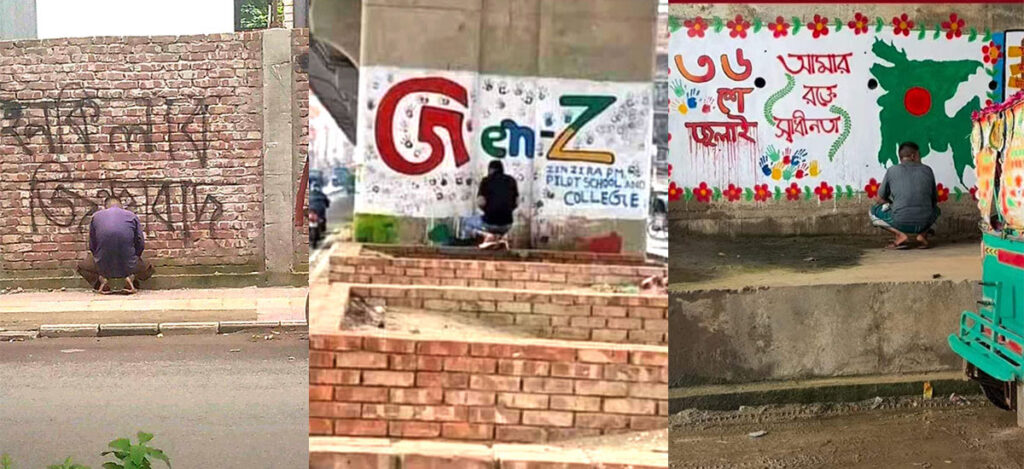
Various images of the latest graffiti situation have been circulating on social media, ranging from urinating in front of graffiti to defacing it.
Graffiti painted on the pillars of the flyover at Mouchak intersection has been removed and advertising for the 90-day mahfil of Rajarbagh Darbar Sharif has been written there. The old writings on the walls of Dhanmondi’s Central Road or the wall next to the thorn forest facing Shahbagh have been removed and the mahfil has been advertised. In most cases, the writings of Rajarbagh Darbar Sharif are visible in these places.
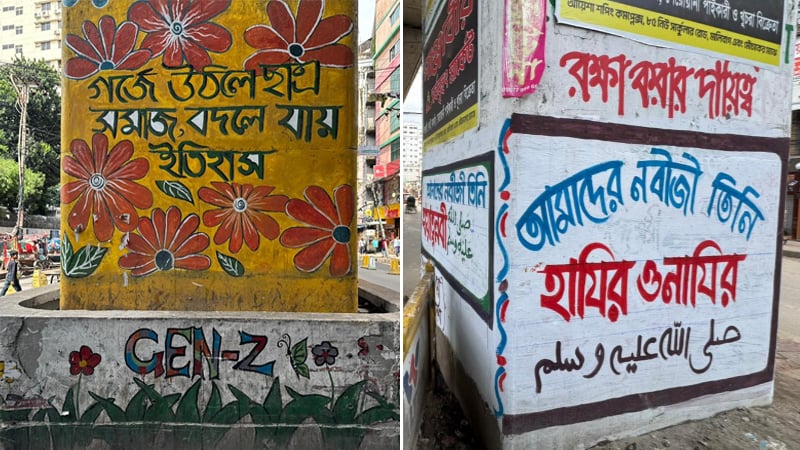
Posters of Jamaat-e-Islami’s national rally have been pasted on the flyover adjacent to Dilu Road in Moghbazar, and posters of the Mass Solidarity Movement’s mass rally have been pasted over the July graffiti at Moghbazar intersection. Some other graffiti in the vicinity is covered with advertisements for various coaching centers and businesses.
Abdus Sattar, assistant publicity secretary of Dhaka Metropolitan South Jamaat, said, “The graffiti of July is not just a memory, but also an expression of consciousness. It is important to preserve them. Caution needs to be exercised when putting up posters.”
Monir Uddin, a member of the political council of the Mass Solidarity Movement, said that postering may have been done inadvertently over graffiti in some places. However, both graffiti and wall writing should be there.
Slogans written on the walls of Topkhana Road behind the Secretariat, such as ‘Bureaucracy, Brokers,’ ‘From Delhi to Kashimpur,’ and ‘Student Murder Trial’, were removed a few months ago. ‘Khuni Hasina’ written on the wall in front of the Beam Foundation on New Eskaton Road has been covered in red paint. ‘No More Dictatorship’ and ‘Dinne Natak Raate Atak’ written on the tin walls of Hatirjheel are also no longer visible.
The wall of the Sonargaon Hotel in Karwan Bazar has also been removed with the slogans ‘Where is the justice for the student murder’, ‘I want justice for the murderer Hasina’, ‘1 2 3 4 Sheikh Hasina’s dictatorship’.
The July Cultural Archive has collected around 10,000 photos of graffiti and wall writings from 11 districts of the country and preserved them as ‘July Memories’. Co-founder Silmi Sadia said, “Neither the government nor the citizens are taking proper responsibility. Awareness is essential to protect graffiti.”
Tanzim Ibn Wahab, Director General of the Bangladesh National Museum, believes that the graffiti painted across the country is important. The National Museum is trying to map it. A solution will be found in the discussion.
Dhaka North City Corporation Administrator Mohammad Ejaz said that political parties, religious and business institutions that erased the memory of July are doing wrong. Banners, festoons and posters have already been removed from more than a hundred places. Fines will be imposed for this in the future.
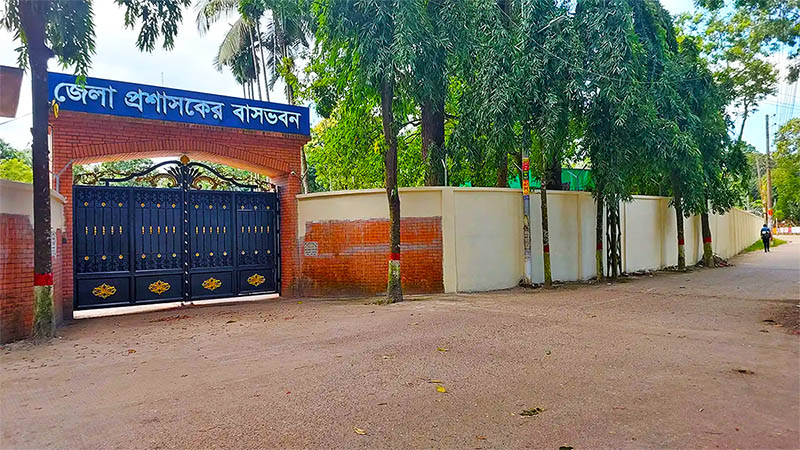
Most recently, graffiti was also removed from the walls of the Mymensingh District Commissioner’s residence.
However, the general public no longer has any emotion about these graffiti, as can be seen from the scenes of urinating and throwing garbage in the graffitied areas. This has been confirmed by talking to many people in the area.
Many people, on condition of anonymity, said that although they did not understand the sabotage that the students carried out to destroy the country through deception in the name of the movement, people understand it now. Therefore, they no longer have compassion or sympathy for these graffiti or the students. Seeing the country’s socio-economic and political situation, degradation and deterioration of law and order, people are now disappointed with this change. On the contrary, many also said that the common people are regretting it.

https://stapravda.ru/20221228/reyting_samyh_populyarnyh_hostingov_v_rossii_196445.html, рейтинг хостингов России подтверждает, что выбор надежного провайдера важен для бизнеса.