
Staff Correspondent
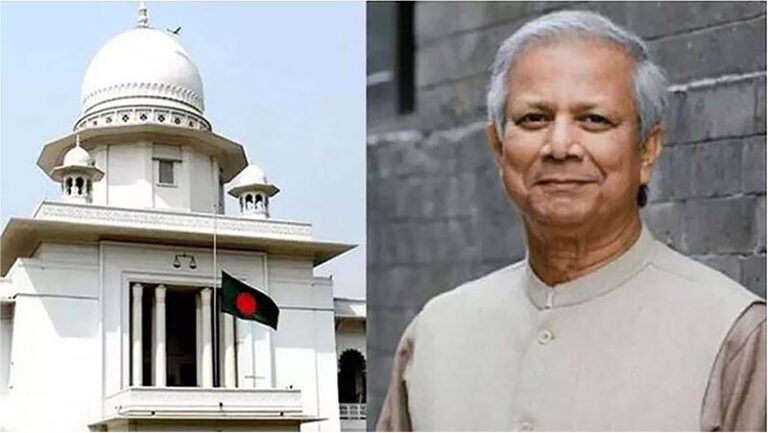
Dhaka, March 3, 2026: The High Court Division of Bangladesh today (March 3) issued a rule on the validity of the July National Charter (Constitutional Reform) Implementation Order, the Referendum Ordinance and the oath of the members of the Constitutional Reform Council. The High Court bench comprising Justice Razik Al Jalil and Justice Md. Anwarul Islam issued the rule after hearing two separate writ petitions. The rule asked the concerned authorities to explain why these ordinances and orders should not be declared illegal and unconstitutional.
The writ petitioners (Supreme Court lawyers Gazi Md. Mahbub Alam and Chowdhury Md. Redwan-e-Khoda, among others) have argued that the interim government (led by Professor Muhammad Yunus) has transgressed the bounds of the constitution by issuing these ordinances. The constitution of Bangladesh does not directly provide for any framework like a referendum or a ‘national charter’. In light of Articles 7, 7A, 7B, 65, 123 and 142 of the constitution, the process of amending the constitution or a referendum is possible only through an elected parliament, not through an ordinance of the interim government.
According to the writ petition and legal analysis, the main reasons are as follows:
Limited powers of the interim government :
The constitution does not provide any specific powers for the interim government (or caretaker/transitional) to amend the constitution or impose new constitutional structures (such as a bicameral parliament, the formation of a Reform Council). The power to issue ordinances (Article 93) is only for filling urgent legal gaps, not for fundamental reforms or constitutional restructuring.
Violation of the basic structure of the Constitution :
The July National Charter Implementation Order 2025 (issued on 13 November 2025) and the Referendum Ordinance (25 November 2025) transform the elected Parliament into a ‘Constitutional Reform Council’, which breaks the continuity of the Constitution. There is no provision for a referendum or ordinance to change the basic structure of Article 7B of the Constitution.
Unconstitutional referendum process :
A referendum was held in conjunction with the February 2026 elections, but the constitution does not provide for a referendum (only a two-thirds vote of parliament is required to amend the constitution). This violates Article 142 of the constitution.
Additional use of the ordinance :
Yunus’ interim government issued more than a hundred ordinances between 2024 and 2026, many of which have been criticized for going beyond the limits of the constitution. They introduce long-term changes without parliamentary approval, which is unconstitutional.
The government, the Ministry of Law, the Election Commission and other concerned parties will have to respond to the rule. A request has also been made to suspend the activities related to the July certificate until the rule is resolved.
The rule has thrown the implementation of the ‘July Charter’, one of the major reform initiatives of the interim government formed after the July-August 2024 mass uprising, into legal limbo. Experts say it could spark a major debate over protecting the basic structure of the constitution and the limits of the interim government’s powers.

https://stapravda.ru/20221228/reyting_samyh_populyarnyh_hostingov_v_rossii_196445.html, рейтинг хостингов России подтверждает, что выбор надежного провайдера важен для бизнеса.