

Staff Correspondent
On July 16, 2025, the Bangladesh Army opened direct fire on an angry crowd in Gopalganj, which was completely unnecessary. However, this incident bears resemblance to a similar firing by the army during the student-led mass movement in July 2024. The weapons used in both cases were 7.62 caliber, fired from the army’s main assault rifle, the BD-08.
These incidents bear witness to the army’s failure to fulfill its duty to maintain law and order and the excessive use of force against civilians. According to the official version, five people were killed in this unauthorized firing by the army in Gopalganj, although according to the Gopalganj residents, the real number is 23, as many people are still missing, and more than a hundred people were injured.
After the Gopalganj incident, BD Digest’s correspondent went to investigate on the spot and found that local residents had preserved shells and bullets used by the army. These bullets were tested and confirmed to be of 7.62×39 mm caliber, which is used in the BD-08 rifle. The BD-08 is the Bangladeshi version of the Chinese Type-81 rifle, which has an effective range of 500 meters and is capable of hitting targets with 99% accuracy.
These weapons and ammunition are produced at the Bangladesh Ordnance Factory (BOF), a state-owned enterprise run by the people’s taxes and controlled by the army.
This rifle is suitable for throwing grenades and using modern sights and lasers. All 23 people who were killed during the government-organized Jatiya Nagorik Party’s provocative public meeting and the protest against the threat of demolition of Bangabandhu’s tomb in Gopalganj (although the government report mentions 5 people), were found to have bullet wounds of 7.62 mm caliber. These bullets are used in army weapons. Forensic analysis, eyewitness accounts and statements from relatives of the victims have revealed that these deaths were caused by the army and paramilitary forces.
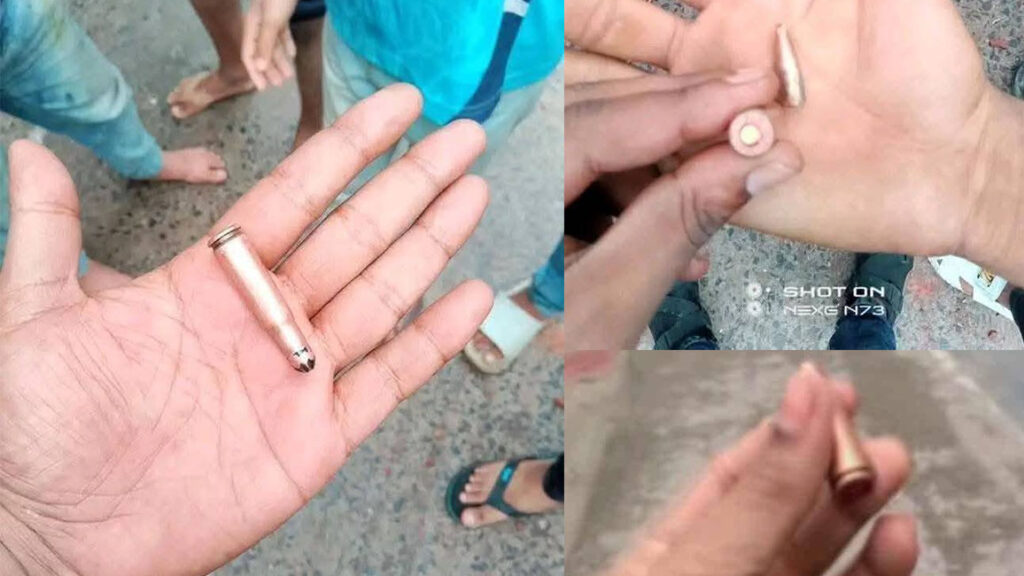
Bullets fired by the army in Gopalganj
As this information has come to light, it has become clear that the state has used its own armed forces to commit brutal killings in response to the angry protests of the people who threw stones. However, the army in a statement described the protests with sticks and stones as “law enforcement forces firing in ‘self-defense’ against an armed riotous crowd.”
Forensic found : 7.62 bullets everywhere
Forensic reports from Dhaka’s Shaheed Suhrawardy Medical College, Chittagong Medical College and Faridpur Medical College Hospital in July-August said that the bodies of the deceased bore wounds from 7.62×51 mm NATO grade bullets – these bullets are used only in the G3 and SLR rifles used by the army and BGB. They do not match the bullets used by the police.
“This type of gunshot wound is specific. It’s not like a pistol, shotgun, or police .303 round,” said a forensic doctor, speaking on condition of anonymity.
In the July 2024 shooting incident on the student crowd, the then Home Affairs Advisor Brigadier (Retd.) Sakhawat Hossain admitted that the 7.62 caliber bullet found in the bodies of the victims was not used by the police, RAB or Ansar force. This means that this bullet was used only by the Bangladesh Army.
So the question arises, was the army responsible for firing on students and the public in July-August 2024, or did some other group use these weapons? Similarly, in July 2025, the army opened fire on civilians in Gopalganj without any warning or caution, which is consistent with previous incidents.
This unauthorized and excessive firing by the army in July 2024 is considered one of the reasons for the fall of the then government. The army later played an important role in the formation of the interim government. But is the opposite of the popular talk of the army’s non-cooperation in the fall of the government true? Did the army play an effective role in hastening the fall of the elected government by killing students and the public ‘unauthorized’? A similar incident of firing in Gopalganj in July 2025 further clarifies the army’s failure to fulfill its duties and its tendency to use excessive force on the people.
Army Chief General Waqar-uz-Zaman claimed in an interview with the international media outlet Al Jazeera that the army does not fire on civilians. But no realistic example of this claim can be found from last July to this July.
In February 2025, the head of the UN Human Rights Commission, Volker Turk, told the BBC, “I told the Bangladesh army not to go against the movement.” This means that the army was pressured to stand against the government’s position on the movement. The army has opened fire on innocent people in Gopalganj, as it did in July-August.
Are these incidents being done to cover up the military’s failures, such as its inability to maintain law and order, its failure to suppress mob terrorism, or its inability to protect the country’s historical and cultural monuments from the country’s liberation war? Or is it a case of misleading humanity and using the UN mission to protect that humanity? One day, time will clarify the answers to all these questions.

https://stapravda.ru/20221228/reyting_samyh_populyarnyh_hostingov_v_rossii_196445.html, рейтинг хостингов России подтверждает, что выбор надежного провайдера важен для бизнеса.