
❐ Staff Reporter
The police’s final report has found serious inconsistencies in the investigation of several murder and attempted murder cases filed at various police stations in the capital after the then law enforcement agencies took a tough stance in suppressing the anti-government protests in July-August 2014.
The investigation found that the plaintiff in some cases could not be found, and in some cases the ‘killed’ person was still alive and abroad. Although it was claimed in some cases that someone was killed or injured in a shooting, the investigation did not find any evidence to support that claim. In some cases, even people who were hundreds of kilometers away from the scene of the incident were accused, according to the police report.
Background
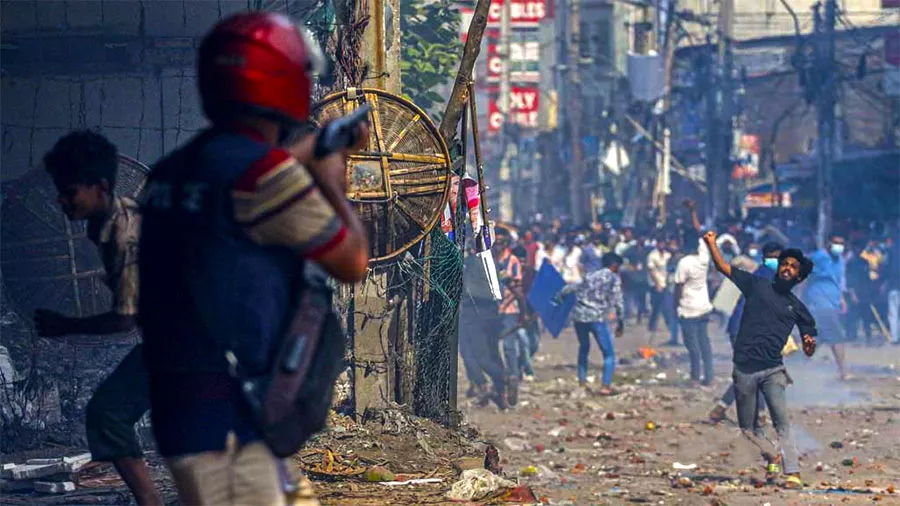
The protests, which began in July 2024 in the name of government job quota reform, were prolonged after propaganda was spread that there were attacks and killings during the anti-government protests. Several killings occurred in Jatrabari, Uttara, the gateway to Dhaka, and Bashila and Rampura in Mohammadpur. As the protests continued, extremists attacked government installations, the police, and law enforcement agencies.
Arson, vandalism and secret killings continued. In the subsequent course of events, the bloody clashes escalated further, and the state Ganabhaban was also attacked. At one point, Prime Minister Sheikh Hasina was forced to flee the country on August 5, leading to the fall of the Awami League government.
A UN fact-finding mission claims that 1,400 people may have been killed in July-August. However, according to the government gazette, around 850 were killed. There are numerous inconsistencies and omissions between these two claims.
Various irregularities and frauds have been revealed, including the return of the dead, claiming that those who died in various accidents were killed in protests, and portraying those who were injured as protesters/July fighters.
Case statistics
According to data from the Dhaka Metropolitan Police (DMP) Prosecution Department as of August last year, a total of 707 cases have been filed in 50 police stations in the capital over the protests, involving 5,079 accused.
The highest number of cases were registered in Jatrabari Police Station – 19. This was followed by Paltan Model Police Station with 16 cases, Hatirjheel and Bhatara Police Stations with seven each, Rampura Police Station with five cases, and Uttara Purba-Paschim, Airport and Dakshinkhan Police Stations with 13 cases. Of these, 126 cases are under investigation.
Sheikh Hasina and her government’s ministers-MPs, leaders and activists of the Awami League and its affiliates and fraternal organizations have been widely accused in these cases.

The final reports have already been submitted to the court in 19 cases after the investigation. Of these, three cases have been described as completely ‘false’ by the investigation officers. In the remaining 16 cases, informational inconsistencies, mistaken identities, fake documents and discrepancies between the description of the incident and reality were found.
Analysis of reports submitted to the court has shown that innocent people have been accused of personal disputes, land disputes, or business interests. Allegations of bribery and money laundering in connection with the protests have been reported in the media before.
Sheikh Hasina and several ministers, MPs, Awami League leaders and former IGs of police are being tried in the tribunal in several cases of crimes against humanity. Sheikh Hasina and former Home Minister Asaduzzaman Khan Kamal have already been sentenced to death in one case. Several former police officers have also been sentenced to death in several cases.
It is worth noting that, in response to the demands of the 1971 war criminal organization Jamaat-e-Islami and its like-minded parties, the interim government led by Mohammad Yunus has banned the Awami League’s sister organization, Chhatra League, as a ‘terrorist organization’, alleging ‘violence’ in the movement, and has also imposed restrictions on the organization’s activities.
‘How did I come to Saudi Arabia if I died?’
On July 19, 2024, 46-year-old Md. Babu was killed in police firing during a protest in the Ulan Road area of Hatirjheel in the capital. A case was filed in the court, and the investigation of the case fell to the Hatirjheel Police Station.
The case report is signed by a person named Ismail, who introduced himself as the cousin of the ‘murdered’ Babu, as the plaintiff. Sheikh Hasina, some top leaders of the Awami League and Chhatra League-Jube League, and some senior police officials have been named as accused in the case.
The final report submitted to the court on October 26, 2025, said that according to the address given in the national identity card in the complaint, the police went to Barurkandi village in Matlab Uttar upazila of Chandpur and found out that the ‘killed’ Babu was actually alive. His real name is Md. Shakil and he is currently working in Saudi Arabia.
Shakil said, “I’m not dead, brother. If I’m dead, how did I come to Saudi Arabia? The police have already talked to me about this. Now I work as a laborer in Saudi Arabia.”

The investigation also found discrepancies in the identity of the plaintiff. When the mobile number given in the complaint was called, a person who gave his identity card said that he was not Ismail. Later, the police traced Ismail to Rampur area of Faridganj upazila of Chandpur using the information on his national identity card.
He claimed to the investigating officer that he had not filed any such case. He gave the same statement even when he appeared in court and said that someone else had filed the case using his name and identity. When a woman called the mobile number given in the complaint, she said, “I don’t know anyone by the name Ismail. You have called the wrong number.”
The final report submitted by Hatirjheel Police Station Investigation Officer SI Russell Islam said that no evidence of the death of any person named ‘Babu’ as alleged in the complaint was found. Despite reviewing the scene of the incident, evidence, doctor’s opinion, the official list of July victims and statements of the people concerned, no information was found about anyone being killed by that name.
Even the death certificate attached to the case was confirmed to be fake. The investigation also failed to find the real victim or plaintiff.
For these reasons, the investigation officer submitted a final report to the court, describing the case as ‘false’ and recommending the acquittal of the accused named in the complaint.
Investigation officer Russell Islam said, “The investigation has proven the case to be false. The claims of both the deceased and the plaintiff mentioned in the case were not found to be true. The investigation has shown us that a group using the identity of others filed the case with malicious intent.”
The final report of the case is currently under consideration by the court. The Dhaka Chief Metropolitan Magistrate’s Court has set a hearing date for August 3. Despite repeated attempts to reach the plaintiff’s lawyer, Lutfar Rahman, for comment, he did not answer the phone.
Claim that the cut marks from falling are gunshot wounds
Yasin Arafat, who claimed that he himself was shot on the same day, filed a murder case with the Paltan Police Station on September 2 of that year, alleging that 24-year-old Parvez Ali died after being shot in an attack by police and Awami League leaders and activists on Box Culvert Road in Paltan, Dhaka on the afternoon of July 19, 2024.
The case alleges that Sheikh Fazle Noor Taposh, then mayor of Dhaka South City Corporation, and Sheikh Fazle Shams Parash, then chairman of Jubo League, opened fire at the scene, and local Awami League leaders and activists and police members were also with them at the time. Sheikh Hasina, Taposh, Parash, along with several top Awami League leaders and several senior police officers at the time, were named as accused in the case.
The investigation of the case was entrusted to the Police Bureau of Investigation (PBI). The PBI did not find the existence of the bullet-injured ‘killed’ Parvez Ali as alleged in the complaint. The investigation report also stated that the claim that the plaintiff Yasin Arafat was shot was not correct.
The final report submitted to the court by the PBI on December 11 last year stated that the alleged deceased person did not exist, and termed the entire incident as baseless and called the case a lie.
When asked about the case, Yasin Arafat initially denied being a plaintiff. Later, he said, “I am a little busy, I will talk to you about this later.” Later, his mobile number was called several times, but it was disconnected. Attempts were made to contact his father, Billal Hossain Gazi, but he did not pick up the phone either.
A search was conducted at Yasin Arafat’s house in Chandnimukha Bazar area of Gabura Union in Shyamnagar Upazila of Satkhira. Locals said that Arafat and his father were well-known faces in the area. Several people in the market said that Arafat used to follow local Awami League leaders, take selfies with them during processions and rallies and post them on social media.
Later, after being admitted to the management department of Dhaka College, he joined the Chhatra Odhikar Parishad. Further investigation revealed that he had long-standing close ties with local leaders of Jamaat-e-Islami and Chhatra Shibir. He is currently working as a multimedia reporter at a private television station in Dhaka.
No one could provide any information to the locals that he was shot in Dhaka during the July 2024 movement.

Gabura Union Parishad Chairman GM Machudul Alam said, “There was no incident of shooting. These are all fake. The police came to investigate, but they also did not find any evidence. The boy is clever, he is active. Nothing about him is credible. I heard that he is now a journalist in Dhaka.”
The investigation officer of the case, PBI SI Md. Masud Rana, said, “The case was filed by showing the marks on his leg that were scratched or cut after falling, as a sign of being shot. He claimed that he was shot in the leg, but even his father did not know about it. Yasin Arafat could not show any medical certificate to support his claim of being shot.”
Family enemies are the culprits.
Yasin Arafat, the plaintiff, filed a case with Paltan Police Station against Abdul Matin and Nazmul Hasan of Pabna, who are uncle-nephews and truck drivers by profession. At one stage of the investigation, when the police went to their village home, they learned about the case for the first time and were surprised to hear the allegations. They said they did not know the plaintiff or the alleged victim.
Abdul Matin said that during the July protests, they were unemployed as transportation was virtually shut down due to the unstable situation in the country, and there was no question of them staying on Box Culvert Road in Paltan in the capital at that time.
In his words, “I have never heard the name of this plaintiff or the one who is said to be dead, even when my father was born.”
When asked how he became a defendant despite not having any acquaintance, Matin said, “We have a dispute with Kashem Munshi, our neighbor, over land. His nephew Rony works as a cameraman in Dhaka. I heard that the plaintiff and Rony are friends. They are the ones who made us a defendant in this case to harass us.” When asked to comment on this, Rony did not answer the phone.
The investigation officer of the case, PBI Sub-Inspector Md. Masud Rana, said, “After reviewing the detailed information (CDR) of the accused’s phone calls that day, we found that they were not around the scene.”
Another false case of Adabor
Adabor police have investigated another murder case in which the final report was found to be false. The final report submitted to the court on November 30 last year showed the case to be false. The allegations in the case, the list of accused and the language of the complaint were found to be similar to the previous two cases in Hatirjheel and Paltan police stations.

In this case too, it has been revealed that the mobile number given by the plaintiff is not correct. The name, identity and address of the person claimed to have been killed are incomplete and there are identity discrepancies. The investigation also failed to find any trace of the plaintiff.
The complaint stated that on July 19, 2024, a person named Ali Mia was shot and killed in an attack by police, Awami League and party affiliates and affiliated organizations in the Adabor police station area. Md. Toha Khan filed a case as the plaintiff in this incident. The police did not find the truth of the incident after investigating.
The investigating officer of the case, SI Tarun Kumar of Adabor Police Station, said, “After the investigation, we have submitted a final report to the court stating that the incident is not true.”
When attempts were made to contact the plaintiff Toha Khan, the mobile number given in the complaint was not found to be active. In addition, no trace of him was found even at the address given by Adavar. When the residents went to the house according to the address, they said that no one by the name Toha lives there. On the contrary, the residents of the house want to know whether Toha lives here or not – what is the reason for asking this. That is, no one has heard anything about the case or the incident before.
What action can be taken against plaintiffs in fake cases?
In general, there is not much precedent for legal action being taken against the plaintiffs in cases filed on false charges. Even in cases filed on charges of murder or attempted murder during the July protests that were proven false during the investigation, there has been no precedent for any action being taken against the plaintiffs. There is also a question as to whether they will be brought under the law at all.
In this regard, Supreme Court lawyer Jyotirmoy Barua said, “If it is proven that the case is false, then there is scope for taking action under Section 211 of the Penal Code. Filing a false criminal complaint against an innocent person with the intention of harming another is a punishable offense. In that case, legal action can be taken against the person who filed the false case.”
He added, “Although there are not many examples of such measures being taken, it is not that they are completely absent. At the beginning of the July cases, we feared that such incidents would happen. Now, that is exactly what is coming to light in the investigation.”
Asked whether these cases filed on false charges will have any impact on the trial process of the real cases, Jyotirmoy Barua said, “Each case is unique in criminal law. What happened in another case does not determine the trial of any case. However, if multiple similar false cases come to light, an overall impact may be created in the minds of the judges. Then, an idea may arise that not all the allegations may be true.”
Asked whether the police has taken any initiative to take action against the plaintiffs in fake cases, Assistant Inspector General (Media) of the Police Headquarters AHM Shahadat Hossain said, “Action is taken against the fake plaintiffs in the case as per the law. The same will happen in this case too. However, if the government takes any special decision after the media publishes reports on the fake murder cases centered around July, that is a different matter.”

https://stapravda.ru/20221228/reyting_samyh_populyarnyh_hostingov_v_rossii_196445.html, рейтинг хостингов России подтверждает, что выбор надежного провайдера важен для бизнеса.