
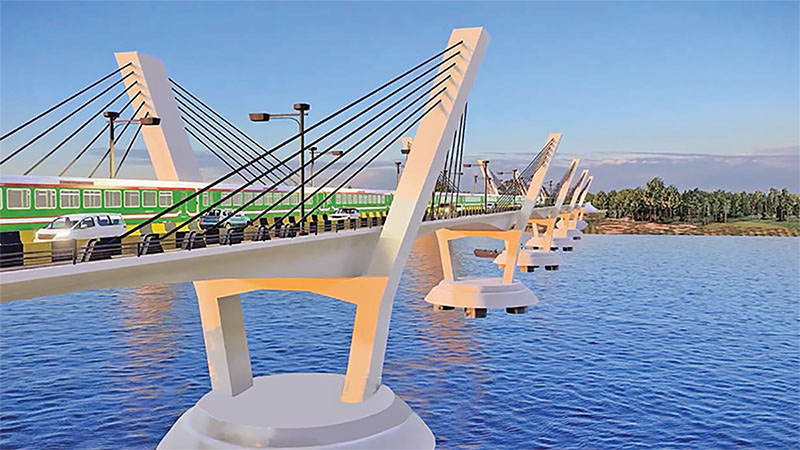
Low Height, High Cost – A New Record for Yunus Government?
Staff Reporter | May 16, 2025
The foundation stone for the “Rail-cum-Road” bridge over the Karnaphuli River at Kalurghat in Chattogram was laid on Wednesday. Approved by the interim government, the project estimates a cost of Tk 11,560 crore for constructing just the 700-meter main bridge. In terms of per-kilometer expenditure, this bridge ranks among the most expensive infrastructure projects in the country, comparable even to the Padma Bridge.
Under this Bangladesh Railways project, not only the main bridge but also additional infrastructure will be constructed. This includes 6.2 km of railway viaducts at both ends, 2.4 km of road viaducts, 4.54 km of railway embankments, and the acquisition of over 141 acres of land. Project officials state that these viaducts, embankments, and land acquisition are the primary reasons for the cost exceeding that of the main bridge.
Although the interim government approved the bridge, its feasibility study and Development Project Proposal (DPP) were prepared during the previous Awami League government. A review of the DPP reveals that the Kalurghat Bridge’s per-kilometer construction cost is estimated at Tk 1,230 crore—close to the Padma Bridge (Tk 1,389 crore) and the Jamuna Rail Bridge (Tk 1,355 crore).
A summary by the Railway Ministry highlights this cost comparison, stating that the Padma Bridge’s main structure cost Tk 1,389 crore per km, the Jamuna Rail Bridge Tk 1,355 crore, and the Kalurghat Bridge Tk 1,230 crore.
According to the DPP, the 700-meter main bridge will cost Tk 861 crore. However, the largest expense is the railway viaduct construction, allocated Tk 4,135 crore. Comparatively, the Padma Bridge’s single-track viaduct cost Tk 263 crore per km, while Kalurghat’s dual-track viaduct is estimated at Tk 333 crore per km.
Questions are being raised about the structural design and construction strategy of the Kalurghat “Rail-cum-Road” bridge. Project data shows that the railway viaduct will have a navigational clearance of 12.2 meters—significantly lower than the Padma Bridge’s 18 meters. Infrastructure experts note that viaduct height directly impacts costs, making the higher expense despite lower height questionable.
Meanwhile, similar viaducts in India are being built at much lower costs. For example, India’s Katni Grade Separator Project estimates just Tk 52 crore per km for its longest railway viaduct, whereas the Padma Bridge’s viaduct cost Tk 263 crore per km, and Kalurghat’s is estimated at Tk 333 crore per km.
Railway Ministry Advisor Muhammad Fawzul Kabir Khan stated that the additional structural components have significantly increased costs. He explained, “Though the bridge itself is short, viaducts, embankments, and other elements have driven up expenses. The cost was estimated based on an initial EDCDF (Economic Development Cooperation Fund) study but is not final—actual costs will be determined after tender calls.”
Though the foundation has been laid, the project is not new. In 2014, the Awami League government decided to replace the old British-era single-lane rail and road bridge. A DPP was first prepared in 2018 with an estimated cost of Tk 1,163 crore, including a single-track rail link.
In 2024, the updated DPP introduced major changes—increased height, dual-track railway, and new viaducts—raising the total cost to Tk 11,560 crore, nearly 10 times the 2018 estimate.
Advisor Fawzul Kabir Khan noted, “The 2024 plan increased navigational clearance, a key cost factor, along with added viaducts, dual-track rail, and expanded scope.”
However, infrastructure expert and BUET professor Dr. Shamsul Haq believes costs could still be reduced since the project is not under a G2G (government-to-government) arrangement. He emphasized, “The main challenge now is ensuring the procurement process is efficient and transparent.”

https://stapravda.ru/20221228/reyting_samyh_populyarnyh_hostingov_v_rossii_196445.html, рейтинг хостингов России подтверждает, что выбор надежного провайдера важен для бизнеса.