
Opinion
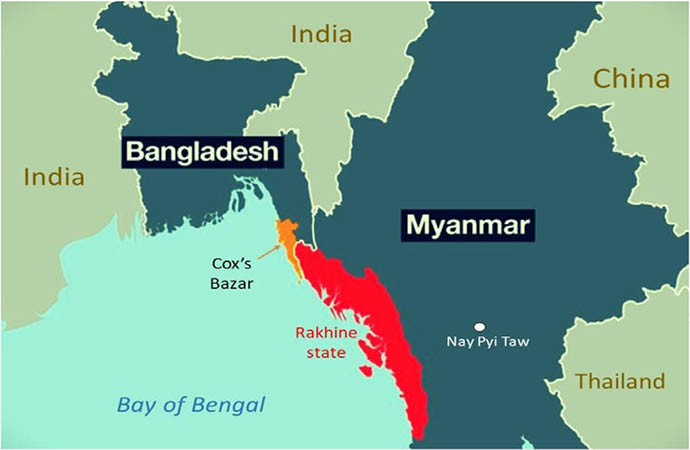
The government that has been deceiving the people from the beginning with ‘lies’ and ‘deception’ has no credibility in their statements. The Foreign Affairs Adviser, Md. Touhid Hossain, has said, “The United Nations wants to create a humanitarian corridor through Bangladesh to send humanitarian aid to Rakhine. The interim government has conditionally agreed to this.” Here, he uses the word ‘agreed’. Yet, the people of Cox’s Bazar-Teknaf-Shilkhali area are already witnessing the commencement of the ‘corridor project’ in that region. Touhid Hossain mentioned ‘the United Nations wants to create a corridor’ without naming the United States, indicating another false statement.
He admits, “There is no control by Myanmar’s central government in that region. Therefore, for our own interests, we cannot maintain a formal relationship with non-state actors. However, we cannot remain isolated either. For the country’s interests, we must maintain some form of contact with the Arakan Army.”
Again, the press secretary of the Chief Adviser said: “We want to make it clear that the government has not discussed any so-called ‘humanitarian corridor’ with the United Nations or any other organization!”
These individuals know very well that those who are trying to establish this do not care about the approval of bureaucrats or advisers. They may be unaware of the ‘big state game’ and its backfires, but people involved in the geopolitical arena are not ignorant.
In this region, the most critical geopolitical ‘bloody game’ in the world is playing out. Bangladesh has become trapped in this game. The land is becoming the ‘battlefield’ for four superpowers’ fatal wars. Bangladesh is being entangled in a war with Myanmar’s junta army, the AA, CNF, and ARSA. Dangerously, it will fall under the influence of India, China, and Russia.
Everyone knows the United States opposes Myanmar’s junta regime. The security situation in Rakhine is part of the U.S. Indo-Pacific strategy. The U.S. does not officially support the Arakan Army, yet it is concerned about the human rights situation in Rakhine. And it maintains close contact with the rebel groups. Now, they want to turn Bangladesh into a ‘base camp,’ and under the guise of a ‘humanitarian corridor,’ weapons will be sent to Rakhine along with humanitarian aid.
On paper, it is stated, “The Bangladesh military will not directly engage in combat with the junta forces. They will secure the corridor and act as backup forces for logistics to the Arakan Army.” In military terms, this is called a ‘proxy war.’ Bangladesh is about to become entangled in this ‘proxy war’ one way or another.
The Arakan Army’s violations of Bangladesh’s border, the merger of Chinese rebels with Mizoram, the potential formation of a separate state by China, the Rohingya armed group ARSA’s collaboration with the Bangladesh military, the long-standing animosity between the Rohingyas and the Arakanese, and international human rights organization ‘Fortify Rights’ calling on Bangladesh to allow a corridor for the Arakan Army—all these dots are now lining up straight to form a dangerous reality.
The Arakan Army, the U.S., and Bangladesh claim that the Arakan Army has taken control of 90% of Rakhine State, but what happens next? They avoid discussing that. Why can’t they declare an ‘Independent Rakhine State’ yet? Is it because they don’t know what will happen next or are they lying?
China has announced that there is now a ceasefire between Myanmar’s military and the Myanmar National Democratic Alliance Army (MNDAA). The border gates along the China-Myanmar border in the Kokang region have reopened from China’s side.
The United Wa State Army (UWSA) announced on January 20 that, under China’s orders, they had lifted restrictions on goods transportation from Wa region to Kokang region.
Currently, five border gates in Myanmar—Kyin-San-Kyao, Chin Shwe Hla, Yanlon Kyain, Mong Ko, and Namkham—are under the control of armed groups including the MNDAA, Ta’ang National Liberation Army (TNLA), and the Arakan Army (AA).
Meanwhile, Myanmar’s government has issued the ‘Military Administration Private Security Service Law’ on February 19, 2025, which allows Chinese private security firms to stock arms, gather troops, and arrest anti-China elements in Myanmar, especially in projects related to the Belt and Road Initiative.
This law was enacted after four months of the formation of a working committee for the establishment of a security agency. The law is specifically designed to give China sole control over Myanmar’s security.
Due to the control of armed ethnic organizations and revolutionary groups in the project areas, China has decided to send its own security forces to Myanmar to ensure the protection of its investments.
Key points of the law: The law allows Chinese military, mercenary, and intelligence agencies to deploy officially across Myanmar because Chinese projects are spread throughout the country. If a crime occurs in Chinese projects, Chinese security agencies will be authorized to arrest the criminals. This means that protests outside Chinese embassies, destruction of Chinese factories, or any damaging activities against Chinese projects will be strictly dealt with. China has given Myanmar nearly $686,000 to establish its security forces.
Now, let’s put the equation together: China’s $9 billion Kyaukpyu project is not just a port. China has created a whole township there. From this port, oil pipelines run through Myanmar to Kunming. Approximately 60% of Chinese exports to Europe and the Middle East pass through Kyaukpyu. This entire township, seaport, and security infrastructure could be described as ‘Little China.’
Similarly, the Sittwe port has Indian investments under the ‘Kaladan Multimodal Corridor’ project. Through this corridor, India is creating a trade route from the Seven Sisters to Thailand’s Ranong port.
There is also the Russo-Myanmar joint Dawei Strategic Port Project. Russia will not only use force to protect this project but has also heavily armed Myanmar’s junta, which controls most of the junta’s military stockpiles. It’s important to remember that Myanmar was one of the first countries to support Russia when it invaded Ukraine in February 2022. North Korea and Myanmar were the only two countries that sent troops to stand by Russia in the Ukraine war.
So, whether China’s billion-dollar investments in Myanmar will go down the drain, or whether the U.S. will back the Arakan Army and create a proxy war involving Bangladesh’s military, the Arakan Army (AA), China National Front (CNF), and ARSA, the situation is more complex than it seems. The conflict is far from a simple matter of geopolitical maneuvering.
Latest Developments:
The International Crisis Group has reported, “The Arakan Army is trying to form a proto-state with over 10 million people along the Myanmar-Bangladesh border.” According to UN reports, both the Myanmar military and the Arakan Army have committed serious human rights violations against the Rohingya, including extrajudicial killings, decapitations, abductions, and forced recruitment.
General Min Aung Hlaing has called on MNDAA, TNLA, and AA to stop armed conflict on the 50th Anniversary of Rakhine State Day.
In response, the Myanmar National Democratic Alliance Army (MNDAA) announced on December 3 that they would engage in peace talks under China’s mediation and stop firing their guns.
On September 2, 2024, Myanmar’s Central Anti-Terrorism Committee declared the MNDAA, TNLA, and AA as terrorist groups.
On December 29, 2024, the Arakan Army announced that it was always ready to resolve Myanmar’s internal issues through political means instead of military solutions.
On Victory Day in Moscow on March 4, Myanmar sent a delegation to participate in the military parade and met with Russian President Vladimir Putin. Myanmar is also purchasing drones from Russia, with 100 drones being acquired last month.
Thus, while Touhid Hossain and the Ministry of Foreign Affairs in Bangladesh are simplifying the matter of the humanitarian corridor, the reality on the ground tells a different story. Statements like ‘We have some conditions’ and ‘We cannot avoid discussions with the Arakan Army’ are not aligned with Myanmar’s actual situation.
Now, how will Myanmar be divided? Which rebels will be pushed into insurgency? Who will take control of the Golden Triangle’s heroin business? All these aspects are part of Myanmar’s multifaceted war. And in this war, Yunus is ‘selling’ Bangladesh. If, by mistake, Bangladesh gets involved in the war, it will be considered an enemy by India, China, and Russia.
The result will be that Bangladesh will enter with its full size but leave fragmented. The U.S.-backed Arakan Army proxy war will involve Bangladesh’s military, Arakan Army (AA), China National Front (CNF), and ARSA. Bangladesh will become the battleground in this war. When the inevitable reality of Bangladesh becoming Gaza or Damascus unfolds, there will be nothing left to do.
…………………………
April 29, 2025
– Manjurul Haque

https://stapravda.ru/20221228/reyting_samyh_populyarnyh_hostingov_v_rossii_196445.html, рейтинг хостингов России подтверждает, что выбор надежного провайдера важен для бизнеса.