
International Desk
Kathmandu, September 9, 2025: Just as the July 2024 quota movement in Bangladesh transformed into an anti-government movement with “new issues” even after the court accepted the quota reform, similarly, in Nepal, the Gen G youth-led protest against corruption, which has moved beyond the issue of social media bans, is also putting pressure on the government.
Is the Nepali movement influenced by political parties and international powers, as in Bangladesh? Analysts are raising this question, although the evidence is still limited. In the case of Bangladesh, students first took to the streets demanding quota reform after the Supreme Court’s ruling to reinstate the 30% quota. But even after the court ruling, the government’s repressive policies, police firing, and Chhatra League attacks led to the movement spreading under new pretexts (corruption, unemployment, dictatorship). More than 300 people were killed and the Hasina government eventually fell.
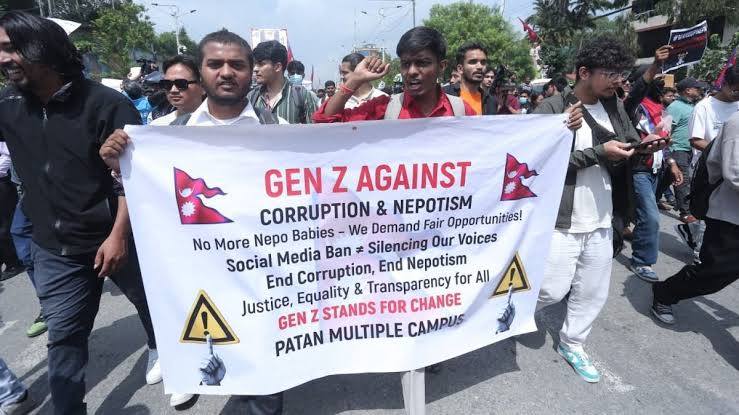
A similar scenario is now unfolding in Nepal. On September 4, the government banned 26 social media platforms (including Facebook, Instagram, TikTok, YouTube), in the name of curbing cybercrime and corruption. This led to the ‘Gen G Protest’ by young people, who are not only against the ban, but also against corruption, nepotism (the luxury of children of political leaders), and economic weakness.
On September 8, thousands of young people, many wearing school and college uniforms, gathered in front of the parliament building in Kathmandu. At least 19 people were killed and more than 300 injured when police used water cannons, tear gas, rubber bullets, and live ammunition to disperse the crowd. According to the Ministry of Health, one of them was a 12-year-old child.
The government lifted the ban and Home Minister Ramesh Lakhak resigned, but the protests continued. A curfew was imposed on Tuesday, but fresh clashes broke out in cities including Kathmandu, Pokhara, and Biratnagar. Protesters are demanding the resignation of Prime Minister K.P. Sharma Oli and have attempted to burn his residence.
The house of opposition Nepali Congress leader Sher Bahadur Debu was vandalized. The government has announced an inquiry committee and compensation for the families of the victims, but the youth are saying, “Stop corruption, not social media.” There are similarities here with Bangladesh: both are youth-led, morphing from a specific issue (quota vs. social media ban) into anti-corruption and anti-government movements. Both have seen heavy casualties from excessive police force, and have been heralded in international media as a “Gen G revolution.”
The UN Human Rights Office and Amnesty International said the “disproportionate use of force is a violation of international law.” India has issued a warning on the border and said it is closely monitoring the situation.
Countries including Australia, France, the US have condemned the casualties and demanded an investigation. But allegations of conspiracy? Prime Minister Oli said, “The violence was the result of infiltration by various vested interests.”
This is similar to the Awami League’s ‘foreign power’ allegations in Bangladesh. Some sources say that internal rebellions in the opposition Nepali Congress and Communist Party have had an impact on this.
Internationally, TikTok videos on social media (showing the luxuries of politicians’ children) are inspired by similar campaigns in the Philippines and Indonesia, which are similar to the movement in Bangladesh.
However, the protesters claim, “We have no connection with any political party; this is a spontaneous movement of the youth.” One protester, Ixma Tumrok (20), said, “We are only fighting against corruption, not under the influence of any party.”
Analysts believe that Nepal’s unstable politics (14 governments since 2008) and economic crisis (income of $1,300 per year) are fueling the movement. If international players continue to exert influence here, as in Bangladesh, the Oli government could fall.

https://stapravda.ru/20221228/reyting_samyh_populyarnyh_hostingov_v_rossii_196445.html, рейтинг хостингов России подтверждает, что выбор надежного провайдера важен для бизнеса.