

❐ News report
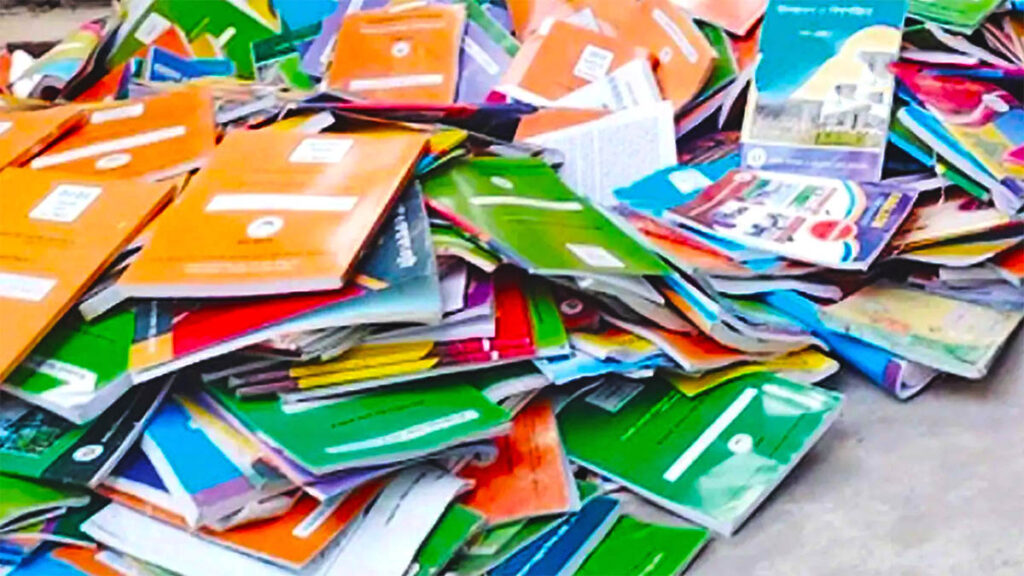
Allegations have emerged that a powerful syndicate is embezzling hundreds of crores of taka from the government every year , focusing on the printing of textbooks provided free of charge to students .
A government report has revealed that this group looted 658 crore 85 lakh 29 thousand 665 taka from the state just for printing books during the 2025 academic year during the tenure of Dr. Yunus’ interim government .
During the Awami League government, printing companies submitted bids for 70 lots of three primary classes at an average of 10 percent less than the estimated price. Then, after the work began, the companies strategically stole additional money by showing costs step by step.
There are allegations that this money was siphoned off through various irregularities such as strategically hiring the lowest bidder , creating an artificial shortage of paper to increase prices , and fraud in the import of art cards .
The report mentions that not only the tender syndicate , but also the control of the paper market and which press will get which work are under the influence of this cycle .
This information emerged recently in a report by the National Curriculum and Textbook Board ( NCTB), an important government agency , on the printing and distribution of textbooks for the 2025 academic year .
The report says that during the tenure of Dr. Yunus’ interim government, a decision was made not to print textbooks in foreign institutions for the last academic year . Taking that opportunity, a section of domestic printing institutions formed a syndicate through a tender process .
There are allegations that they shared the book lots among themselves by leaking the estimated price of the tender and collecting additional money beyond the government’s budget by bidding 20 to 25 percent higher .
According to the data , 40 crore 15 lakh 67 thousand 202 books were printed from pre- primary to class 10 in the 2025 academic year . The government spent about 2 thousand 762 crore 8 lakh 91 thousand 144 taka on this work .
The report also said that a few big printing houses led the syndicate in the tender process for printing NCTB books. Among them, Karnaphuli Art Press, Letter N Color, Apex Printing and Color, Sarkar Printing and Publishing, Agrani Printing Press, Anand Printers Limited, Kachua Press and Publications , Simanta Printing Press and Publication, Prama Press and Publications and Bright Printing Press were mentioned .
It is learned that among the owners of the big presses, Mohsin of Proma Press and Publications, Dulal Sarkar of Sarkar Printing and Publishing, Rabbani Jabbar of Anand Printers, Rubel of Agrani Printing Press, Robin and Kajal of Karnaphuli Art Press held a secret meeting and shared the preferred lots.
Through the syndicate, the unscrupulous group not only shared the preferred lots but also grabbed additional work orders. Through compromise, they submitted tenders as the first, second and third lowest bidders.
A secret report has revealed that the tender was negotiated in the office of Dulal Sarkar, the owner of Sarkar Printing and Publishing.
The report further states that although there are currently 119 registered paper mills in the country , the number of mills capable of supplying paper as per the standards set by NCTB is very limited. Out of which, only a handful including Bashundhara, Meghna, Amber Super, and Partex have the capacity to supply as per NCTB standards.
Other mills do not have the machinery, capacity, and financial support to supply paper as per NCTB specifications. As a result, in many cases , low-quality paper is supplied .
Some printing presses that get book printing jobs come towards the end of the year and do various printing jobs in addition to notes and guide books. This creates a shortage of paper. At the same time, book printing also lags behind.
Some printing houses are involved in paper trading as well as book publishing. They buy most of the paper by making advance agreements with various paper mills and store it in various warehouses, creating an artificial shortage and raising the price. Later, they force small printing houses to buy this paper.
The report says that Mintu Mollah, Sheikh Siraj, Dulal Sarkar, Omar Faruk, Mohsin, Rubel-Robin, Rabbani Jabbar, Dewan Kabir, and others are involved in the paper syndicate.
According to the report, about 23 large and small paper mills in the country have supplied paper to the presses directly and through their dealers for the printing of textbooks in the 2025 academic year.
The daily production capacity of the mills is about 1,000 tons. But as the demand for paper increases every year, the mill owners increase the price of paper. In addition, they produce and supply low-quality paper at a certain price for a certain quality of paper.
Some unscrupulous printing press owners, either alone or in groups, create artificial shortages and increase the price of paper.
Regarding the price increase, the report says that Mallick Paper Mill, Capital Paper Mill and Azad Paper Mill are run by Sarkar Press owner Omar Faruk. Rashid Paper Mill is run by Mintu Mollah, owner of Auto Printing Press and Mollah Printing Press.
There have also been allegations of irregularities in the import of art cards .
According to information, the 230 GSM art cards used in textbooks are completely dependent on imports. If art cards are imported according to the rules, the price is higher due to VAT and taxes. But the syndicate imports these art cards illegally, stores them secretly, and creates an artificial crisis, increasing the price in the market. Five-six individuals and three-four organizations are directly involved in this.
The organization’s report revealed that Dewan Kabir of Master Cimex Paper Limited, Union Associate, Rahmat Enterprise, Yusuf Enterprise of Nayabazar, Omar Faruk of Sarkar Press, Press owner Tofail, Amin Hilali of Dosh Disha Printers, Rafin Enterprise and others were involved in this.
However, representatives of some of the relevant organizations have denied these allegations .
Rashed Hossain, executive of Letter N Color Limited, said that he completed the tender process for printing textbooks himself and there was no syndicate or compromise in it .
He claimed that all work was done according to the rules .
On the other hand, Mamun Hossain, owner of Proma Press and Publications, refused to comment on the matter .
The report also made several recommendations to break the syndicate in book printing . Among them, it mentioned assigning honest and skilled officials to the NCTB to prevent leakage of estimated tender prices and breaking up the influential syndicate that has been established over a long period of time .

https://stapravda.ru/20221228/reyting_samyh_populyarnyh_hostingov_v_rossii_196445.html, рейтинг хостингов России подтверждает, что выбор надежного провайдера важен для бизнеса.