
Staff Correspondent
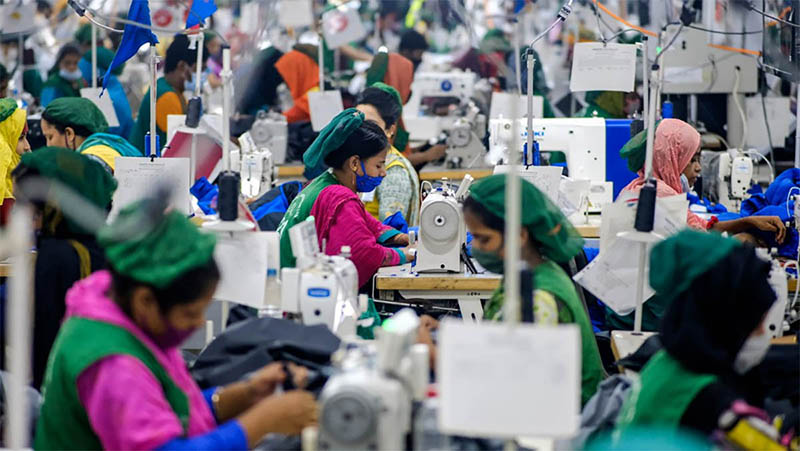
Severe uncertainty has gripped Bangladesh’s garment industry after the United States announced a 35 percent tariff on imported garments from the country. With fears of declining orders from its key export market, millions of garment workers are spending their days in anxiety. Many say they feel like they might lose their jobs any day now.
Momena Khatun, a 32-year-old sewing operator at a garment factory in Ashulia, Dhaka, said, “For the past few months, every day it feels like I’ll hear about being laid off. If someone even talks to me differently, I feel like they might be about to fire me.”
Not just Momena, BD Digest spoke to over 50 workers across areas like Savar, Narayanganj, and Gazipur. All of them expressed fears over decreasing new orders, factory closures, and sudden job losses.
Mohammad Abdullah, a maintenance worker at a garment factory in Gazipur, said, “I used to earn some extra money with overtime, which I could send home. Now, forget overtime — even holding onto the job is a struggle. If I lose my job, I don’t know where I’ll go with my wife and kids.”
Mizanur Rahman, an ironman at a factory in Narayanganj, said, “Orders from big companies are drying up. Our supervisors keep saying all we can do now is wait and see.”
Garment manufacturers have confirmed that several US-based brands, including Gap Inc. and VF Corporation (owner of Vans and The North Face), have currently halted new orders and are monitoring the situation.
Analysts warn that if this situation persists, it will deal a heavy blow to the garment sector. Export volumes will fall, employment will shrink, poverty will rise, and women workers will be the worst affected. Another major concern is the children of workers — many of whom are in school — whose futures are now uncertain.
Habibur Rahman, a manager at a garment factory in Gazipur, said, “Because Bangladeshi workers are paid lower wages, we can export at competitive prices. But even after crunching numbers at the end of the year, profits are not meeting expectations. Now, with this added tariff burden, it will be impossible to continue operations. The owners may have no choice but to shut down the factory.”
A factory owner in Narayanganj, requesting anonymity, said, “Comparing last year with this one, I feel like quitting business altogether. During the Awami League era, we were at least able to do business. Even if we had to spend here and there, business was protected. Now those costs have multiplied. From the jhoot (scrap fabric) trade to food supply for workers and canteen leases — everything has been forcibly taken over by influential people. They’ve clearly warned that if we don’t comply, we won’t be allowed to operate.”
When asked who is interfering in business this way, he hesitated and told BD Digest, “In addition to BNP-Jamaat leaders, we also have to pay regular monthly extortion to NCP leaders, anti-discrimination coordinators, and student activists. From birthdays, circumcisions, and naming ceremonies to local religious gatherings — we have to regularly pay for all of them. If this new tariff is added to that burden, we’ll have to shut down. It’s impossible to run a business this way.”
Not wanting to fall victim to political vengeance, the well-established garment entrepreneur requested that his name and company not be published.
Ranu Akter, a helper in the cutting section of a garment factory in Savar, told this reporter her husband — a truck driver — is now paralyzed from an accident. With one son and one daughter, she is the sole provider for the family. “We’ve heard the factory might shut down. Everyone’s saying the company will have to pay America a lot of money, so there’ll be no profit left. That’s why the owner wants to reduce the number of workers.” Like her, everyone’s life is now filled with uncertainty.
Bangladesh’s garment sector contributes over 80 percent of the country’s total export earnings and employs around 4 million people. It accounts for nearly 10 percent of the national economy.
Recently, US President Donald Trump, in a letter to Bangladesh’s Chief Advisor Dr. Yunus, stated that a 35 percent tariff on Bangladeshi exports will take effect from August 1. This is more than double the previous average tariff of 15 percent.
Meanwhile, one of Bangladesh’s main competitors in the garment sector, Vietnam, has been imposed with only a 20 percent tariff. Industry insiders believe this could lead to a shift in orders from Bangladesh to Vietnam. The US has yet to decide on tariffs for India and Sri Lanka. As a result of this decision, Bangladesh’s garment sector is becoming significantly more expensive than its competitors.
In response to the situation, discussions are underway between Dhaka and Washington on a potential trade agreement. Representatives from both countries are scheduled to hold a second round of talks this week. However, until a deal is finalized, uncertainty for workers is expected to continue.

https://stapravda.ru/20221228/reyting_samyh_populyarnyh_hostingov_v_rossii_196445.html, рейтинг хостингов России подтверждает, что выбор надежного провайдера важен для бизнеса.