
International Desk
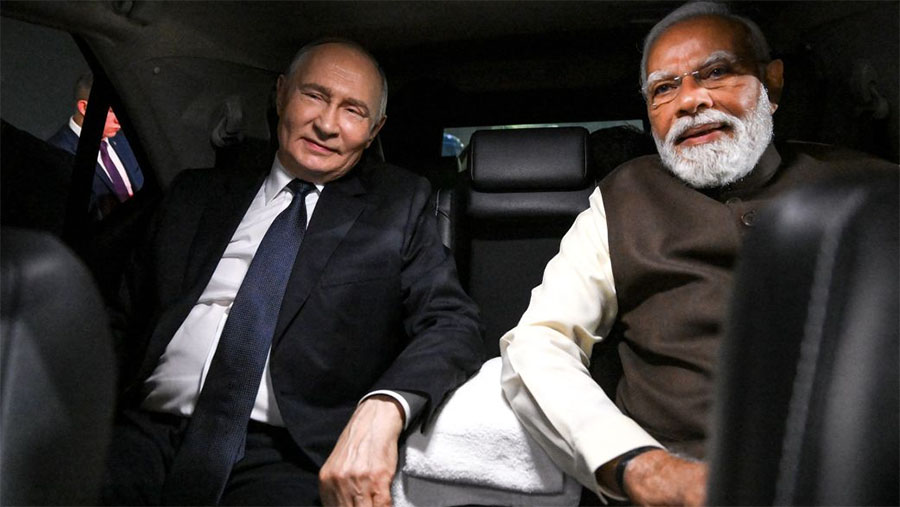
Russian President Vladimir Putin has arrived in India on a state visit after almost four years. The visit has generated a lot of discussion in the international arena.
The Putin-Modi meeting is of particular importance for both countries, as Russia faces unprecedented Western sanctions over the Ukraine war, and US President Donald Trump has imposed new tariffs on Indian goods, putting pressure on Delhi. In this context, what Putin wants and what Modi expects are starting to emerge quite clearly.
Putin has made it clear from the start of his visit to India that he is in a “deal mood.” Modi personally welcomed him at the airport upon landing in New Delhi, a symbol of the warmth of the personal relationship between the two leaders.
Putin, in an interview with India Today, said he considers Modi a ‘friend’ and described the relationship between the two countries as “extraordinarily broad”. His speech included issues such as increasing defence and energy cooperation, as well as an interest in taking trade ties to a new level. Russia also wants a deep partnership with India in areas such as shipbuilding, aircraft manufacturing, nuclear energy, space research.
Trade is the main topic of the visit. In the past three years, bilateral trade between the two countries has increased almost fivefold, from $13 billion to about $69 billion, largely due to imports of Russian crude oil. But the relationship is unbalanced. Russia exports a large amount of oil to India, but buys very few goods from India.
This is why the Kremlin’s deputy chief of staff, Maxim Oreshkin, said that the Russian delegation had come to “buy Indian goods and services” and that this was not a one-day diplomatic maneuver, but a long-term decision. Russia is keen to increase imports of Indian industrial goods, machinery, consumer goods and technology. As the world’s fastest-growing economy, the Indian market could create long-term opportunities for Russia.
On the other hand, India also wants a trade balance with Russia, especially now that the US has imposed a total tariff of 50 percent on Indian goods, which is a big blow to exporters.
India’s Commerce Minister Piyush Goyal has made it clear that India wants to increase exports of various industrial products to Russia, including cars, electronics, computer parts, industrial components, food products. Shrimp, one of India’s main exports, is also looking for new markets due to high US tariffs, and Russia could become that market. For India, this is not just trade diversification – but also strategic relief, because the Russian market is large and relatively free of political conditions.
But the invisible backdrop to the discussion is the war in Ukraine. Russia’s oil exports are the main driver of its war economy, and the Trump administration’s new tariffs and Western sanctions are aimed at reducing Russia’s revenues. This has also put the India-Russia energy relationship at risk. In the past few years, about 35 percent of India’s total oil imports have come from Russia, although this has decreased somewhat with recent sanctions.
Russian officials, however, say this is “temporary” and they are trying to overcome the ban by creating new supply channels.
According to analysts, during this visit, Modi will informally remind Putin of the need for a ceasefire and peace talks—something he has done in the past.
Another area of discussion is space cooperation. Russia wants to deepen the partnership that India has built in space research after the Chandrayaan-3 and Gaganyaan missions. The possibility of hiring skilled Indian workers in the Russian labor market has also been discussed, as Russia is facing a labor shortage due to the war in Ukraine.
While defense has historically been the backbone of the relationship between the two countries, India’s imports of Russian weapons have been declining over the past decade—due to new technologies, Western alternatives, and increased domestic production. Nevertheless, the large presence of Russian platforms in the Indian armed forces will keep the relationship strong for at least another two decades, making defense discussions a key focus of this visit.
All in all, Putin’s visit is not just about new agreements—it is a moment to redefine the strategic relationship between the two countries in a new international reality. India and Russia are once again seeking a balanced path amid US pressure, the rise of China, and changing global geopolitics. The Putin-Modi meeting will be an important chapter on that path.

https://stapravda.ru/20221228/reyting_samyh_populyarnyh_hostingov_v_rossii_196445.html, рейтинг хостингов России подтверждает, что выбор надежного провайдера важен для бизнеса.