
International Desk
Dhaka, 30 May 2026 —
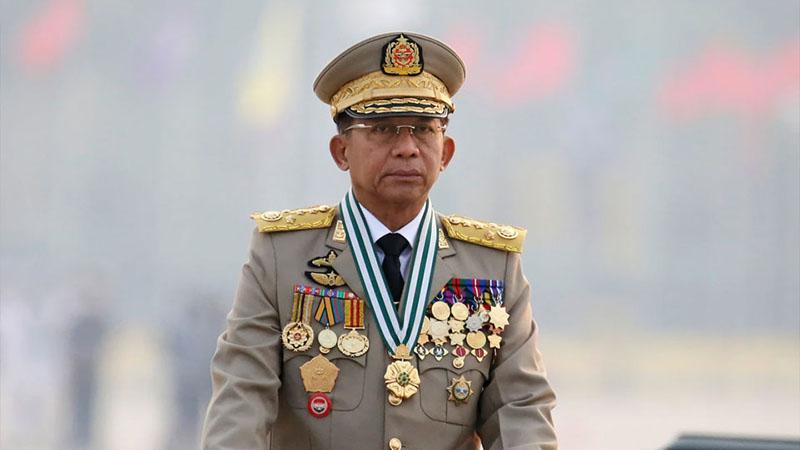
After five years of international isolation following a 2021 coup, Myanmar’s former junta chief and current president Min Aung Hlaing left for India on Saturday — and most surprisingly, he chose India, not China, as his first foreign trip.
Tour details
During the four-day official visit from May 30 to June 2, Hlaing will first visit Bodh Gaya in Bihar, then hold an official bilateral meeting with Prime Minister Narendra Modi in New Delhi on June 1, and on the last day of the visit, he will meet with Indian industrialists and business leaders in Mumbai. He is also expected to meet Indian President Droupadi Murmu.
Geopolitical significance: Strategies to balance China
Analysts say the biggest significance of the trip is the election. Most analysts had expected Hlaing’s first foreign trip to be to China, as Beijing is the biggest backer of Myanmar’s military rule and also backed the recently held disputed elections.
Beijing has provided diplomatic protection to Myanmar, invested heavily in infrastructure, maintained influence over several armed ethnic groups, and is deeply involved in the border economy. Yet Hlaing has chosen India for his first visit, in what is clearly a strategic attempt to balance Chinese dominance.
“This has been Myanmar’s strategy for a long time — to strengthen ties with India while leaning more towards China,” said Gautam Mukherjee, a former Myanmar ambassador to India. He added that Hlaing is seeking regional and international acceptance to overcome the post-election legitimacy crisis.
India’s interests: rare minerals, border security and deterrence against China
This visit is very important for India for three reasons. First, it creates an opportunity to reduce China’s excessive influence in Myanmar. Second, it ensures India’s access to Myanmar’s rare mineral resources and third, it strengthens the security of the border areas of northeastern India.
The visit comes at a time when India is seeking to further strengthen its “Neighborhood First” and “Act East” policies amid growing geopolitical competition in the Indo-Pacific and Bay of Bengal regions.
Morgan Michels, a Myanmar expert at the International Strategic Research Institute in Singapore, said India has maintained relations with Naypyidaw since the 2021 coup. India even sent its foreign minister to Hlaing’s swearing-in ceremony in April, making it clear that New Delhi is keen to move forward with the new government.
Myanmar’s interests: The search for legitimacy and investment
Hlaing is trying to gain international legitimacy for Myanmar’s new administration, and the India visit is an important step in that direction. Western governments and human rights groups have dismissed Myanmar’s recent elections as a “farce,” and millions of voters were unable to vote due to the war. In this context, building ties with a major democratic country like India is strategically valuable for Myanmar.
Criticism and opposition reactions
Myanmar’s pro-democracy opposition government, the National Unity Government (NUG), has strongly criticized the visit. The NUG’s foreign minister said any involvement that could be seen as giving political legitimacy to “illegal military rule” should be avoided.
For India too, the visit is a difficult balancing act. For New Delhi, the question is how much engagement is needed and how much legitimacy is given. Because on the one hand, India needs Myanmar to deal with border management, insurgent sanctuaries, connectivity projects and Chinese influence. On the other hand, it would not be right to alienate Myanmar’s democratic forces and ethnic communities, which have social and ethnic ties with India’s northeast.
Signals of regional reconnection
Analysts say the visit is not just a bilateral affair — it signals a broader regional reintegration. The visit is also a signal of legitimacy for Hlaing. Myanmar’s military rulers are slowly seeking regional acceptance after years of isolation from ASEAN and parts of the Western world.
The visit is also significant for Bangladesh. The Rohingya crisis in Myanmar, border instability and the dynamics of India-Myanmar relations directly affect Bangladesh’s security and diplomatic interests. Diplomatic experts in Dhaka believe that if the New Delhi-Naypyidaw relationship warms up, there may be an opportunity for India to mediate on the Rohingya repatriation issue.

https://stapravda.ru/20221228/reyting_samyh_populyarnyh_hostingov_v_rossii_196445.html, рейтинг хостингов России подтверждает, что выбор надежного провайдера важен для бизнеса.