
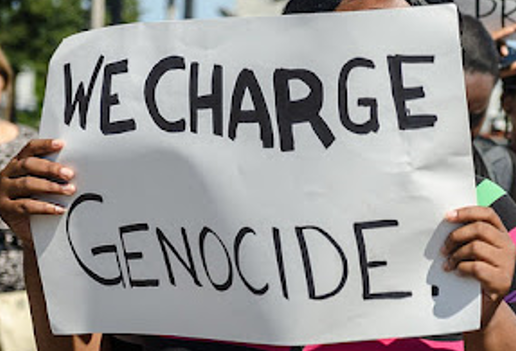
With the fall of the Awami League government on the afternoon of August 5, the entire country, from the capital Dhaka to the remote villages, was devastated by unimaginable terrorism. According to a report published by the daily Prothom Alo on September 12, from August 5 to 20, there were 1,068 attacks on minority homes, places of worship and business establishments across the country in these 15 days. On average, more than 70 attacks occurred every day. Although most of the attacks were against Hindus, Buddhists, Christians, Ahmadis and tribals of the plains were also attacked. Even after these 15 days, the attacks continue continuously. In the wake of the attacks in the hill districts of Khagrachari and Rangamati, the main religious festival of Buddhists, the Katha Chibardan festival, was canceled.
Significantly, attacks were also carried out on the Khankas, Dargahs and Mazar-e-Sharifs of the Sufi Muslim community. Although the radical Wahhabis have campaigned against the shrine at various times, there has never been an attack on the shrine like this before.
Analyzing the dynamics of the attacks, it has been understood that these are not just political change-related chaos. Terror has been spread in a planned manner with the aim of establishing an ideological trend by partially or completely eradicating all kinds of minority religions, including different sects of Muslims. In the terminology of international law, such a planned crime is called genocide, and genocide is an international crime. The Genocide Convention drafted by the United Nations in 1948 also calls genocide a planned attack with the aim of eradicating a religion/race/race/ethnic group.
Monitoring the situation in Bangladesh, the international organization Lemkin Institute of Genocide Prevention issued a genocide warning on September 27 and said that if there is a threat of genocide in any part of the world, the responsibility falls on the international community, including the United Nations, to provide prompt relief. They expressed the opinion that this also applies to Bangladesh.
But the interim government that took power in Bangladesh on August 8 completely ignored these events. When the head of government, Dr. Muhammad Yunus, went to the United States in late September, the media there questioned him about this. Yunus, who won the Nobel Peace Prize, instead blamed the victims and said –
“People were in a revolutionary mood. That is why they attacked the supporters of the party led by Sheikh Hasina. These minorities, especially the Hindu community, are associated with her (Sheikh Hasina) party.”
But various international organizations and media are vocal against the persecution of minorities and attacks on shrines. At one point, just before the US presidential election, presidential candidate Donald Trump gave a very strong message on this issue through social media. Incidentally, when Donald Trump was elected US President, the interim government of Bangladesh was shaken. Dr. Yunus, a close associate of the defeated Democratic Party, took a cautious stance.
In this context, on December 10, the Chief Advisor’s Press Secretary Mohammad Shafiqul Alam said in a news briefing that 70 people have been arrested in 88 cases of violence targeting minorities in the country from August 5 to October 22. Cases have also been filed in connection with subsequent incidents. The police are also compiling that list. Due to this, the number of cases and arrests will increase further.
A message sent from the Chief Advisor’s Press Wing on January 18, 2025 stated that in the last 5 months, 44 attacks, vandalism, looting and arson have occurred at 40 shrines across the country. The message also stated that legal action has been taken in all 44 attacks. Even after receiving complaints from the victims of the attacks and in some cases on their own initiative, the police have filed 15 regular cases and 29 general diaries (GDs) in different police stations. It is also reported that 23 criminals have been arrested in these criminal cases. In addition, charge sheets have already been submitted to the court in two regular cases. Investigations in 13 more regular cases and 29 general diaries are ongoing.
According to the victims and analysts, the number mentioned by the government is much lower than the actual number of attacks and assaults. Yet, in the context of the changing international landscape, the interim government of the Nobel Peace Prize laureate has been forced to move away from the position of complete denial and at least acknowledge it.

https://stapravda.ru/20221228/reyting_samyh_populyarnyh_hostingov_v_rossii_196445.html, рейтинг хостингов России подтверждает, что выбор надежного провайдера важен для бизнеса.