
❐ BD Digest Desk
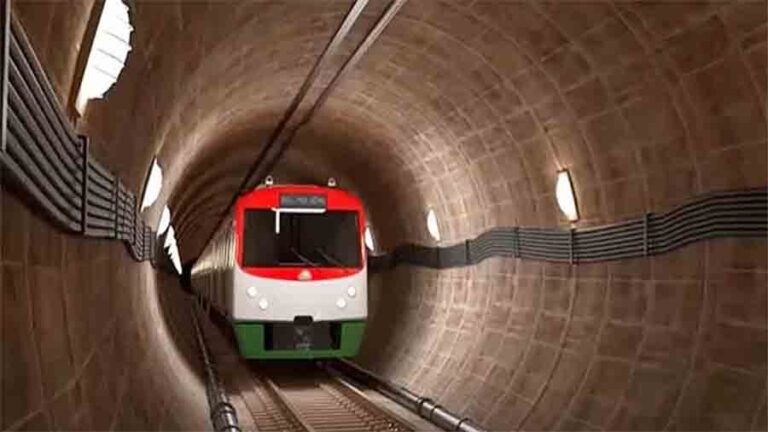
The cost of the country’s first underground metro rail MRT Line-1 project has been proposed to be increased by about 130 percent. The project implementing agency, Dhaka Mass Transit Company Limited (DMTCL), has proposed to increase the cost of the project from Tk 52,562 crore to Tk 1,20,794 crore.13 lakh.
This proposal, sent to the Road Transport and Highways Department through the first Revised Development Project Proposal (RDPP), is now under consideration by the Planning Commission.
If the proposal is approved, MRT Line-1 will be the second-costliest development project in the country’s history, after the Rooppur Nuclear Power Plant project, which cost Tk 1,38,685.76 crore.
Even the new cost will be almost four times the total cost of the currently ongoing metro rail project from Uttara to Motijheel.
The length of MRT Line-1, which received ECNEC approval on October 15, 2019, is 31.24 kilometers. At that time, Tk 52,562 crore was allocated for the project and the target of completing the work was set between September 2019 and December 2026.
The revised proposal requests an extension of the project period by another nine years, until December 2035.
The amount of debt and government financing is also increasing along with the cost of the project. The revised proposal calls for an increase of 116.82 percent in the Japanese loan from Tk 39,450 crore 32 lakh to Tk 85,535 crore 56 lakh.
At the same time, there is a proposal to increase the government’s own financing by 168.92 percent from Tk 13,111 crore to Tk 35,258 crore.
Unusually, the new proposed cost is much higher than the DMTCL’s estimate a few months ago. In a letter sent to the Planning Commission on January 28 this year, the agency had said that the project cost could increase by about 83 percent to around Tk 96,500 crore. In the space of a few months, that estimate has been proposed to be increased by about Tk 24,000 crore.
Officials of DMTCL and the Planning Commission say that the main reason for the cost increase is the prices quoted by contractors for various construction packages. In many cases, the prices quoted by contractors are significantly higher than the estimated cost of the project. Along with this, the depreciation of the taka against the dollar and inflation in the domestic and foreign markets have also increased the project cost.
The project, which extends from the airport to Kamalapur and from Notun Bazar to Purbachal, has been divided into a total of 12 contract packages. According to DMTCL sources, the initial estimated cost of these packages from CP-01 to CP-12 was Tk 37,655.66 crore.
According to the latest contractors’ bids and revised estimates, the cost has increased to 80,999.79 crore taka.
There was a large discrepancy between the initial estimates and the contractors’ proposed rates in some packages. The original DPP cost of the CP-04 package for the underground section from the north side of Rampura station to Notun Bazar station was Tk 5,330.20 crore.
Later, the Japanese consulting firm estimated the potential cost at Tk 13,266.44 crore. In the tender, Japan’s Tokyu-MIL Joint Venture submitted the lowest bid of Tk 14,988.7 crore.
A similar picture was found in the CP-06 package. The original cost of constructing the underground section from the north side of Nadda Station to Airport Station was estimated at 4,604.80 crore taka. Later, Japan’s Nishimatsu-Toda Joint Venture offered the lowest bid of 10,821.91 crore taka.
Project stakeholders complain that in projects implemented with Japanese funding, there is a condition of dependence on Japan for the appointment of consultants. Later, the technical conditions of the tenders prepared by these consulting firms have become such that it practically becomes easier for Japanese contractors to participate.
They say that while tenders are open on paper, the scope of competition is limited in reality. As two or three similar companies repeatedly emerge as the top bidders, the opportunity for new or alternative qualified contractors to participate is reduced. As a result, the question of how far the objective of competitive tendering is being achieved is also being raised.
A senior official of the Planning Commission said that the feasibility study of MRT Line-1 was conducted by the Japan International Cooperation Agency (JICA). The project cost was calculated in the original DPP based on that study. But later, Japanese consulting firms revised the estimates and increased the cost in various sectors. As a result, the prices of Japanese contractors also increased, he said.
The official also said that the detailed design of the project did not adequately reflect the actual needs of the work and the potential costs. He believes that the project cost later increased so much due to design deficiencies and limitations in the initial calculations.
When contacted about the cost increase, Project Director Md. Sarwar Uddin declined to comment.
He said that he could not speak on the matter due to instructions from the Managing Director of DMTCL. Later, attempts were made to contact Managing Director Md. Shaogatul Alam, but his statement could not be obtained.
Dr. Shamsul Haque, professor of the Civil Engineering Department of Bangladesh University of Engineering and Technology (BUET), has expressed concern over the huge cost increase of the project.
According to him, the issue of determining the cost of such large projects and the continuous increase in costs needs to be discussed openly in public, including in the National Parliament.
Professor Shamsul Haque said, it is important to verify how solid the basis of the current proposed expenditure is and whether it has been determined through competitive tendering or not. Because the current calculation is also based on estimates. There is a risk that the expenditure will increase again in the future.
For this reason, it is necessary to verify the calculations by comparing them with international standards and the costs of similar projects.
According to him, before implementing such a large investment project, it is important to analyze the construction cost, potential efficiency of the project, and future financial liabilities according to international benchmarks. Transparency and accountability must also be ensured in projects implemented with public money.
He also believes that if the estimates of the consulting firms that were involved in the initial survey and design later show a significant increase in costs, then the matter needs to be reviewed separately.
Even when compared with metro rail projects in different countries, questions arise about Dhaka’s cost. According to data from metro rail tenders in different countries in 2024 and a review report conducted by the interim government in 2025, the cost of constructing a metro rail per kilometer in Patna, India is about $40.77 million. In Riyadh, Saudi Arabia, the cost is about $166 million and in Dubai, United Arab Emirates, about $188 million.
On the other hand, the cost per kilometer of various metro rail projects in Dhaka ranges from $226.74 million to $253.63 million. This means that Dhaka’s construction cost is almost five times that of Patna; it is even significantly higher than that of Riyadh and Dubai.
The proposal to increase the cost of MRT Line 1 comes at a time when another metro rail project being implemented, funded by the Asian Development Bank (ADB) and South Korea, has been proposed to reduce the cost.
Initiatives have been taken to reduce the original cost of the project from Tk 54,618.96 crore to Tk 45,503.77 crore. As a result, the difference in cost management of the two projects has also come under discussion.
The total length of the country’s first underground metro rail, MRT Line-1, is 31.241 kilometers. Its construction began on February 2, 2023. The length of the airport route is 19.872 kilometers and the entire section is being built underground. There will be 12 stations in this section.
On the other hand, the 11.369-km long Purbachal route has both elevated and underground systems. There are plans to build seven elevated and two underground stations in this section. Out of the 12 packages, the work on the CP-01 package related to land development in the depot area has already been completed. The procurement process for the remaining 11 packages is at various stages.
The tender process for some packages of the project was also suspended after questions were raised about the high bids of the contractors. To bring down the cost to a reasonable level, the Economic Relations Department (ERD), DMTCL and the Road Transport Department have held several meetings with JICA and relevant Japanese government agencies. A high-level Bangladesh delegation has also visited Japan to discuss the matter.
Yet now a proposal has been made to increase the project cost to over 1.2 lakh crore taka. As a result, the question arises – at what stage of the initial estimate, design, tender and appointment of consultants did such a huge cost gap arise?
At the same time, the bigger question is, is this revised cost the final one, or is there a risk that the figure will increase further as the project is implemented?

https://stapravda.ru/20221228/reyting_samyh_populyarnyh_hostingov_v_rossii_196445.html, рейтинг хостингов России подтверждает, что выбор надежного провайдера важен для бизнеса.