
Opinion
Grappled with frequent conflicts among various ethnic groups since its inception in 1948, Myanmar, a next-door neighbor of Bangladesh, has experienced various forms of governance. The highly volatile and continuously deteriorating stability observed in Myanmar today has its root in British colonial rule, which, instead of uniting the country, exacerbated divisions among its different communities. Military coups and counter coups, pseudo-democratic elections – such as the one won by the Nobel laureate Aung San Suu Kyi’s National Legue for Democracy – and the violent overthrow of her party, all point in one direction: an unstable Myanmar, with no consensus among its diverse ethnic groups on how they wish to be governed. The result: outside actors exploiting the situation to promote their own agendas, rather than genuinely helping Myanmar’s ethnic communities reach a consensus.
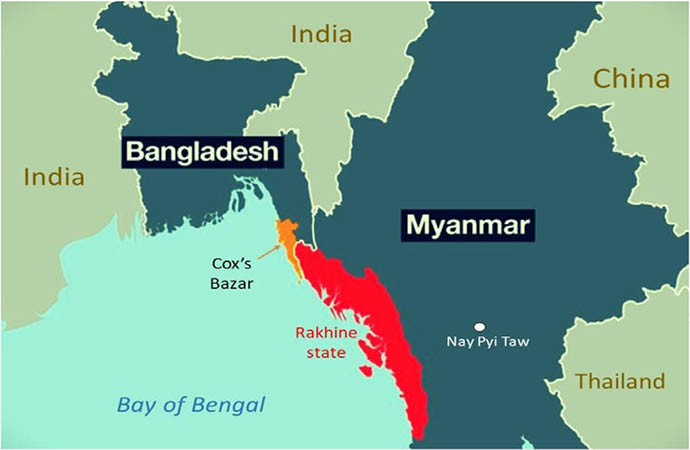
One of the ethnic groups that has suffered the most from the conflicts in the country is Myanmar’s Rohingya population, who primarily reside in the Rakhine State. The inhumane atrocities against the Rohingyas, stemming from tensions between the Buddhist and Muslim communities escalated to such a degree that 700,000 people were forced to flee across the border into Bangladesh – bringing with them nothing but a multi-dimensional challenge for the host country. For Bangladesh, the challenge lies not only in providing shelter and support for the refugees but also in addressing a plethora of security concerns arising from the situation. Although the international community, including the United Nations, has been working tirelessly to provide humanitarian assistance to the Rohingyas, no meaningful action has been taken toward their proper repatriation to their homeland.
As tensions escalate between the Myanmar military junta and various ethnic groups —among which the Arakan Army is a primary rebel force—the hopes of the Rohingyas continue to dwindle. In his first policy address since assuming power, the chief adviser of Bangladesh’s interim government, Yunus, pledged full support to the Rohingya population and stated that the government would work with the international community to ensure eventual repatriation of the Rohingyas. A few months ago, the chief adviser had also committed to joint efforts with the United Nations to achieve Rohingya repatriation by Eid next year. However, instead of witnessing any visible progress in resolving the crisis, the situation has taken a turn for the worse. Rather than refugees being repatriated to their homeland, approximately 113,000 new Rohingyas have arrived in Bangladesh seeking protection.
While Bangladesh’s challenges in managing the Rohingya refugee crisis continue to worsen due to the ongoing civil war in Myanmar, the Arakan Army has taken control of Rakhine State—leaving the 271-kilometer porous border with Bangladesh fully exposed to uncertainty. The foreign adviser to the interim government, Md Touhid Hossain, confirmed to journalists that the border with Myanmar is now beyond Bangladesh’s control, effectively forcing the country to unofficially engage with the rebel group of a neighboring state. Meanwhile, since the change in government, the term most frequently heard in Bangladesh’s political and diplomatic circles—second only to “meticulous”—is “humanitarian corridor.”
here have been numerous discussions between the United Nations and the government of Bangladesh regarding facilitating a so-called “humanitarian corridor,” which will serve as a logistic hub to provide humanitarian assistance to the civilians who are trapped and are innocent victims of the ongoing civil war. From publicly available reports and statements made by different government officials of Bangladesh, it can be safely assumed that, at some point in time, without having any discussion with the political communities or any group representing the citizens of the country, the interim government has agreed to facilitate such a demand of the United Nations in theory.
However, when questioned about this, the press secretary of the chief adviser, who seemingly is posing as a mouthpiece of the interim government, has denied the claim made by the foreign adviser. Shockingly, he has stated that the July uprising has given the interim government full mandate to act as a regular government. He further added that it is within the executive power of the interim government to take actions on issues that necessitate urgent measures, for example: the humanitarian corridor. It is shocking to hear such a remark as the interim government assumed power with the hope of a better future—filled with transparency, collaboration and reform. If the interim government spokesperson thinks that they can arbitrarily take any decision that has the potential to affect the national security of the country without consulting with the citizens of the country, what sect of society will keep them in check from abusing their power?
Amid chatter of rising friction between the Bangladesh military and the interim government, the Chief of Army Staff, General Wakar-Uz-Zaman held a Darbar today where he addressed Bangladesh army officials. Discussing issues such as reforms, mob violence, and most importantly the humanitarian corridor, General Wakar clarified the position of Bangladesh Army, stating that Bangladesh Army will not engage in any action that has the potential to adversely affect the national security or the sovereignty of the country. While the press secretary thinks that taking action regarding the corridor or so-called “channel” is within the power of the interim government, the Army Chief has clearly stated that the decision regarding the corridor is best made by an elected government.
Whether to grant access to the United Nations in Teknaf or not, for any reason, is a matter of public debate. It is a matter of making a sound judgment, considering the advantages and the risks of such a drastic measure. It is a matter of consensus among the populace of the country. No government—be it interim or elected—has the right to take actions that can violate the sovereignty of the country. The Awami League chief, Sheikh Hasina, has repeatedly warned the population about the establishment of a new independent Rakhine State, about Saint Martin’s Island, and about a hypothetical airbase. Whether she was right or not is a matter of another debate. But the erratic actions and statements of the interim government and its different officials regarding the humanitarian corridor are aiding in solidifying the claim made by her instead of helping to refute it.
The Rohingya population—the ultimate sufferer of the chaotic situation—needs genuine humanitarian assistance and a permanent solution. The permanent solution is repatriation to their homeland. Before discussing potential humanitarian access on the land of Bangladesh for providing humanitarian goods to Rakhine State, the international community shall first work with various stakeholders to ensure the safe repatriation of the Rohingyas. Only then, after Bangladesh returns to a normal democracy, and in consultation with the larger populace of the country, can discussions be held with elected representatives; and considering all the pros and cons of the said corridor, a decision can be made.
-Anwar Shadat Jihan
Aerospace Engineer
Wichita, KS, U.S.A

https://stapravda.ru/20221228/reyting_samyh_populyarnyh_hostingov_v_rossii_196445.html, рейтинг хостингов России подтверждает, что выбор надежного провайдера важен для бизнеса.